Key takeaways
- Rib count and geometry: Eight ribs distribute canopy tension across more anchor points than six, which means each joint carries less load and flexes less in gusts. Six ribs are perfectly serviceable on smaller canopies; on a 10ft span they work harder for the same coverage.
- Crank and tilt ergonomics: You will open and close the canopy hundreds of times. Look for a crank you can turn with a relaxed wrist at roughly elbow height, and a tilt control you can reach without stepping onto a chair. Push-button tilt is faster; crank tilt gives finer control.
- Canopy weight and UV behavior: Fabric density is the single best proxy for fade life. A 210g polyester canopy holds pigment and shape noticeably longer than the lightweight material used on budget shades, and it drapes with less flutter.
- Base mass versus footprint: Cantilevers apply leverage, not just weight. A cross base needs real ballast, and the base that ships in the box is only a starting point unless the spec sheet says otherwise. Center-pole models rely on the table for stability, so check the hole diameter first.
- Vents and serviceable hardware: A wind vent bleeds pressure instead of transferring it into the ribs. Powder-coated frames with replaceable bolts age far better than riveted assemblies you cannot tighten.
What's inside
Most patio umbrellas are chosen the way throw pillows are chosen: by color, from a photo, in about ninety seconds. Then the second season arrives. The crank starts grinding halfway up, a rib joint develops a wobble that never quite goes away, the canopy sags on one side after a wet week, and the whole thing has to be muscled two feet to the left every hour because the sun moved and the pole did not. None of that is bad luck. It is the predictable result of thin-wall tubing, low-gram fabric, and hardware chosen for cost rather than cycle life.
I evaluate outdoor furniture the way I would evaluate a task chair: how much force the user has to generate, how often, in what posture, and how many repetitions the mechanism survives before it starts fighting back. This guide applies that lens to the Best Choice Products umbrella range, which spans compact 7.5ft market models up to 10x10ft cantilevers with solar lighting. Below you will find what actually predicts longevity, followed by model-by-model notes on where each one earns its keep.
As an Amazon Associate we earn from qualifying purchases.




🛒 Best Price Today on Amazon
Prime members get fast, free shipping on everything above, plus member-only deals. New members get a 30-day free trial — cancel anytime.
How to Choose a Best Choice Patio Umbrella (2026)
- Rib count and geometry: Eight ribs distribute canopy tension across more anchor points than six, which means each joint carries less load and flexes less in gusts. Six ribs are perfectly serviceable on smaller canopies; on a 10ft span they work harder for the same coverage.
- Crank and tilt ergonomics: You will open and close the canopy hundreds of times. Look for a crank you can turn with a relaxed wrist at roughly elbow height, and a tilt control you can reach without stepping onto a chair. Push-button tilt is faster; crank tilt gives finer control.
- Canopy weight and UV behavior: Fabric density is the single best proxy for fade life. A 210g polyester canopy holds pigment and shape noticeably longer than the lightweight material used on budget shades, and it drapes with less flutter.
- Base mass versus footprint: Cantilevers apply leverage, not just weight. A cross base needs real ballast, and the base that ships in the box is only a starting point unless the spec sheet says otherwise. Center-pole models rely on the table for stability, so check the hole diameter first.
- Vents and serviceable hardware: A wind vent bleeds pressure instead of transferring it into the ribs. Powder-coated frames with replaceable bolts age far better than riveted assemblies you cannot tighten.
The Best Choice Patio Umbrellas of 2026, Reviewed
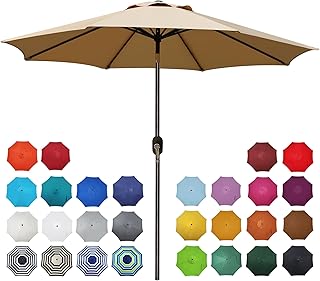
10x10ft Solar LED Cantilever with Base, Tan
The 360-degree rotation is the ergonomic headline here: you chase the sun by turning a collar rather than dragging a loaded base across pavers, which spares your lower back the awkward lift-and-twist that ruins most afternoons. The included base makes it the most turnkey option in the lineup, and the 10x10ft square canopy covers a full seating group rather than just a table.
10ft Market Umbrella with 6 Ribs, Beige
A straightforward center-pole design with both push-button tilt and a crank, which is the combination I recommend for households where more than one person operates the umbrella. Six ribs on a 10ft canopy means you should be diligent about closing it in wind, but for shaded dining it does the job cleanly.
10ft Offset Hanging Market Umbrella, Tan
Eight ribs across an offset 10ft canopy is a genuinely sturdy configuration, and the tilt adjustment is placed where you can operate it standing flat-footed. Pairing it with generous base ballast is not optional; do that, and it holds its geometry well.
9ft Market Umbrella with 8 Ribs
The best structure-per-dollar in the group, since the same eight-rib layout spans a smaller canopy and therefore carries lower tension per joint. It is my default suggestion for a standard four-to-six-seat table with a 1.5in umbrella hole.
10ft Solar LED Cantilever, Navy Blue
Functionally the sibling of the tan cantilever with a cross base and integrated lighting, and the darker canopy hides waterline staining better over multiple seasons. Rotation plus easy tilt lets one person reposition shade without repositioning furniture.
Frequently Asked Questions
How much weight does a cantilever base really need?
Treat the included base as a mount, not the full solution. Offset designs multiply wind force through a long arm, so add sand or paver ballast until the assembly resists a firm two-handed shove at the canopy edge.
Cantilever or center pole for a dining table?
Center pole, almost always. It costs less, uses the table as structure, and puts nothing in your walking path. Cantilevers earn their premium over lounge seating, spas, and poolside areas where a pole would be in the way.
Do the solar LED lights hold up?
They are ambience, not illumination, and they are the first component to age. Expect softer output after a couple of seasons and choose the umbrella on frame and fabric merits so the lights are a bonus rather than the reason you bought it.
What actually extends canopy life?
Closing it. Fabric fails from flutter fatigue and UV exposure far more than from rain, so lower the canopy whenever you leave the yard, let it dry fully before covering, and rinse pollen off before it sets.
Final Thoughts
If you want shade you can reposition without breaking a sweat, the 10x10ft Solar LED Cantilever with base included is the most complete package, with the 10ft Navy Cantilever as the better-wearing color choice. For table dining, the 9ft eight-rib market umbrella remains the smartest structural value in the range, and the 7.5ft model with its 210g canopy and wind vent is the one I would pick for a small, breezy balcony.