Key takeaways
- Weather rating: Match the rating to the installation. Wet-rated construction is the safer choice for exposed porches, while damp-rated models are generally better suited to fully covered areas protected from direct rain.
- Airflow and blade design: Larger blades and efficient motors usually move air more effectively across a seating area. Three-blade propeller designs can deliver strong circulation, but blade pitch and motor output matter more than blade count alone.
- Mounting height: Check ceiling height, downrod length, and the fan’s overall drop before buying. A low-profile or hanging-hook design may be more comfortable in a gazebo, while a standard mount often works better on a conventional porch ceiling.
- Controls: A remote with multiple speeds, reverse, timer, and light controls is easier to use than a pull chain when you are seated outdoors. App control can add convenience, but physical controls remain useful when Wi-Fi or phone access is unavailable.
- Lighting and maintenance: Integrated lights help with evening use, but inspect color-temperature and dimming options before purchase. Sealed housings, corrosion-resistant finishes, and accessible blades reduce the cleaning and upkeep required over time.
What's inside
A porch ceiling fan has a harder job than an indoor model. It must handle humidity, airborne dust, temperature swings, and limited mounting clearance while still moving enough air to make an open-sided space comfortable. A fan that looks attractive in a product photo can disappoint if its motor struggles outdoors, its controls are awkward from a chair, or its blades sit too low over a busy walkway.
This guide evaluates the listed fans from an ergonomics-and-durability perspective. The focus is practical: weather resistance, airflow control, mounting flexibility, noise, lighting, maintenance, and how well each design suits a porch, patio, gazebo, or covered outdoor room.
As an Amazon Associate we earn from qualifying purchases.


How to Choose a/an Ceiling Fan For Porch (2026)
- Weather rating: Match the rating to the installation. Wet-rated construction is the safer choice for exposed porches, while damp-rated models are generally better suited to fully covered areas protected from direct rain.
- Airflow and blade design: Larger blades and efficient motors usually move air more effectively across a seating area. Three-blade propeller designs can deliver strong circulation, but blade pitch and motor output matter more than blade count alone.
- Mounting height: Check ceiling height, downrod length, and the fan’s overall drop before buying. A low-profile or hanging-hook design may be more comfortable in a gazebo, while a standard mount often works better on a conventional porch ceiling.
- Controls: A remote with multiple speeds, reverse, timer, and light controls is easier to use than a pull chain when you are seated outdoors. App control can add convenience, but physical controls remain useful when Wi-Fi or phone access is unavailable.
- Lighting and maintenance: Integrated lights help with evening use, but inspect color-temperature and dimming options before purchase. Sealed housings, corrosion-resistant finishes, and accessible blades reduce the cleaning and upkeep required over time.
The Best Ceiling Fan For Porch (2026)s Reviewed
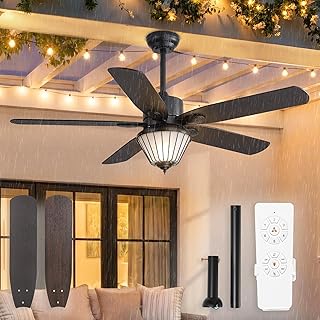
52-Inch Outdoor Fan With Lights
This 52-inch farmhouse-style fan is the most versatile choice for a larger porch or covered patio where both airflow and illumination matter. Its IP65 waterproof construction, wet rating, reversible DC motor, six speeds, and remote control address the main demands of outdoor use, while the dual-finish blades provide some flexibility when coordinating with existing furniture. The larger span is best where there is ample overhead clearance.
52-Inch Solid Wood Fan Without Light
For buyers who want strong circulation without an integrated light, this dark walnut model takes a straightforward approach. Its quiet BLDC motor, six-speed remote, and high-airflow design should suit a broad seating area, while the solid-wood, three-blade profile gives it a more furniture-like appearance. Its damp rating makes careful placement under a well-protected roof especially important.
ABZ 52-Inch Solid Wood Outdoor Fan
The ABZ combines a walnut finish with a simple three-blade layout, making it a natural fit for porches that already use warm wood tones. Remote operation is useful for adjusting speed without reaching overhead, and the water-resistant construction supports covered outdoor installations. Because it has no light, it works best where separate sconces, string lights, or ceiling fixtures already provide evening visibility.
Hunter Cassius 44-Inch Outdoor Fan
The Hunter Cassius is a compact, uncomplicated option for smaller porches, garages, and indoor-outdoor transition spaces. Its 44-inch span helps preserve walking and sightline clearance, while the three-blade design and standard mount keep the installation visually tidy. The pull-chain control is less convenient than a remote from a lounge chair, but it is durable, simple, and does not depend on batteries or connectivity.
Orison 24-Inch Weatherproof Caged Fan
The Orison is designed for compact outdoor areas where a conventional 52-inch fan would be too large or too low. Its caged form, hanging hook, plug-in installation, remote and app control, and three-color-temperature dimmable light make it particularly practical for pergolas, canopies, and small gazebos. Its smaller diameter will not replace a full-size fan for cooling a broad porch, but it can provide targeted airflow and useful task lighting.
Frequently Asked Questions
What size ceiling fan is best for a porch?
A 44- to 52-inch fan generally suits many residential porches, but the correct size depends on the area and ceiling height. Choose a larger span for broad seating zones and a smaller model when clearance, beams, or visual bulk are concerns.
Should a porch fan be wet rated?
Wet-rated construction is preferable when the fan may encounter windblown rain or direct moisture. A damp-rated fan can be appropriate beneath a deep, protective roof, but it should not be treated as interchangeable with a wet-rated model.
Are DC motors worthwhile outdoors?
DC motors can offer quiet operation, efficient speed control, and smooth reversing. They are especially useful when a porch is adjacent to a bedroom or conversation area, although the motor’s overall construction and the fan’s weather rating remain equally important.
Do outdoor ceiling fans need winter maintenance?
Clean accumulated dust, inspect the blades and mounting hardware, and replace remote batteries as needed. In severe climates, follow the manufacturer’s guidance about covering, disconnecting, or removing the fan during prolonged freezing or storm conditions.
Final Thoughts
For a full-size porch that needs both cooling and light, the 52-Inch Outdoor Fan With Lights is the strongest all-around choice. The 52-Inch Solid Wood Fan Without Light is better for quiet, high-volume circulation, while the Hunter Cassius makes sense where compact dimensions and simple controls matter most. For a small gazebo or pergola, the Orison’s caged, plug-in format is the most adaptable option.