Key takeaways
- Rated life over sticker price: A 15,000-hour LED in a dining chandelier used three hours a night lasts well over a decade. Multiply the price gap by how many ladder sessions you avoid, not by how many bulbs you buy.
- Base and envelope shape: Nearly all chandeliers use an E12 candelabra base, but the glass matters. B10 and B11 are slim torpedoes that clear crowded arms and clip-on shades; CA10 flame-tip styles look better bare but need a little more room between sockets.
- Verified dimmer compatibility: Older leading-edge dimmers were built for incandescent loads and often flicker or hum with low-wattage LEDs. Look for bulbs explicitly rated dimmable, and expect best results when all sockets carry identical bulbs.
- Construction and vibration tolerance: Filament-style LEDs live or die by their glass seal and lead wires. If the fixture is a ceiling fan or hangs in a stairwell with airflow, favor thicker clear glass and a solid base collar over feather-light housings.
- Color temperature and glare: 2700K reads as clean warm white and suits most modern rooms; 2500K leans amber and flatters brass, crystal, and bare-bulb designs. Buy one consistent temperature across the whole fixture, and consider frosted glass if bulbs sit at seated eye level.
What's inside
A chandelier is one of the few fixtures in a home that punishes bad bulb choices twice: once visually, and once physically. Six to twelve sockets sit eight or more feet up, often over a dining table or an open stairwell, which means every replacement involves a ladder, an awkward overhead reach, and a quarter-inch twist of a small glass base while your shoulder holds the position. Buyers rarely think about that until the third bulb of the season goes dark and the whole array no longer matches in tone. Add flickering on an older dimmer, audible buzz at low output, and glass that cracks at the shoulder after a few months on a ceiling fan, and the real cost of a cheap candelabra bulb becomes obvious.
This guide looks at chandelier bulbs the way a durability tester would: rated service life against how often you will actually be climbing, base and envelope geometry against tight socket clusters and clip-on shades, and construction quality against heat soak and fan vibration. Below are the E12 candelabra options worth installing, plus a short framework for matching brightness, color temperature, and dimmer behavior to your specific fixture.
As an Amazon Associate we earn from qualifying purchases.


🛒 Best Price Today on Amazon
Prime members get fast, free shipping on everything above, plus member-only deals. New members get a 30-day free trial — cancel anytime.
How to Choose a Bulb For Chandelier (2026)
- Rated life over sticker price: A 15,000-hour LED in a dining chandelier used three hours a night lasts well over a decade. Multiply the price gap by how many ladder sessions you avoid, not by how many bulbs you buy.
- Base and envelope shape: Nearly all chandeliers use an E12 candelabra base, but the glass matters. B10 and B11 are slim torpedoes that clear crowded arms and clip-on shades; CA10 flame-tip styles look better bare but need a little more room between sockets.
- Verified dimmer compatibility: Older leading-edge dimmers were built for incandescent loads and often flicker or hum with low-wattage LEDs. Look for bulbs explicitly rated dimmable, and expect best results when all sockets carry identical bulbs.
- Construction and vibration tolerance: Filament-style LEDs live or die by their glass seal and lead wires. If the fixture is a ceiling fan or hangs in a stairwell with airflow, favor thicker clear glass and a solid base collar over feather-light housings.
- Color temperature and glare: 2700K reads as clean warm white and suits most modern rooms; 2500K leans amber and flatters brass, crystal, and bare-bulb designs. Buy one consistent temperature across the whole fixture, and consider frosted glass if bulbs sit at seated eye level.
The Best Bulb For Chandelier (2026)s Reviewed
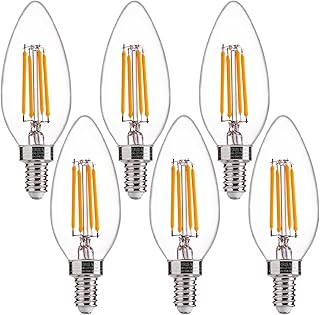
60W Equivalent Clear B11 LED Filament, 2700K (6-Pack)
The strongest all-round pick for a main dining or entry chandelier, delivering genuine 60W-equivalent output with the visible filament look that suits clear-glass fixtures. The B11 envelope is narrow enough for tight six- and eight-arm clusters, and the 2700K tone stays consistent from full brightness down through most of the dimming range.
E12 Flame Tip Candle Bulbs, 4W 460 lm (12-Pack)
A sensible bulk buy when you need to relamp an entire fixture at once and keep every socket matched. The flame-tip silhouette suits traditional and farmhouse chandeliers, and 460 lumens per bulb across eight or more arms produces plenty of ambient light without harsh hotspots.
COLWATT CA10 Clear 2500K (12-Pack)
The warmest option here at 2500K, which is the right call for brass, bronze, and crystal fixtures where cooler light looks sterile. Rated for outdoor and pendant use as well, so it doubles as a stock bulb for porch lanterns and fan light kits.
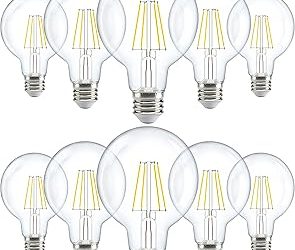
B11 Vintage Filament Clear Glass, 450 lm (12-Pack)
A well-balanced durability play: clear glass, straight B11 body, and 4W draw at 450 lumens with 2700K warmth. The slim profile is particularly forgiving in fan light kits, where wider flame-tip glass often contacts adjacent shades.
B10 Edison Filament, 470 lm (5-Pack)
The brightest per-bulb output in this group and the tidiest fit for narrow sockets, which makes it useful for smaller fixtures or as a top-up when you only need a handful. The exposed Edison filament earns its place in chandeliers designed to be seen with bare bulbs.
Frequently Asked Questions
How many lumens should each chandelier bulb produce?
Work from the total. A six-arm fixture at 450 lumens each gives roughly 2,700 lumens, which comfortably lights a standard dining room. In small entries or over a bar, 380 to 460 lumens per bulb avoids overlighting the space.
Will these work on my existing dimmer?
Usually, provided the bulb is rated dimmable and you fill every socket with the same model. Mixed bulbs are the most common cause of flicker. If buzzing persists at low levels, a modern LED-compatible dimmer resolves it.
Does B10, B11, or CA10 actually matter?
Mostly for fit and aesthetics. B10 and B11 are slimmer and clear crowded arms and clip-on shades more easily, while CA10 flame tips look more traditional in open fixtures. Light output is set by the specification, not the shape.
Why do my chandelier bulbs keep failing early?
Heat and vibration. Enclosed shades trap heat around the base, and fan-mounted fixtures shake filaments loose over time. If you prefer incandescent warmth despite the shorter life, the MEQIQTEK B10 60W 2500K 12-pack is the practical way to buy it, since you will be replacing more often.
Final Thoughts
For most homes, the 60W Equivalent Clear B11 LED Filament set is the bulb to install and forget, pairing full brightness with a slim body that fits nearly any socket cluster. If you are relamping a large fixture in one go, the 12-pack of B11 Vintage Filament bulbs keeps every arm matched at a lower cost per socket, while the COLWATT CA10 2500K pack is the better choice when your fixture calls for a deeper amber glow.