Key takeaways
- Construction: Look for steel or heavy-duty molded materials, reinforced corners, and a finish that can tolerate workshop dust, oil, and incidental impacts.
- Ergonomics: Drawers should open at a comfortable height, handles should support a neutral grip, and frequently used tools should not require excessive bending or reaching.
- Mobility: Smooth casters and a stable handle matter when moving a loaded chest. Locking wheels are essential if the cabinet will be used while tools are being applied.
- Organization: Removable trays, liners, dividers, racks, and stackable modules help prevent tools from shifting and reduce wasted drawer space.
- Security and capacity: Check the locking arrangement, drawer depth, overall footprint, and realistic load distribution rather than relying on maximum capacity alone.
What's inside
A tool chest has to do more than hold equipment: it should organize weight sensibly, roll predictably, protect contents from workshop grime, and tolerate years of drawers opening, closing, and being overloaded. The wrong cabinet can develop sticky slides, unstable casters, or wasted space long before its paint looks worn.
This guide evaluates the listed tool chests from an ergonomics-and-durability perspective. The focus is on access height, mobility, storage flexibility, locking practicality, portability, and how each design fits a garage, repair room, or mobile work setup.
As an Amazon Associate we earn from qualifying purchases.


How to Choose a/an Brand Tool Chest (2026)
- Construction: Look for steel or heavy-duty molded materials, reinforced corners, and a finish that can tolerate workshop dust, oil, and incidental impacts.
- Ergonomics: Drawers should open at a comfortable height, handles should support a neutral grip, and frequently used tools should not require excessive bending or reaching.
- Mobility: Smooth casters and a stable handle matter when moving a loaded chest. Locking wheels are essential if the cabinet will be used while tools are being applied.
- Organization: Removable trays, liners, dividers, racks, and stackable modules help prevent tools from shifting and reduce wasted drawer space.
- Security and capacity: Check the locking arrangement, drawer depth, overall footprint, and realistic load distribution rather than relying on maximum capacity alone.
The Best Brand Tool Chest (2026)s Reviewed
Goplus 5-Drawer Rolling Tool Chest
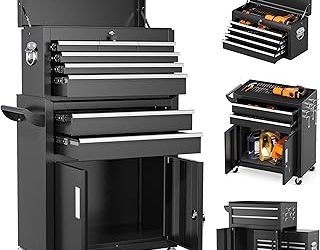
The Goplus combines a detachable top toolbox with a rolling lower cabinet, making it a versatile choice for a garage that needs both portable and centralized storage. Its lockable wheels, lock bar, protective liners, and tool rack support orderly everyday use, while the five-drawer layout keeps smaller hardware within easy reach.
DEWALT TSTAK II Flat-Top Tool Storage Case
The DEWALT TSTAK II is best suited to users who carry tools between rooms, vehicles, and job areas rather than leave them in a fixed chest. Its stackable hard-case format and flat top make it easy to integrate into a modular system, with a compact shape that is less awkward to lift and store than a full rolling cabinet.
DEWALT TSTAK Rolling Tool Box
For heavier portable loads, the DEWALT TSTAK rolling tool box adds a telescopic handle and wheels to the brand’s modular storage approach. The deep carrier design is useful for bulky power tools and accessories, although its larger profile deserves attention in narrow hallways, crowded workshops, or vehicle trunks.
Craftsman 3-Drawer Metal Portable Chest
This red Craftsman chest takes a straightforward, durable approach: a compact metal body and three drawers for essential hand tools. It is a sensible option for a bench-top setup or users who value portability over maximum capacity, but it will not provide the rolling convenience or vertical storage of a full-height cabinet.
8-Drawer Rolling Tool Chest with Detachable Top
The eight-drawer rolling chest offers substantial compartmentalization for users with a broad hand-tool collection. Its detachable top box, hooks, tray divider, liners, and casters provide useful flexibility, though a heavily loaded cabinet should be pushed rather than pulled aggressively to reduce tipping and strain on the wheels.
Frequently Asked Questions
What size tool chest is best for a home garage?
A five- to eight-drawer rolling chest is usually a practical middle ground. It provides dedicated spaces for hand tools without consuming the floor area required by a professional-size cabinet.
Are rolling tool chests stable when fully loaded?
They can be, provided the heaviest tools are stored in the lowest drawers and the wheels are locked during use. Avoid opening several heavily filled drawers at once, since that shifts the center of gravity forward.
Is a portable toolbox better than a rolling chest?
Portable cases are better when tools travel frequently or must be carried up stairs. Rolling chests are more comfortable for a fixed workshop because they reduce lifting and provide faster access to a larger assortment.
Do drawer liners really matter?
Yes. Liners reduce rattling, protect both tools and drawer surfaces, and help prevent small items from sliding to the rear when a drawer is opened. They also make cleanup easier after dusty or oily work.
Final Thoughts
The Goplus 5-Drawer Rolling Tool Chest is the strongest all-around choice for a home workshop needing flexible storage, while the 8-Drawer Rolling Tool Chest suits larger collections that benefit from finer organization. For portability and modular stacking, the DEWALT TSTAK II and TSTAK Rolling Tool Box are more ergonomic choices; the compact Craftsman remains a dependable bench-top solution.