Key takeaways
- Set realistic output expectations: Treat 150 to 200W as a directional warm-air stream measured in inches, not a room temperature change. If a listing claims whole-room heating from a battery, discount everything else it says.
- Study the base and grip geometry: A wide, slightly weighted footprint with a rubberised contact patch resists sliding on a sloped dash. Check that the handle or body can be lifted one-handed while the other hand holds a scraper or a tool.
- Insist on glove-friendly controls: Raised rocker switches and detented mode dials work with cold, gloved fingers. Flush capacitive pads and recessed micro-buttons do not, and that single detail decides whether you actually use the thing.
- Look at the battery interface, not just the capacity: Units running on an established 18V tool platform inherit a latch and terminal design already validated across thousands of insertion cycles. Sealed internal packs are tidier but eventually become the product’s expiry date.
- Verify thermal protection and housing quality: You want a tip-over or anti-tilt cutoff, a thermal fuse, and an intake grille that will not deform near the element. Flexible cord entries with proper strain relief are a reliable sign of a manufacturer that expects the product to be moved often.
What's inside
Search for a battery powered space heater and you run straight into a physics problem. A plug-in room heater pulls roughly 1500 watts from the wall; a rechargeable pack that fits in your hand or clips onto a drill delivers somewhere between 100 and 200. That gap is why so many buyers feel misled after their first cold morning. These units are personal warmers and defrosters, not room heaters, and the ones worth owning are honest about it. Judged on that basis, a good cordless heater is genuinely useful: it clears a windshield while you scrape, keeps your hands working in an unheated garage, and takes the edge off a tent at dawn.
This guide looks at the current crop through an ergonomics and durability lens, because that is where these products separate. Wattage figures cluster tightly, so the deciding factors are how the housing sits on a dashboard without walking off, whether the switch can be worked with a gloved thumb, how the pivot feels after a season of adjustment, and whether the battery interface is a proven tool-platform latch or a proprietary connector with an unknown service life. Below are the models currently worth your attention, followed by the selection criteria I apply and answers to the questions readers ask most.
As an Amazon Associate we earn from qualifying purchases.


🛒 Best Price Today on Amazon
Prime members get fast, free shipping on everything above, plus member-only deals. New members get a 30-day free trial — cancel anytime.
How to Choose a Battery Powered Space Heater (2026)
- Set realistic output expectations: Treat 150 to 200W as a directional warm-air stream measured in inches, not a room temperature change. If a listing claims whole-room heating from a battery, discount everything else it says.
- Study the base and grip geometry: A wide, slightly weighted footprint with a rubberised contact patch resists sliding on a sloped dash. Check that the handle or body can be lifted one-handed while the other hand holds a scraper or a tool.
- Insist on glove-friendly controls: Raised rocker switches and detented mode dials work with cold, gloved fingers. Flush capacitive pads and recessed micro-buttons do not, and that single detail decides whether you actually use the thing.
- Look at the battery interface, not just the capacity: Units running on an established 18V tool platform inherit a latch and terminal design already validated across thousands of insertion cycles. Sealed internal packs are tidier but eventually become the product’s expiry date.
- Verify thermal protection and housing quality: You want a tip-over or anti-tilt cutoff, a thermal fuse, and an intake grille that will not deform near the element. Flexible cord entries with proper strain relief are a reliable sign of a manufacturer that expects the product to be moved often.
The Best Battery Powered Space Heater (2026)s Reviewed
5-Cell 3000mAh Cordless Heater with Dual USB
The five-cell layout and anti-tilt cutoff make this the most sensible pick for a tent floor or a cluttered desk, where a knock-over is a matter of when rather than if. Running quiet matters more than the spec sheet suggests, and the twin USB ports mean it doubles as a power bank once the element is off.
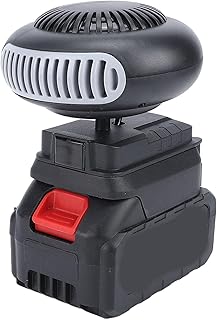
banapoy 200W Car Window Defroster
Because it runs on BL1850B and BL1840B style 18V packs, this is the most repairable option here: when the battery fades you buy a battery, not a new heater. The two-setting switch is easy to find by feel, and the flat base sits stably against a windscreen while you work.
Cordless 200W with 360° Rotation and Dual USB
The full-rotation head plus a natural-wind mode alongside the 55°C and 85°C settings makes this the most adaptable unit for garage and jobsite use, where you often want air moved onto your hands rather than heated. Confirm the pivot holds its position under vibration before committing to a dash mount.
CUIFATI Portable Car Heater and Defogger
With 360° rotation and 160° of tilt, this has the widest aiming envelope of the group, which is exactly what you want when a rear-view mirror or A-pillar blocks the useful line. Articulation is also the first thing to wear on this class of product, so treat smooth, firm detents as a quality signal.
12000mAh 170W Cordless Heater
The largest integrated pack in this roundup, and the one I would choose for extended off-grid stretches where no tool batteries are in the mix. Dual speed lets you trade intensity for runtime, which is the only meaningful lever you have on a fixed cell budget.
Frequently Asked Questions
Can a battery powered heater warm an entire room?
No. A 200W output is roughly an eighth of a standard plug-in heater, and in an uninsulated space that energy dissipates faster than it accumulates. Think of these as directional comfort devices for the space immediately in front of you.
How long do they actually run on a charge?
Do the arithmetic: a 12000mAh pack at typical nominal voltage stores somewhere in the region of 130Wh, so a 170W draw lands you under an hour at full heat. Lower fan and heat settings stretch that considerably, and fan-only mode runs for many hours.
Are these safe in a tent or small enclosed space?
They are resistive electric, so unlike propane or catalytic heaters there is no combustion and no carbon monoxide risk. The remaining hazards are fire and contact burns: keep 12 inches of clearance from fabric and sleeping bags, use a model with an anti-tilt cutoff, and never leave one running while you sleep.
Is a tool battery model better than a built-in one?
For durability, yes. Tool-platform units let you swap in a fresh charged pack for continuous use and replace a degraded cell stack for a fraction of the unit price. Built-in packs win on portability and simplicity if you have no compatible batteries already.
Final Thoughts
If you already own 18V tool batteries, the banapoy 200W defroster is the most economical and longest-lived choice in this group. For camping and desk use where a knock-over is likely, the 5-cell 3000mAh unit with its anti-tilt cutoff is the safer companion, and for the longest untethered sessions the 12000mAh 170W model gives you the biggest energy reserve and the dual-speed control to ration it sensibly.