Key takeaways
- Grip and wrist geometry: Hold the tool as if you were reaching behind a wheel arch. The handle should keep your wrist close to neutral rather than forcing it into a cocked position, and the trigger or button should sit where your index finger naturally lands. Rubber overmolding on the palm face matters more than overall weight.
- Hose length and flexibility: A short, rigid hose transmits pump vibration straight into the valve stem and your hand. Look for at least a foot of supple hose with a swivel or brass-bodied chuck so you can thread it without contorting your arm or leaning your weight on the tool.
- Duty cycle and heat management: Sustained inflation is where cheap pumps fail. Dual-cylinder designs and stated 100% duty cycles run cooler and slower to derate, which means less thermal stress on seals, pistons, and the plastic around the motor over the life of the tool.
- Housing and impact resistance: Check for a recessed gauge, ribbed corners, and integrated feet. These details decide whether a tumble out of a hatchback is an inconvenience or a replacement. Glass-filled nylon housings resist cracking far better than plain ABS in cold weather.
- Battery ecosystem or self-contained: If you already own a platform, a bare tool is the better long-term value, since packs are the first component to age out. If you don’t, an integrated lithium pack with 12V backup keeps you from stranding yourself on a dead battery.
What's inside
A cordless inflator looks like a simple purchase until you’re crouched on a cold driveway at an awkward angle, holding a vibrating plastic housing against your palm while a short, stiff hose fights to unthread itself from the valve stem. That’s where most of these tools reveal themselves. The pressure numbers on the box tell you almost nothing about whether the grip loads your wrist correctly, whether the chuck can be threaded one-handed, or whether the pump will still hold its seal after two summers of heat-soaked storage in a trunk.
This guide looks at battery air compressors the way a bench tester would: hand-tool geometry, vibration transfer, thermal behavior under sustained load, and the material choices that decide whether a tool lasts three years or thirteen. Below you’ll find the models worth shortlisting for 2026, followed by the buying criteria that actually predict long-term satisfaction, plus short assessments of each pick and answers to the questions buyers ask most.
As an Amazon Associate we earn from qualifying purchases.


How to Choose a Battery Air Compressor (2026)
- Grip and wrist geometry: Hold the tool as if you were reaching behind a wheel arch. The handle should keep your wrist close to neutral rather than forcing it into a cocked position, and the trigger or button should sit where your index finger naturally lands. Rubber overmolding on the palm face matters more than overall weight.
- Hose length and flexibility: A short, rigid hose transmits pump vibration straight into the valve stem and your hand. Look for at least a foot of supple hose with a swivel or brass-bodied chuck so you can thread it without contorting your arm or leaning your weight on the tool.
- Duty cycle and heat management: Sustained inflation is where cheap pumps fail. Dual-cylinder designs and stated 100% duty cycles run cooler and slower to derate, which means less thermal stress on seals, pistons, and the plastic around the motor over the life of the tool.
- Housing and impact resistance: Check for a recessed gauge, ribbed corners, and integrated feet. These details decide whether a tumble out of a hatchback is an inconvenience or a replacement. Glass-filled nylon housings resist cracking far better than plain ABS in cold weather.
- Battery ecosystem or self-contained: If you already own a platform, a bare tool is the better long-term value, since packs are the first component to age out. If you don’t, an integrated lithium pack with 12V backup keeps you from stranding yourself on a dead battery.
The Best Battery Air Compressor (2026)s Reviewed
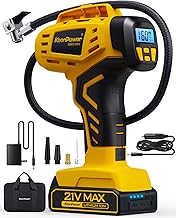
21V 160PSI Dual-Power Tire Inflator
The dual-power layout is the practical highlight here, letting you switch to the 12V lead when the pack runs low, which sidesteps the most common failure mode in cordless inflators. Its compact body sits comfortably in one hand, though the housing is light enough that you’ll want to set it on the ground rather than hold it through a long fill.
DEWALT DCC020IB 20V MAX
Built with the tolerances you’d expect from a jobsite tool: a genuinely stable base, a hose long enough to reach all four stems without repositioning, and an LED that puts light where the valve actually is. Sold as a bare tool, so it makes sense only if you already run 20V MAX packs, but the wear resistance justifies the ecosystem commitment.
ETENWOLF VORTEX S6
The dual-cylinder pump and 100% duty cycle rating make this the pick for truck tires, trailer stacks, and paddleboards, where continuous run time punishes lesser designs. The 19200mAh cell and robust shell add heft, so treat it as a set-down tool rather than a handheld one.
CRAFTSMAN V20 CMCE521B
A well-balanced bare tool with a clearly readable digital gauge and a body shape that stays put on uneven pavement. The 150 PSI ceiling covers passenger vehicles and bikes comfortably, and the V20 platform keeps replacement pack costs reasonable years down the road.
AVID POWER 20V Cordless Inflator
The most sensible middle path for households with no existing tool platform: rechargeable pack, 12V DC adapter, auto shut-off, and a grip profile that keeps the wrist relaxed during bike and ball duty. Sustained truck-tire work will heat it up, so pace long fills.
Frequently Asked Questions
Does higher PSI mean faster inflation?
No. Maximum pressure and airflow are separate specifications. A 160 PSI unit like the upgraded 20V and 12V dual-power inflator fills faster because of its cylinder volume and stroke rate, not its pressure ceiling, which mainly matters for high-pressure road bike tires.
How long should a battery inflator last on one charge?
Expect several top-offs of a few PSI each, or roughly one or two full passenger tires from flat. Cold weather cuts this noticeably, which is the strongest argument for a model with a 12V backup lead.
Can these replace a shop compressor?
For top-offs, inflatables, and roadside recovery, yes. For seating tire beads, running air tools, or repeated high-volume work, a corded compressor with a tank remains the right tool.
What actually wears out first?
Battery capacity, then the piston seal and chuck threads. Storing the tool indoors instead of in a hot trunk meaningfully extends the life of all three.
Final Thoughts
For sustained heavy-duty work the ETENWOLF VORTEX S6 is the most durable choice here, thanks to its dual-cylinder pump and full duty cycle. If you already own compatible packs, the DEWALT DCC020IB offers the best build quality and hose ergonomics of the group, while the AVID POWER 20V remains the most sensible self-contained option for a typical household garage.