Key takeaways
- Compatibility: Confirm the blade’s exact length, width, and gauge against your saw manual. A blade that is even slightly too long may not tension correctly, while an oversized width can exceed the guides’ adjustment range.
- Tooth pitch: A 2–4 TPI blade clears sawdust efficiently from thick stock. Finer teeth can produce a cleaner surface in thinner boards but may clog or burn during deep resawing.
- Blade width: Wider blades resist deflection and make straighter veneers, provided your saw can tension them properly. Narrower blades are easier to steer but demand more careful feed control.
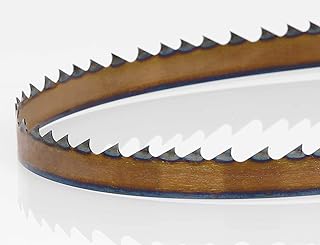
- Tooth construction: Hardened carbon-steel teeth offer economical performance for ordinary lumber. Carbide teeth cost more but hold an edge substantially longer in abrasive or high-volume hardwood work.
- Set and tension: A blade with a consistent tooth set and suitable low-tension design can track smoothly without overloading a smaller frame. Check that the blade’s recommended tension matches your machine’s practical limits.
What's inside
Resawing exposes every weakness in a band saw setup: a blade that wanders, heats up, or loses its edge can turn expensive stock into firewood. The right choice depends on more than tooth count; blade length, kerf, tooth geometry, steel quality, and the saw’s tensioning capacity all affect cut accuracy and blade life.
This guide compares practical options for furniture makers, from compact 10-inch saw blades to carbide-tipped blades intended for serious hardwood work. The recommendations focus on tracking stability, edge retention, feed feel, and long-term value rather than headline specifications alone.
As an Amazon Associate we earn from qualifying purchases.



How to Choose a/an Band Saw Blade For Resawing (2026)
- Compatibility: Confirm the blade’s exact length, width, and gauge against your saw manual. A blade that is even slightly too long may not tension correctly, while an oversized width can exceed the guides’ adjustment range.
- Tooth pitch: A 2–4 TPI blade clears sawdust efficiently from thick stock. Finer teeth can produce a cleaner surface in thinner boards but may clog or burn during deep resawing.
- Blade width: Wider blades resist deflection and make straighter veneers, provided your saw can tension them properly. Narrower blades are easier to steer but demand more careful feed control.
- Tooth construction: Hardened carbon-steel teeth offer economical performance for ordinary lumber. Carbide teeth cost more but hold an edge substantially longer in abrasive or high-volume hardwood work.
- Set and tension: A blade with a consistent tooth set and suitable low-tension design can track smoothly without overloading a smaller frame. Check that the blade’s recommended tension matches your machine’s practical limits.
The Best Band Saw Blade For Resawing (2026)s Reviewed
Dark Stone 111-Inch Carbide-Tipped Resaw Blade
The Dark Stone 111-inch blade is a strong choice for demanding hardwood resawing where edge life matters more than the lowest purchase price. Its 3/4-inch width, 2 TPI hook geometry, and carbide teeth are designed to maintain a straight, controlled cut through thick stock, though the saw must be rigid and accurately tuned to exploit its capability.
Dark Stone 131-1/2-Inch Carbide-Tipped Resaw Blade
For larger saws that accept a 131-1/2-inch blade, this Dark Stone model offers the same durability-focused carbide construction in a longer format. The 0.032-inch gauge balances stiffness with a reasonably narrow kerf, making it particularly appealing for repeated furniture-scale resawing in dense hardwoods.
Timber Wolf 93-1/2-Inch Low-Tension Resaw Blade
The Timber Wolf 3423VPC is well suited to saws that benefit from lower operating tension. Its silicone-steel construction provides a useful combination of flexibility and tracking stability, making it a sensible premium option for controlled resaw cuts when a carbide blade would be unnecessary overkill.
93-1/2-Inch SK5 Carbon Steel Blade Assortment
This four-pack is the most versatile selection for a workshop that handles both resawing and general shaping. The included 1/2-inch 6 TPI blades are the most appropriate for moderate resaw work, while the 1/4-inch and 1/8-inch blades give you better control for curves and smaller components. It is a practical starter assortment, although it will not match carbide for abrasive hardwood longevity.
AYAO 70-1/2-Inch Hardened-Tooth 4 TPI Blade
Designed for compatible Craftsman and Rikon 10-inch saws, this AYAO blade gives compact machines a useful coarse-tooth option for straightforward resawing. Hardened teeth improve wear resistance over basic soft-tooth blades, but the shorter length and narrower format make careful fence alignment and moderate feed pressure especially important.
Frequently Asked Questions
What TPI is best for band saw resawing?
For thick wood, 2–4 TPI is usually the most effective range because the deep gullets remove chips efficiently. Around 4–6 TPI can be preferable for thinner boards or when surface finish is more important than maximum cutting speed.
Is a wider blade always better for resawing?
No. A wider blade generally resists bending, but only if your saw can tension it adequately and the guides support it correctly. On a compact machine, a well-made 1/2-inch blade may outperform an overly wide blade that cannot be tensioned properly.
Are carbide-tipped blades worth the cost?
They can be, especially when resawing dense, abrasive, or reclaimed wood regularly. Carbide retains its cutting edge longer and often reduces blade changes, but occasional users may get better value from a quality hardened carbon-steel blade.
Why does my blade drift during resawing?
Drift can result from incorrect tracking, dull or uneven teeth, insufficient tension, misaligned guides, or feeding the board too aggressively. Tune the saw first, then verify that the blade is sharp and that the fence is aligned to the blade’s natural cutting direction.
Final Thoughts
For serious hardwood production, the Dark Stone 111-inch and 131-1/2-inch carbide blades are the durability leaders. The Timber Wolf 93-1/2-inch blade is a refined low-tension alternative, while the SK5 assortment and AYAO hardened-tooth blades offer sensible value for lighter-duty furniture workshops and compatible compact saws.