Key takeaways
- Airflow: Check the spray gun’s required CFM at its stated PSI, then choose a compressor that exceeds that figure with practical headroom. A higher horsepower rating does not automatically mean higher usable airflow.
- Tank capacity: A larger tank provides a buffer during spraying and reduces rapid cycling. Small tanks can work for airbrushes and brief touch-ups, but full panels generally benefit from more reserve.
- Moisture control: Condensation can cause fisheyes, uneven gloss, and surface contamination. Look for a compressor with a drainable tank and plan to add a water separator, regulator, and suitable air-drying accessories.
- Noise and vibration: Quiet operation matters in a residential garage or attached workshop. Oil-free designs simplify upkeep, while sturdy feet, wheels, and a balanced frame make the compressor easier to live with.
- Spray scale: Match the compressor to the tool. An airbrush or miniature detail gun has modest demands; an LVLP or conventional automotive gun may require continuous airflow that compact compressors cannot sustain.
What's inside
Automotive painting puts unusual demands on an air compressor: the airflow must remain steady, moisture must stay out of the finish, and the machine needs enough reserve capacity to avoid pulsing halfway through a panel. A compressor that works well for inflating tires or driving brad nails may still produce inconsistent spray patterns, excessive overspray, or long recovery pauses.
This guide focuses on the details that matter in a home workshop—usable airflow, tank capacity, noise, portability, maintenance, and moisture control. The recommendations cover everything from compact airbrush and graphics work to larger automotive touch-ups, so you can match the compressor to your spray gun and project size rather than relying on horsepower alone.
As an Amazon Associate we earn from qualifying purchases.


How to Choose a/an Air Compressor For Automotive Painting (2026)
- Airflow: Check the spray gun’s required CFM at its stated PSI, then choose a compressor that exceeds that figure with practical headroom. A higher horsepower rating does not automatically mean higher usable airflow.
- Tank capacity: A larger tank provides a buffer during spraying and reduces rapid cycling. Small tanks can work for airbrushes and brief touch-ups, but full panels generally benefit from more reserve.
- Moisture control: Condensation can cause fisheyes, uneven gloss, and surface contamination. Look for a compressor with a drainable tank and plan to add a water separator, regulator, and suitable air-drying accessories.
- Noise and vibration: Quiet operation matters in a residential garage or attached workshop. Oil-free designs simplify upkeep, while sturdy feet, wheels, and a balanced frame make the compressor easier to live with.
- Spray scale: Match the compressor to the tool. An airbrush or miniature detail gun has modest demands; an LVLP or conventional automotive gun may require continuous airflow that compact compressors cannot sustain.
The Best Air Compressor For Automotive Painting (2026)s Reviewed
California Air Tools 8010 PK
The California Air Tools 8010 PK is a practical entry point for small automotive repairs because it combines an eight-gallon tank with a quiet, oil-free pump and an LVLP spray-painting kit. Its wheels and relatively light construction improve maneuverability, while the 60 dBA rating is more workshop-friendly than many traditional compressors; however, it is best suited to touch-ups and smaller sections rather than uninterrupted full-vehicle spraying.
Klutch 29-Gallon Vertical Compressor
For users who need more breathing room between compressor cycles, the Klutch 29-Gallon model is the strongest general-purpose choice in this group. Its vertical layout saves floor space, the large tank supports steadier painting sessions, and the stated 5.1 CFM at 90 PSI makes it more appropriate for demanding tools than compact portable units. Confirm your electrical setup and spray gun requirements before purchase.
California Air Tools CAT-4610AC
The CAT-4610AC is a highly portable option built around a 4.6-gallon aluminum twin-tank design. Its quiet, oil-free operation suits a home furniture workshop where noise and maintenance are concerns, and the twin tanks provide useful stability for intermittent detail work. It is a better fit for small panels, trim, and controlled touch-ups than for sustained high-volume spraying.
VEVOR 13-Gallon Air Compressor
VEVOR’s 13-gallon oil-free compressor offers a middle ground between compact portability and larger shop capacity. Its 4.6 SCFM at 90 PSI, wheels, and 125 PSI maximum make it versatile for automotive repairs, inflation, woodworking, and occasional spray painting. For a clean finish, treat the built-in compressor as one part of the air system and add a quality inline moisture separator near the gun.
Timbertech ABPST08 Mini Compressor
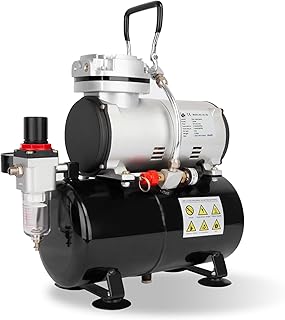
The Timbertech ABPST08 is designed for airbrush-scale work rather than conventional automotive spray guns. Its three-liter tank, regulator, moisture trap, cooling fan, and oil-free single-piston pump make it useful for graphics, model work, custom accents, and very small automotive details. Its compact format is easy to store, but its limited reserve rules out efficient coverage of large panels.
Frequently Asked Questions
What size compressor is best for automotive painting?
There is no universal size because spray guns vary widely. For occasional touch-ups, a compressor with a modest tank may suffice; for larger panels, prioritize a unit whose delivered CFM comfortably exceeds the gun’s requirement, preferably with a tank of roughly 20 gallons or more.
Can an oil-free compressor be used for automotive paint?
Yes. Oil-free compressors are convenient and reduce the risk of oil entering the air line, but they still need proper filtration and moisture separation. Always use a clean regulator and drain the tank regularly.
Is a quiet compressor powerful enough for painting?
Quietness and painting capacity are separate characteristics. A low-noise compressor may be excellent for airbrushing yet unable to keep up with an HVLP gun, so compare its delivered CFM at the operating pressure rather than its sound rating alone.
How can I prevent water in the paint line?
Drain the compressor tank, use an inline water separator, keep the air hose away from hot compressor discharge areas, and allow the air to cool before it reaches the gun. A final moisture filter near the spray gun adds another layer of protection.
Final Thoughts
The Klutch 29-Gallon compressor is the most capable choice here for larger automotive painting jobs, while the California Air Tools 8010 PK offers a quieter, more approachable setup for smaller repairs. For airbrush graphics and fine detail, the Timbertech ABPST08 is the sensible specialist pick; whichever model you choose, airflow matching and moisture control will matter as much as the compressor itself.