
Key takeaways
- Warranty Description: 2 years
- Item Dimensions L x W: 8.82"L x 7.01"W
- Handle Diameter: 28 millimeters
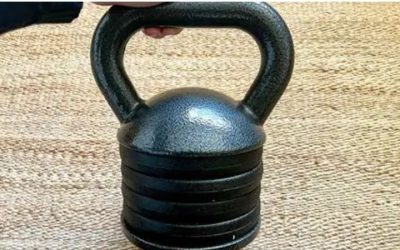
Kettlebell shopping usually stalls at the same question: which single weight do you buy? A 20-pounder is right for pressing and wrong for swings. A 40-pounder is honest for deadlift-pattern work and humbling for a Turkish get-up. Adjustable kettlebells exist to end that stalemate, and the BowFlex SelectTech 840 does it with a dial at the base rather than a stack of loose plates — you rotate the selector, lift the bell out of its cradle, and the internal weights you didn’t select stay behind. Six settings, one footprint of roughly a shoebox on end.
The trade-off worth naming up front: a selector mechanism means a shell, and a shell means a handle that feels different from a solid cast-iron bell. The SelectTech’s grip window is wide enough for a two-hand swing and the finish is smooth and matte rather than raw, textured cast iron, so chalk bites less and sweat matters more. That’s not a dealbreaker — it’s a thing to plan around, the same way you plan around a treadmill’s deck feel. Below I break down how the load steps map to actual training, what to check before you buy any adjustable bell, and where this one earns its place.
Our top picks
 BowFlex SelectTech 840 Adjustable Kettlebell
- Warranty Description: 2 years
- Item Dimensions L x W: 8.82"L x 7.01"W
- Handle Diameter: 28 millimeters

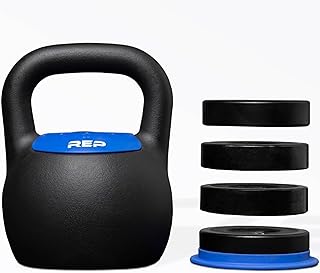
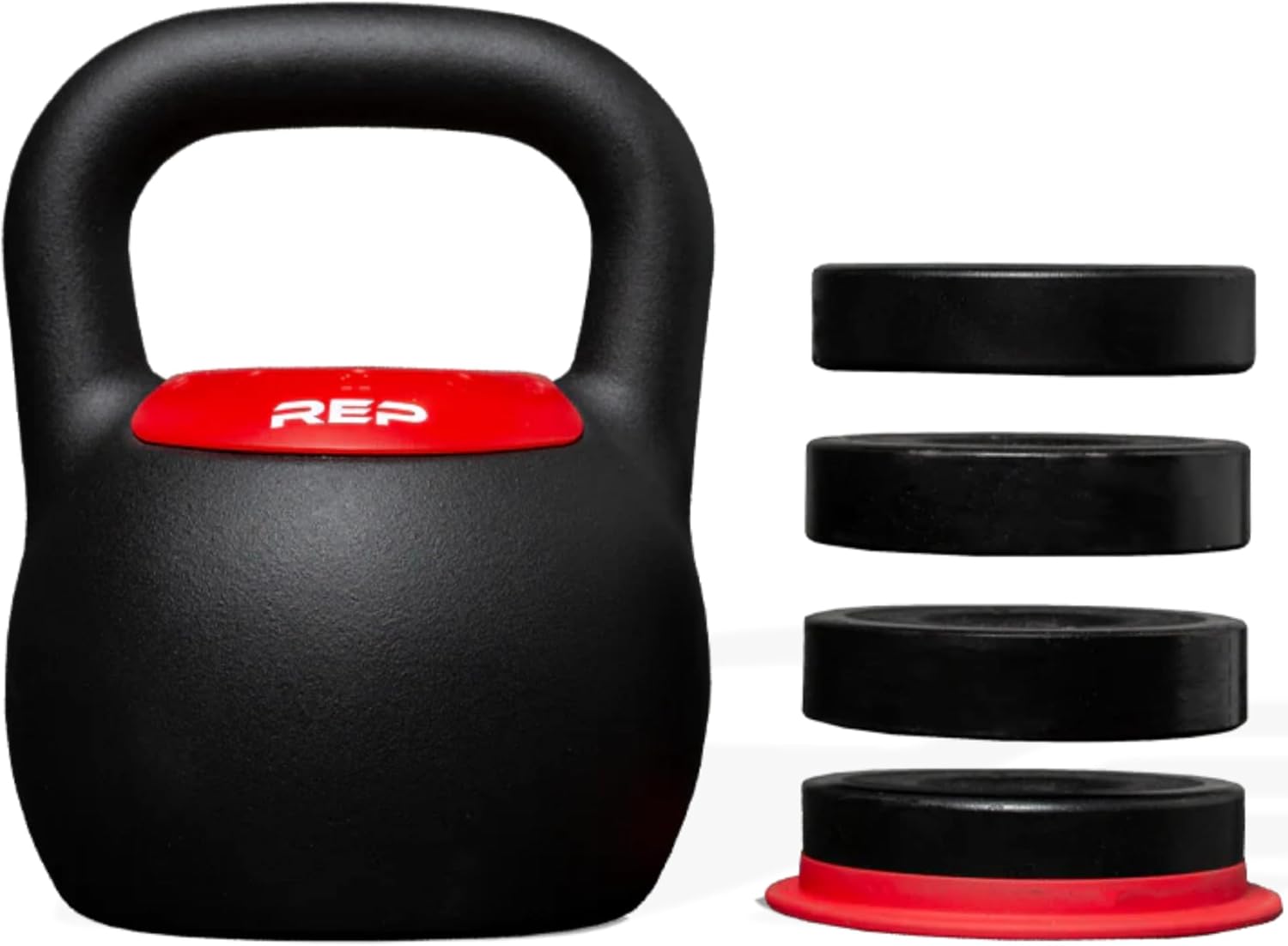 Rep Fitness Adjustable Kettlebell
- Handle Diameter: 1.3 inches
- Material: Iron
- Recommended Uses For Product: Cross Fit, HIIT, Weight Lifting
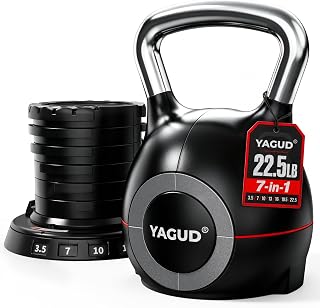



As an Amazon Associate we earn from qualifying purchases at no extra cost to you.
As an Amazon Associate we earn from qualifying purchases.

Quick Comparison
| Setting | Load | Typical Use | Grip Demand |
|---|---|---|---|
| 1 | 8 lb | Halos, arm bars, shoulder prep, teaching a new pattern | Minimal |
| 2 | 12 lb | Single-arm presses for smaller lifters, windmills, rehab-adjacent work | Low |
| 3 | 20 lb | Cleans, snatches, high-rep goblet squats, get-up practice | Moderate |
| 4 | 25 lb | Two-hand swings for beginners, rows, suitcase carries | Moderate |
| 5 | 35 lb | Working-set swings, loaded squats, farmer carries | High |
| 6 | 40 lb | Heavy swings, deadlift patterning, top-end carries | Highest — this is where the smooth finish shows up |
How to Choose
- Match the top end to your hinge, not your press. Swings and deadlifts eat weight fast. If a 40 lb ceiling already feels light on your swing today, an adjustable bell in this class is a supplement to your collection, not the whole collection.
- Interrogate the handle before the weight range. Measure the window height and handle diameter against your hand. Anything under about four inches of clearance gets cramped for two-hand work, and a slick coating turns high-rep sets into a forearm test rather than a hip test.
- Prefer dial selection over pin-and-plate designs if you superset. Changing load in under five seconds keeps a circuit intact; unbolting collars does not.
- Assume you cannot drop it. Every selector-based bell has a mechanism inside. If your training involves letting the bell hit the floor from overhead — or you train on concrete with no mat — solid cast iron is the more honest purchase.
- Check the cradle footprint against your actual floor space. Adjustable bells only work when the base stays put. Budget a square foot of permanent floor real estate, ideally on rubber or a mat rather than hardwood.
Top Picks Reviewed
BowFlex SelectTech 840 Adjustable Kettlebell
The 840 replaces six kettlebells with one unit that spans 8 to 40 pounds. Adjustment happens through a dial on the underside: turn to your number, then lift. There’s a satisfying mechanical certainty to it — the bell either releases from the base or it doesn’t, which means you get immediate feedback if the selector isn’t fully seated. That matters more than it sounds, because the failure mode you fear with any adjustable implement is a plate parting company with the handle mid-swing.
On load quality, the weight sits noticeably compact for its heaviest setting. At 40 pounds the mass is packed into a body slightly smaller than a comparable cast-iron 18 kg bell, which shifts the center of gravity closer to your hand. Practically, that makes racked positions feel a little tidier and ballistic work feel slightly less pendulum-like than a traditional bell of the same weight. Some lifters prefer that; competition-bell purists won’t.
Grip is where you should set expectations carefully. The handle is broad and flat-faced with a smooth finish rather than the sandy texture of powder-coated iron, so it’s kind to your palms across dozens of goblet squats and less grabby when you’re at the top settings with damp hands. Chalk or a thin pair of gloves solves most of it. The window comfortably accepts two hands for swings, though very large hands will find it snug when interlocking.
Who it’s for: home lifters short on space who train the full kettlebell vocabulary — get-ups, presses, cleans, swings — and want the load steps to keep pace with progress. Who should skip it: anyone doing heavy competition-style snatch volume, or anyone who intends to drop the bell. Treat it as gym equipment rather than gear you throw around, and it covers an enormous amount of programming from a single square foot.
Frequently Asked Questions
Can I really swing an adjustable kettlebell safely?
Yes, with two habits. First, confirm the selector is fully engaged by lifting the bell clear of the base before your first rep — if the plates you deselected come along, the dial isn’t seated. Second, set the bell down under control rather than releasing it at the bottom of the swing. Repeated impacts are what stress a selector mechanism over time.
How does the smooth handle affect high-rep sets?
It’s kinder to skin and rougher on grip security. Callus formation slows down, which most people appreciate, but once your hands are wet the bell wants to rotate. Chalk, a towel within reach, or lightweight lifting gloves close the gap entirely. It’s a solvable problem, not a design flaw.
Is 40 pounds enough to keep progressing?
For presses, get-ups, windmills, carries, and single-leg work, it will last most lifters a long time. For two-hand swings and deadlift patterns, it’s a ceiling you’ll approach faster. The usual path is to keep the adjustable bell as your do-everything tool and add one heavy cast-iron bell later for hinge work, rather than buying a second adjustable unit.
Does it need a mat underneath?
Strongly recommended. The base is the part that takes repeated set-downs, and a rubber mat protects both the mechanism and your floor. It also stops the cradle from sliding when you’re pulling the bell out one-handed mid-circuit.
Final Thoughts
The case for the SelectTech 840 isn’t that it beats cast iron on feel — it doesn’t, and no selector bell will. The case is that six discrete kettlebells cost more, occupy far more space, and still leave gaps in your progression. If you train at home, value fast load changes between exercises, and are willing to use chalk at the top settings and set the bell down rather than drop it, this is a genuinely efficient purchase. Buy it as your primary bell, add a heavy iron one when your swings outgrow 40 pounds, and you’ve built a complete kettlebell setup out of two objects.
8 Best Kettlebell Weights for Men: How to Pick the Right Size
Best kettlebell weight for men is the decision that quietly settles whether...
8 Best Kettlebell Ab Exercises: 6 Adjustable and Fixed Picks
Best kettlebell ab exercises rarely share a single weight. A loaded carry,...
Best Kettlebell Core Exercises: 6 Picks for Floor Space
Best kettlebell core exercises tend to be floor-based or overhead, which makes...
8 Best Kettlebell Exercises for Abs: 5 Bells for Long Holds
Best kettlebell exercise for abs options nearly all involve holding load away...
8 Best Kettlebell Ab Workouts: 6 Bells Sized for Circuit Work
Best kettlebell ab workout equipment is chosen for sustained rounds, not for...
Best Kettlebell Weight: How to Size It Plus 6 Top Picks
Best kettlebell weight is not one number, because a swing, a press...
8 Best Kettlebell Routines: How to Pick the Right Bell Weight
Best kettlebell routine arguments usually skip the one decision that determines whether...
8 Best Kettlebell Routines: 6 Bells Matched to Each Format
Best kettlebell routines fail more often on equipment than on programming. A...
8 Best Kettlebell Trainings: 6 Bells to Build a Progression
Best kettlebell training runs into a hardware problem early: the traditional weight...
8 Best Workout Kettlebells: 6 Bells Matched to Your Training
Best workout kettlebell choices depend entirely on the session you plan to...
Write Your Review
No reviews yet. Be the first to share your experience!