Key takeaways
- Drawer glide type: Ball-bearing runners are the dividing line. They keep pull effort low and consistent as weight climbs, while roller or friction slides bind under load and wear unevenly. Check the per-drawer rating, not just the cabinet total.
- Working height and reach zone: Aim for a top surface between 34 and 38 inches so you can work standing without hunching. Put your heaviest, least-used items in the bottom drawers and keep daily tools in the 28-to-42-inch band where your arms travel naturally.
- Caster spec: Larger diameter wheels roll over cords, chips, and door thresholds with far less push force. Two locking swivels plus two rigid casters give you steering without the shopping-cart wander that makes loaded chests unpredictable.
- Frame construction: Look for welded or bolted steel with a powder-coat finish, folded drawer fronts rather than single-thickness stampings, and deburred edges. Rivet-only assembly tends to loosen and rack once the drawers are full.
- Modularity and liners: A detachable top box lets you carry a subset of tools to the job instead of relocating the whole cabinet. Anti-scratch liners and tray dividers cut drawer rattle, which is the main cause of tool finish wear.
What's inside
Most tool storage complaints have nothing to do with capacity. They come down to the twenty-odd times a day you bend, reach, and yank a drawer that fights back. A chest that sits too low turns every socket grab into a squat. Drawers riding on stamped friction slides get sticky the moment you load them past forty pounds. Casters chosen to hit a price point judder across expansion joints and skate sideways on a sloped driveway. None of that shows up in a spec sheet, and all of it shows up in your lower back by Sunday afternoon.
This guide looks at rolling tool chests through two lenses: how the unit behaves under your hands during a full working session, and how its structure holds up after a few years of load cycles. That means drawer glide type and travel, working-surface height, caster diameter and swivel behavior, steel gauge and weld quality, and whether the locking hardware still lines up once the frame has taken a knock. Below are six current options worth your attention, followed by a buying framework and answers to the questions that come up most.
As an Amazon Associate we earn from qualifying purchases.


How to Choose a Rolling Tool Chest (2026)
- Drawer glide type: Ball-bearing runners are the dividing line. They keep pull effort low and consistent as weight climbs, while roller or friction slides bind under load and wear unevenly. Check the per-drawer rating, not just the cabinet total.
- Working height and reach zone: Aim for a top surface between 34 and 38 inches so you can work standing without hunching. Put your heaviest, least-used items in the bottom drawers and keep daily tools in the 28-to-42-inch band where your arms travel naturally.
- Caster spec: Larger diameter wheels roll over cords, chips, and door thresholds with far less push force. Two locking swivels plus two rigid casters give you steering without the shopping-cart wander that makes loaded chests unpredictable.
- Frame construction: Look for welded or bolted steel with a powder-coat finish, folded drawer fronts rather than single-thickness stampings, and deburred edges. Rivet-only assembly tends to loosen and rack once the drawers are full.
- Modularity and liners: A detachable top box lets you carry a subset of tools to the job instead of relocating the whole cabinet. Anti-scratch liners and tray dividers cut drawer rattle, which is the main cause of tool finish wear.
The Best Rolling Tool Chests of 2026, Reviewed
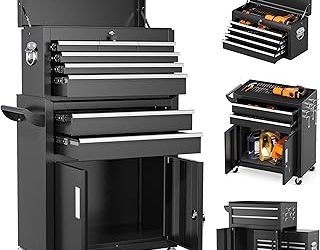
8-Drawer Rolling Tool Chest with Detachable Top
Ships assembled with liners, hooks, and a tray divider already in place, which removes the usual weekend of fiddling with hardware bags. The detachable top box is the practical draw here: it lets you split a heavy load between a mobile base and a carry unit, so you are not wheeling forty pounds of unused sockets across the shop.
7-Drawer Rolling Tool Chest with Vertical Stacking
The connecting rods and link buckle let you stack vertically without the assembly wobbling, and the 360-degree swivel casters make tight-aisle repositioning genuinely easy rather than a three-point turn. The waterproof top earns its keep in a garage bay where condensation and spilled fluids are routine.
13-Drawer Double Door Rolling Tool Chest
The best fit if you are consolidating from scattered bins, since the double-door lower cabinet swallows power tools and cases that no drawer will take. It is a two-in-one detachable design, so the upper chest can move to a bench while the base stays put as a standing storage anchor.
Oakcloud Lockable 8-Drawer Chest and Cabinet Combo
Heavy-duty steel with a full black liner set and side hooks, and the top-plus-cart pairing gives you a usable staging surface at standing height. Worth noting the finish is a genuine color choice rather than the default red-or-black, which matters if the chest lives in a visible mudroom or hobby space.
24″ Metal Portable Tool Box with 5 Drawers
A compact ball-bearing-runner box for anyone who does not need a full cabinet footprint, with a proper carry handle and a top storage tray for fasteners. Best used as a bench-top or shelf unit, or as the portable half of a larger setup.
Frequently Asked Questions
How much weight can a rolling tool chest actually hold?
Mid-range steel chests typically rate individual drawers between 40 and 90 pounds, with total cabinet capacity several hundred pounds. Distribute weight low and centered; loading the top drawers heavily raises the center of gravity and makes the unit prone to tipping when a drawer is extended.
Do I need to assemble it myself?
Several of these arrive fully assembled, including the 8-drawer chests and the Superday cart. Pre-assembled units generally hold their squareness better over time, since factory alignment of the drawer runners is more consistent than a first-time home build.
Are drawer liners worth using?
Yes. Liners stop tools sliding on open and close, which reduces both noise and the chipped finishes that lead to rust. They also protect the drawer bottom from point loads that dent thin steel.
Can these be used on rough or sloped floors?
On sealed concrete they roll well. On cracked slabs or gravel, larger casters help but no standard chest handles them comfortably; keep the unit parked and locked in one bay, and use a detachable top box or portable chest to carry tools to the work.
Final Thoughts
For most home garages and workshops, the 13-Drawer Double Door chest offers the widest storage range in a single footprint, while the 7-Drawer with vertical stacking is the smarter pick if you expect your kit to grow and want to build upward. If you want the least friction on day one, the assembled 8-Drawer with detachable top gets you working immediately and gives you a portable half when the job moves away from the bench.