Key takeaways
- Clamp architecture: Look for jaws with a wide bite and a spring rate you can compress with one hand, ideally with insulated shoulders wide enough to keep knuckles off adjacent metal. Cheap stamped clamps splay open after a dozen uses and lose contact pressure, which is where most “it won’t start” complaints actually originate.
- Cable strain relief: The junction where the cable enters the housing is the first thing to fail. Molded, tapered boots outlast flush-mounted grommets, and cables with fine-strand copper stay flexible near freezing instead of taking a permanent memory coil.
- Inflator duty cycle and heat path: A 150–160 PSI rating means little without a stated runtime and a vented body. Compressors that sit directly on the battery pack with no thermal separation throttle sooner and age the cells faster.
- Housing and ingress resistance: Textured polycarbonate with rubberized corners survives being tossed under a seat; glossy ABS scuffs and cracks. Recessed ports with real covers keep grit out of the USB-C and 12V contacts, which is the quiet killer in truck-bed storage.
- Interface you can operate blind: Backlit displays, tactile detented buttons, and an integrated light that aims at the terminals rather than your eyes. Auto-shutoff on the inflator matters more than peak PSI, since it lets you set a target and keep both hands on the hose.
What's inside
A dead battery rarely picks a convenient moment. It happens in a parking garage with your hands full, or on a gravel shoulder in February, and the thing that decides whether the next ten minutes are annoying or genuinely miserable is usually not raw amperage — it’s whether the tool in your trunk was designed for a human body under stress. Clamps that need two hands and a prayer, cables stiff as rebar, buttons you can’t find in the dark: these are ergonomic failures, and they show up exactly when tolerance for friction is lowest.
This guide looks at combination jump starters and air compressors through the lens I use for any object that lives in a hard environment: grip geometry, cable strain relief, housing resilience, thermal behavior, and how the unit holds up after three years of heat cycling in a car’s cargo area. Below you’ll find current standouts from GOOLOO, WOLFBOX, and ANCEL, plus the selection criteria that separate a five-season tool from a two-season one.
As an Amazon Associate we earn from qualifying purchases.




How to Choose a Jump Start And Air Compressor (2026)
- Clamp architecture: Look for jaws with a wide bite and a spring rate you can compress with one hand, ideally with insulated shoulders wide enough to keep knuckles off adjacent metal. Cheap stamped clamps splay open after a dozen uses and lose contact pressure, which is where most “it won’t start” complaints actually originate.
- Cable strain relief: The junction where the cable enters the housing is the first thing to fail. Molded, tapered boots outlast flush-mounted grommets, and cables with fine-strand copper stay flexible near freezing instead of taking a permanent memory coil.
- Inflator duty cycle and heat path: A 150–160 PSI rating means little without a stated runtime and a vented body. Compressors that sit directly on the battery pack with no thermal separation throttle sooner and age the cells faster.
- Housing and ingress resistance: Textured polycarbonate with rubberized corners survives being tossed under a seat; glossy ABS scuffs and cracks. Recessed ports with real covers keep grit out of the USB-C and 12V contacts, which is the quiet killer in truck-bed storage.
- Interface you can operate blind: Backlit displays, tactile detented buttons, and an integrated light that aims at the terminals rather than your eyes. Auto-shutoff on the inflator matters more than peak PSI, since it lets you set a target and keep both hands on the hose.
The Best Jump Start And Air Compressor (2026)s Reviewed
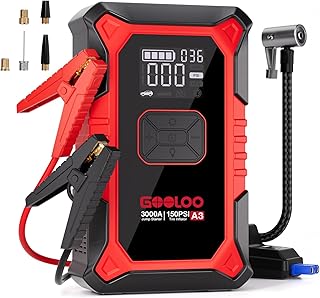
GOOLOO A3 3000A Jump Starter with Air Compressor
The A3 strikes the best balance of clamp quality and inflator manners in this group: the jaws close with modest hand force and hold pressure well, while the 150 PSI auto-off inflator lets you walk away mid-fill without watching a gauge. Rated for 9L gas and 6.5L diesel, it has meaningful headroom, which reduces deep-discharge cycling and extends pack life.
WOLFBOX MV16A 3000A Jump Starter with Air Compressor
At 59.2Wh with a 160 PSI compressor and 65W USB-C charging, the MV16A is the most versatile all-rounder here, and its 65W input means it recovers fast enough that you’ll actually keep it topped up. The chassis is well braced and the cable exits are properly booted — a detail that pays off after repeated coiling in cold weather.
WOLFBOX MV24 4000A Jump Starter
The MV24 skips the compressor in favor of an 88.8Wh pack and 4000A output covering 10L gas and diesel engines, making it the right call for trucks, vans, and anyone starting big displacement in the cold. The LED display gives real state-of-charge data rather than a four-bar guess, which is how you avoid discovering an empty pack at the worst time.
ANCEL BS300 Super Starter
A different philosophy entirely: the BS300 mounts permanently and uses supercapacitors instead of lithium cells, so it tolerates −40°F to 176°F and doesn’t degrade from sitting hot and idle. If your problem is a vehicle that dies repeatedly rather than a roadside emergency kit, its 1000A start assist and battery health monitoring solve it more elegantly than any portable.
WOLFBOX MV10A 2000A Jump Starter with Air Compressor
The 37Wh MV10A is the pocketable option, sized for engines up to about 5L, and it keeps the 150 PSI inflator that makes these units worth carrying year round. Its light weight is an ergonomic win in itself — it stows in a door pocket, so it’s actually with you.
Frequently Asked Questions
Does a built-in compressor shorten the jump starter’s life?
It can, if the design lets compressor heat soak the cells. Inflate in shorter passes, pause between tires, and choose a unit with vents and a stated duty cycle rather than only a headline PSI figure.
How much amperage do I actually need?
Match the engine displacement rating, then add margin for cold. A 3000A unit on a 2.5L four-cylinder loafs through a start, which is easier on the battery than a marginal pack straining at its ceiling.
Can I leave one in the car through summer?
Lithium packs tolerate it but age faster above roughly 100°F, so store the unit in the cabin rather than the trunk and recharge every three to six months. Supercapacitor systems like the ANCEL BS300 are the exception and are built to live under the hood.
Why won’t my jump starter engage on a truly dead battery?
Most units need a small residual voltage to detect the battery, which is why a manual boost or override mode is essential. Also clean the terminals — poor clamp contact mimics a failed pack more often than the pack is at fault.
Final Thoughts
For most drivers, the WOLFBOX MV16A is the smartest buy: strong output, a well-mannered 160 PSI inflator, and fast 65W recharging in a housing built to take abuse. The GOOLOO A3 is the value alternative with excellent clamps and hands-free inflation, while the ANCEL BS300 is the durable, install-once answer for a vehicle that keeps leaving you stranded.