Key takeaways
- Match seat depth to your torso, not your room: Deep 40″+ seats reward reclining but force shorter users into a slumped pelvic tilt with no thigh contact. If you sit upright to read or work, target 21–23″ of usable depth, and treat oversized cloud-style seats as furniture you lie on rather than sit in.
- Check seat height against your knee crease: Around 17–19″ lets most adults plant both feet with thighs parallel to the floor, which unloads the lower back. Low-profile floor sofas sit closer to 12–14″ and demand more effort from hips and knees on every stand-up, which matters for older users and anyone with joint sensitivity.
- Read the frame and suspension before the fabric: Kiln-dried hardwood or reinforced metal with corner blocking resists the racking forces a chaise generates. Sinuous spring suspension outlasts webbing straps, which stretch and telegraph the frame edge into the back of your leg within a couple of years.
- Judge foam by density and layering, not thickness: High-resilience foam cores in the 1.8 lb/ft³ range with memory foam or fiber as a comfort layer hold their shape far longer than a single soft block. A thick cushion made of low-density foam will develop a permanent body impression exactly where you sit most.
- Choose upholstery for your traffic level: Chenille and performance linen handle friction and hide wear well. Corduroy is durable but the pile flattens along the chaise where legs slide. Velvet shows nap marks quickly and needs regular brushing, though it resists snagging better than loose-weave alternatives.
What's inside
Sectionals get judged on looks in the showroom photo and on the body six months later. The gap between those two moments is where most buyers get burned: a chaise that looks generous but sits two inches too shallow for a 5’10” frame, cushions that lose 20% of their loft in a season, or a corner connector that develops a squeak because it was stamped steel instead of a bolted bracket. Chaise sectionals amplify these issues because one arm of the piece carries asymmetric load every single day — someone always claims the chaise.
This guide evaluates 2026’s best-selling chaise sectionals through two lenses that rarely appear on spec sheets: postural fit (seat height, depth, back pitch, and how the chaise supports the lower leg) and structural longevity (frame construction, suspension, foam resilience, and upholstery abrasion behavior). You’ll find selection criteria first, then focused assessments of the strongest performers, from sprawling U-shaped conversation pits to compact convertibles built for tight apartments.
As an Amazon Associate we earn from qualifying purchases.


How to Choose a Amazon Best Selling Sofa Chaise Sectional (2026)
- Match seat depth to your torso, not your room: Deep 40″+ seats reward reclining but force shorter users into a slumped pelvic tilt with no thigh contact. If you sit upright to read or work, target 21–23″ of usable depth, and treat oversized cloud-style seats as furniture you lie on rather than sit in.
- Check seat height against your knee crease: Around 17–19″ lets most adults plant both feet with thighs parallel to the floor, which unloads the lower back. Low-profile floor sofas sit closer to 12–14″ and demand more effort from hips and knees on every stand-up, which matters for older users and anyone with joint sensitivity.
- Read the frame and suspension before the fabric: Kiln-dried hardwood or reinforced metal with corner blocking resists the racking forces a chaise generates. Sinuous spring suspension outlasts webbing straps, which stretch and telegraph the frame edge into the back of your leg within a couple of years.
- Judge foam by density and layering, not thickness: High-resilience foam cores in the 1.8 lb/ft³ range with memory foam or fiber as a comfort layer hold their shape far longer than a single soft block. A thick cushion made of low-density foam will develop a permanent body impression exactly where you sit most.
- Choose upholstery for your traffic level: Chenille and performance linen handle friction and hide wear well. Corduroy is durable but the pile flattens along the chaise where legs slide. Velvet shows nap marks quickly and needs regular brushing, though it resists snagging better than loose-weave alternatives.
The Best Amazon Best Selling Sofa Chaise Sectional (2026)s Reviewed
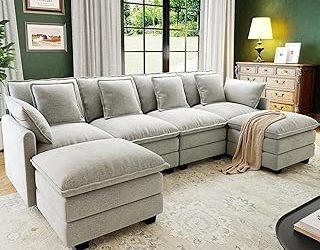
125″ U-Shaped 7-Seat Sectional with Adjustable Headrest and Storage Chaise
The adjustable headrest is the standout ergonomic feature here — it lets you set cervical support independently of back pitch, which is the single most effective fix for neck strain during long viewing sessions. With a pull-out sleeper and storage beneath the chaise, it earns its 125″ footprint, though the sleeper mechanism is the component most likely to need attention over time, so keep it clear and cycle it occasionally.
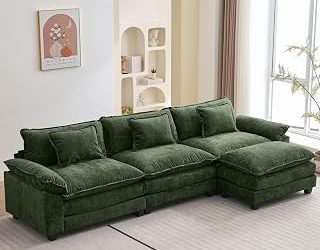
ovios Modular Cloud Couch with Plush Corduroy
This is a lounging platform rather than a sitting chair: the memory-foam-heavy build and low modular profile encourage reclining, and the no-assembly design means fewer hardware joints to loosen. Corduroy holds up well to abrasion but expect pile flattening on the chaise, so rotate seat cushions monthly to distribute compression.
L-Shape Modular Sectional with Three Chairs and Corner, Navy Chenille
Modularity is a genuine durability advantage — the individual chairs and corner unit can be reconfigured so the same seat never absorbs every hour of use, meaningfully extending cushion life. Navy chenille is one of the more forgiving surfaces for high-traffic households, resisting pilling and disguising minor abrasion better than smoother weaves.
Velvet Sectional with Ottoman, 7-Seat Curved Floor Design in Deep Gray
The curved geometry distributes lumbar contact across a continuous arc instead of a hard corner seam, which suits conversation-oriented rooms well. Its floor-level height is the tradeoff: comfortable for extended lounging, less accommodating for anyone who needs an easy transition to standing.
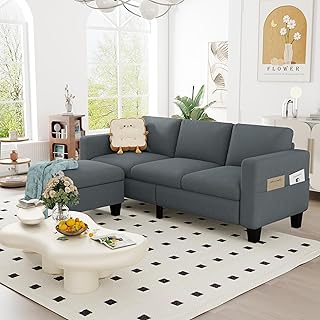
ZeeFu Convertible 3-Seat L-Shaped Sectional with Movable Ottoman
For small apartments, the movable ottoman is the smartest ergonomic detail in this roundup — you can convert the chaise to whichever side the room demands, then reposition it as leg support when you want your knees higher than your hips. Compact dimensions mean shallower seating, so it favors upright sitting over sprawling.
Frequently Asked Questions
How long should a chaise sectional realistically last?
With a hardwood or reinforced metal frame and high-resilience foam, eight to ten years of daily use is a fair expectation. Cushion covers and foam inserts wear out first — replaceable inserts effectively double the life of an otherwise sound frame.
Does a floor-style sofa cause back problems?
Not inherently, but low seating shifts the pelvis into a posterior tilt that flattens the lumbar curve. If you spend hours seated, add a lumbar bolster or choose a model with an adjustable headrest and firmer back support.
Which fabric survives pets and kids best?
Tightly woven chenille and performance linen lead here, since dense weaves resist claw snags and clean up more predictably. Velvet is surprisingly snag-resistant but shows every water mark and crush pattern.
Are modular sectionals less stable than one-piece builds?
Quality modular systems with bolted or interlocking connectors are comparably stable and easier to move and repair. Watch for models relying only on friction clips, which drift apart under regular use.
Final Thoughts
For most households, the 125″ U-shaped sectional with adjustable headrest offers the strongest ergonomic adjustability alongside genuinely useful storage and a sleeper. If reconfigurability and long-term cushion life matter more, the navy chenille modular L-shape is the durability pick, while the ZeeFu convertible remains the sensible answer for compact rooms where flexibility beats sheer scale.