Key takeaways
- Tooth count and grind: For moulding, 80 to 120 teeth in an ATB or Hi-ATB grind slices fibers rather than tearing them. Lower counts around 40T are for framing stock, not profiles, and will leave you sanding delicate edges you should never have had to touch.
- Feed effort and kerf: A thin-kerf plate removes less material, so the motor loads less and your arm needs noticeably less downward pressure. Lighter effort means better control on shallow bevels and far less fatigue over a room’s worth of cuts.
- Plate stability and vibration: Look for laser-cut expansion slots, a tensioned plate, and a hardened body. These features suppress the high-frequency buzz that travels up the handle into your hand, and they keep the blade tracking true as it heats up.
- Carbide grade and edge life: Micro-grain carbide holds a keen edge through MDF, primer, and finger-jointed pine, all of which dull cheaper tips quickly. A blade that stays sharp stays predictable, which matters more for durability than raw hardness claims.
- Arbor fit and diameter honesty: Confirm 5/8-inch or 1-inch bore against your saw, and match the diameter exactly. An undersized or shimmed blade introduces runout, and runout ruins tight miters no matter how many teeth you paid for.
What's inside
Crown, base cap, chair rail, and shoe moulding all punish a blade in the same way: thin profiles, long unsupported spans, and painted or primed surfaces that telegraph every flaw. When a blade is even slightly wrong for the job, you feel it before you see it. Feed pressure climbs, the arm wants to chatter through the detent, and your wrist absorbs the vibration the blade should have damped. Then you flip the piece over and find the fuzzed shoulder, the chipped bead, the tear-out along the primer that no amount of caulk will forgive.
This guide looks at moulding blades the way a tool designer would: how much force the cut asks of your body, how steadily the plate runs after a hundred miters, and how long the carbide holds its edge before the blade starts pushing back. Below you will find selection criteria focused on tooth geometry and plate stability, followed by hands-on notes on the blades that hold up best in trim work through 2026.
As an Amazon Associate we earn from qualifying purchases.


How to Choose a/an Miter Saw Blade For Moulding (2026)
- Tooth count and grind: For moulding, 80 to 120 teeth in an ATB or Hi-ATB grind slices fibers rather than tearing them. Lower counts around 40T are for framing stock, not profiles, and will leave you sanding delicate edges you should never have had to touch.
- Feed effort and kerf: A thin-kerf plate removes less material, so the motor loads less and your arm needs noticeably less downward pressure. Lighter effort means better control on shallow bevels and far less fatigue over a room’s worth of cuts.
- Plate stability and vibration: Look for laser-cut expansion slots, a tensioned plate, and a hardened body. These features suppress the high-frequency buzz that travels up the handle into your hand, and they keep the blade tracking true as it heats up.
- Carbide grade and edge life: Micro-grain carbide holds a keen edge through MDF, primer, and finger-jointed pine, all of which dull cheaper tips quickly. A blade that stays sharp stays predictable, which matters more for durability than raw hardness claims.
- Arbor fit and diameter honesty: Confirm 5/8-inch or 1-inch bore against your saw, and match the diameter exactly. An undersized or shimmed blade introduces runout, and runout ruins tight miters no matter how many teeth you paid for.
The Best Miter Saw Blade For Moulding (2026)s Reviewed
DEWALT 12-Inch 100-Tooth Fine Finish (DWA112100)
The tensioned body runs remarkably calm at full speed, which translates into a lighter grip and less arm creep on long crown cuts. Its ultra-sharp carbide keeps that composure through primed pine and MDF longer than most blades in this class, making it the safest all-day choice for trim carpenters.
LM6300 12-Inch 100T Miter Joint Blade
Built around a 1-inch bore, this blade is aimed squarely at larger production saws where plate rigidity does the heavy lifting. The joint-grade geometry leaves shoulders crisp enough to glue, and the heft of the plate soaks up vibration instead of passing it to your hands.
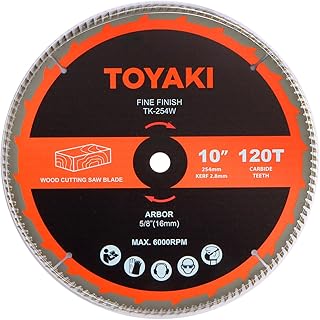
10-Inch 120-Tooth Fine-Finish Blade
At 120 teeth, this is the finest cut on the list and the right call for hardwood beads, small returns, and anything you plan to stain rather than paint. Feed slowly and let the tooth count work; rushing it generates heat that shortens carbide life.
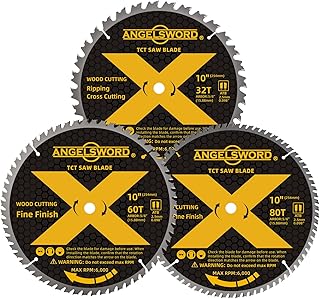
ANGELSWORD 10-Inch 3-Pack (32T / 60T / 80T)
The 80T blade handles most moulding duty while the 32T and 60T cover framing and general crosscutting, so you swap blades instead of compromising on one. For a home shop that alternates between rough carpentry and finish work, the value here is hard to argue with.
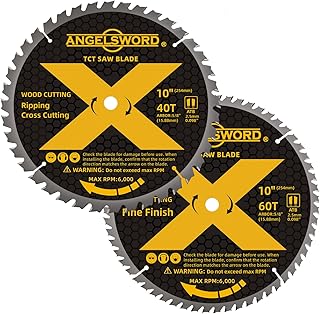
ANGELSWORD 12-Inch 2-Pack (40T / 60T)
The 60T member is a capable mid-range finish blade for painted softwood trim and shoe moulding, while the 40T keeps ripping and framing off your good blade. Reach for a higher tooth count if your profiles are intricate or headed for clear finish.
Frequently Asked Questions
How many teeth do I actually need for moulding?
Eighty teeth is a practical floor for painted trim, and 100 to 120 is better for hardwood or stained profiles. Above that, chip clearance suffers and the blade can burn if you push it.
Does a thin-kerf blade sacrifice durability?
Not meaningfully on a well-tensioned plate. Thin kerf reduces motor strain and feed force, though it does deflect more if you force the cut, so let the blade set its own pace.
Can I use a 10-inch moulding blade on a 12-inch saw?
No. Diameter and bore must match your saw’s specification, since a mismatch changes tooth speed and introduces runout that shows up directly in your miters.
Why do my miters open up even with a fine blade?
Usually saw calibration or an out-of-square wall, not the blade. Check your detents and fence, support long stock at both ends, and confirm the blade seats flat against the arbor washer.
Final Thoughts
For most trim work, the DEWALT DWA112100 is the blade that asks least of your body while staying sharp the longest, and the LM6300 100T is the pick if you run a 1-inch arbor and want glue-ready joints. Home shops splitting time between framing and finish will get the most mileage from the ANGELSWORD 10-inch 3-pack, which keeps a dedicated 80T blade in reserve for the cuts that matter.