Key takeaways
- Runner material and adjustability: UHMW polyethylene glides with almost no drag and shrugs off humidity swings, while extruded aluminum bars resist long-term wear better. Either way, look for set screws or expansion hardware so you can dial out slot slop as the miter track wears rather than replacing the whole sled.
- Fence height and hand position: A rear fence tall enough to rest your palm flat, roughly 3 to 4 inches, keeps your wrist neutral instead of cocked. Low fences force a pinch grip that fatigues fast and encourages you to reach across the blade path.
- Zero-clearance support: A sacrificial base and fence face that the blade cuts its own kerf into will hold the fibers on the underside of your workpiece, eliminating tearout and preventing thin offcuts from dropping into the throat plate.
- Mass versus manageability: Heavier sleds track more smoothly but have to be lifted on and off the saw. If you work alone or have a shoulder that complains, favor a compact small-parts sled or a kit built on a lighter plywood base with cutouts for grip.
- Capacity you will actually use: Full-size sleds handle wide panels but eat bench space and travel. Match crosscut width to the furniture you build, and consider keeping a dedicated small sled alongside a larger one instead of asking one jig to do everything.
What's inside
Anyone who has spent an afternoon crosscutting stock on a table saw knows the moment when precision quietly slips away. The miter gauge shifts a few thousandths, the offcut skitters into the blade, and your fingers end up closer to the teeth than good sense allows. Repeat that a hundred times over a build and the toll is physical as much as dimensional: hunched shoulders, thumbs pinned against a fence, wrists twisting to hold a short piece steady. A crosscut sled solves both problems at once by giving the workpiece a moving floor and giving your hands somewhere safe to live.
This guide looks at crosscut sleds and sled kits through two lenses that matter more the longer you own them: how comfortably the sled positions your body during repetitive cuts, and how well its materials hold tolerance after a few thousand passes. We cover ready-made small-parts sleds, complete build kits with hardware, and standalone UHMW runners for woodworkers who prefer to make their own base. Below you will find the current standouts, followed by selection criteria, individual assessments, and answers to the questions that come up most often.
As an Amazon Associate we earn from qualifying purchases.


How to Choose a Crosscut Sled For Table Saw (2026)
- Runner material and adjustability: UHMW polyethylene glides with almost no drag and shrugs off humidity swings, while extruded aluminum bars resist long-term wear better. Either way, look for set screws or expansion hardware so you can dial out slot slop as the miter track wears rather than replacing the whole sled.
- Fence height and hand position: A rear fence tall enough to rest your palm flat, roughly 3 to 4 inches, keeps your wrist neutral instead of cocked. Low fences force a pinch grip that fatigues fast and encourages you to reach across the blade path.
- Zero-clearance support: A sacrificial base and fence face that the blade cuts its own kerf into will hold the fibers on the underside of your workpiece, eliminating tearout and preventing thin offcuts from dropping into the throat plate.
- Mass versus manageability: Heavier sleds track more smoothly but have to be lifted on and off the saw. If you work alone or have a shoulder that complains, favor a compact small-parts sled or a kit built on a lighter plywood base with cutouts for grip.
- Capacity you will actually use: Full-size sleds handle wide panels but eat bench space and travel. Match crosscut width to the furniture you build, and consider keeping a dedicated small sled alongside a larger one instead of asking one jig to do everything.
The Best Crosscut Sled For Table Saw (2026)s Reviewed
Rockler Small Parts Crosscut Sled
Rockler’s small-parts sled is the most thoughtfully shaped option here from a hand-safety standpoint, with a hold-down arrangement and zero-clearance support that let you cut short tenon cheeks and tiny blocks without your fingertips entering the danger zone. Fit and finish are consistent enough that it stays square out of the box, and the machined runner keeps it tracking cleanly year after year.
POWERTEC 71403 Crosscut Sled Kit
This jig and hardware kit is the best route for anyone who wants a full-size sled tailored to their own saw and stature, since you choose the base thickness and fence height. The included T-track and clamping hardware are respectably robust, and building your own base means you can position handles exactly where your arms fall naturally.
Small Crosscut Sled with Zero-Gap Support
Built for accurate 90-degree cuts on thin dowels, small tenons, and delicate molding, this compact sled rides on aluminum slide rails that resist the seasonal movement that plagues wooden runners. Its footprint is small enough to leave on the saw between operations, which in practice means you actually use it instead of reaching for the miter gauge.
UHMW Miter Bars, 3/4″ x 3/8″ x 17″
Four bars in a standard section give you enough material for a sled plus a spare jig or two, and UHMW’s low friction coefficient means noticeably less push force per cut, something your shoulder notices by the end of a long session. Drill and countersink carefully, and shim with tape if your slots run wide.
21P Table Saw Sled Kit
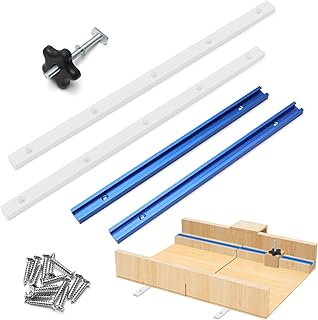
The most complete parts package of the group, pairing two aluminum T-tracks with two UHMW miter bars, predrilled holes, knobs, and screws. Predrilled hardware saves layout time and keeps fastener spacing sensible, making this a strong pick for a first sled build.
Frequently Asked Questions
Is a crosscut sled safer than a miter gauge?
Generally yes. The sled base carries the workpiece and the offcut together, so neither piece can pivot into the blade, and a tall rear fence gives your hands a fixed, distant place to apply pressure.
How thick should the sled base be?
Half-inch plywood or MDF is the usual compromise. Thinner bases flex; thicker ones steal blade height, which matters if your saw only offers 3 inches of cut depth.
Will UHMW runners loosen over time?
UHMW is dimensionally stable but slightly compressible, so runners can develop play after heavy use. Runners with adjustment screws let you take up that slack in seconds.
Do I need a separate small-parts sled?
If you cut short pieces regularly for drawers, frames, or joinery, yes. A dedicated small sled keeps hands far from the blade and prevents offcuts from being flung back at you.
Final Thoughts
For safe, comfortable work on short stock, the Rockler Small Parts Crosscut Sled is the one to buy and keep within arm’s reach. If you would rather build a sled sized to your saw and your reach, the POWERTEC 71403 kit and the 21P sled kit both supply solid hardware, with the 21P’s predrilled tracks and UHMW bars making the fastest path to a jig that stays square for years.