Key takeaways
- Power source honesty: Electric models like the Lerat only make sense where you have shore power — a powered site, cabin, or camper hookup. Off-grid, propane radiant heaters are the only practical option, since running 500W from a battery bank drains it in an hour or two.
- Footprint over height: Stability is a function of base width relative to center of mass. Look for a wide, reinforced base or a tank holder that captures the cylinder rather than balancing on it. Anything that wobbles on a flat floor will topple on packed snow or root-laced dirt.
- Glove-operable controls: Test the mental picture: could you find, grip, and turn that knob wearing winter gloves in the dark? Large knurled valves and clicking piezo igniters beat flush buttons and recessed dials every time.
- Hinge and hardware quality: Folding legs, tank arms, and wire guards are the parts that fail. Steel pivots with a bushing survive seasons; thin stamped tabs develop play, and play becomes wobble. Check that the guard mesh is stiff enough that pressing it doesn’t deflect toward the element.
- Safety hardware as standard: Tip-over shutoff and overheat cutoff are non-negotiable, and for propane, low-oxygen shutoff (ODS). None of these replace ventilation — every combustion heater produces carbon monoxide, so keep a vent open, never sleep with one running, and carry a battery CO alarm.
What's inside
Cold-weather camping punishes gear in ways showroom specs rarely capture. A heater that feels solid on a kitchen counter can behave very differently at 3 a.m. on uneven ground, with numb fingers, condensation on every surface, and a sleeping bag six inches from a hot guard. The failures I see most often aren’t thermal — they’re mechanical and postural: valve knobs too small to turn in gloves, folding legs whose hinges wear loose after a dozen trips, bases so narrow that a boot toe becomes a tip-over event, and carry handles that force a bent-wrist grip when you’re already hauling a cooler.
This guide evaluates portable camping heaters through an ergonomics-and-durability lens: how the controls sit under a gloved hand, how stable the footprint really is, how the folding hardware and guard mesh hold up to repeated packing, and how much warmth you get per pound carried. I’ve grouped picks by realistic use case — powered campsites and cabins versus untethered tent, blind, and ice-shack setups — and flagged the ventilation requirements that make each one safe to run.
As an Amazon Associate we earn from qualifying purchases.



How to Choose a/an Space Heater For Camping (2026)
- Power source honesty: Electric models like the Lerat only make sense where you have shore power — a powered site, cabin, or camper hookup. Off-grid, propane radiant heaters are the only practical option, since running 500W from a battery bank drains it in an hour or two.
- Footprint over height: Stability is a function of base width relative to center of mass. Look for a wide, reinforced base or a tank holder that captures the cylinder rather than balancing on it. Anything that wobbles on a flat floor will topple on packed snow or root-laced dirt.
- Glove-operable controls: Test the mental picture: could you find, grip, and turn that knob wearing winter gloves in the dark? Large knurled valves and clicking piezo igniters beat flush buttons and recessed dials every time.
- Hinge and hardware quality: Folding legs, tank arms, and wire guards are the parts that fail. Steel pivots with a bushing survive seasons; thin stamped tabs develop play, and play becomes wobble. Check that the guard mesh is stiff enough that pressing it doesn’t deflect toward the element.
- Safety hardware as standard: Tip-over shutoff and overheat cutoff are non-negotiable, and for propane, low-oxygen shutoff (ODS). None of these replace ventilation — every combustion heater produces carbon monoxide, so keep a vent open, never sleep with one running, and carry a battery CO alarm.
The Best Space Heater For Camping (2026)s Reviewed
Mr. Heater 9,000 BTU Portable Buddy
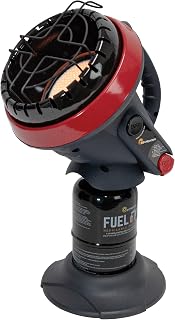
The benchmark for durable off-grid warmth: a squat, wide-based body with a fold-down handle that keeps your wrist neutral, plus a swivel regulator that lets you run a 1 lb cylinder or hose in from a 20 lb tank. Build quality is the reason it lasts — steel guard, real hinge pins, and a control knob you can operate in mittens.
Mr. Heater 3,800 BTU Little Buddy
The ergonomic answer for solo backpackers and small tents: it sits directly on a 1 lb cylinder with a broad plastic base ring, weighs a fraction of the Portable Buddy, and packs flat against a pack panel. Output suits a two-person tent or an ice shack, not a large canvas wall tent.
Portable Propane Heater with Control Valve & Foldable Tank Holder
A cordless radiant unit whose folding tank cradle is the standout feature — it drops the center of gravity and stops the cylinder from acting as a lever. The dedicated control valve gives finer output trimming than simple high/low designs, which helps when a small tent overheats quickly.
Propane Camping Heater with Reinforced Base
Chosen specifically for its beefed-up base and tank holder, this is the pick for windy, uneven sites where tip resistance matters more than gram counting. The heavier bracket adds pack weight but meaningfully reduces the wobble that kills lighter clones after a season.
Lerat 500W Portable Mini Heater
Not a tent heater — a personal-space heater for powered campsites, campers, and cabin desks, with tip-over and overheat protection and a genuinely one-hand-portable form factor. At 500W it takes the chill off a small enclosed area without tripping a 15A site breaker shared with other appliances.
Frequently Asked Questions
Is it safe to run a propane heater in a tent?
Only with active ventilation, a CO alarm, and never while asleep. Radiant propane heaters consume oxygen and emit carbon monoxide; ODS shutoff is a backstop, not a substitute for a cracked vent at both low and high points.
How many BTUs do I actually need?
Roughly 3,000–4,000 BTU handles a one- to two-person backpacking tent or ice shack, while 9,000 BTU suits a family dome, truck bed, or small cabin. Oversizing forces constant cycling and wastes fuel.
Can I power an electric heater from a portable battery?
Technically yes, practically no. A 500W unit drains a 1,000Wh station in about two hours, so electric models belong where you have a hookup.
What wears out first on these heaters?
Folding hardware and regulator connections. Store heaters dry, don’t overtighten cylinder threads, and inspect hinge play before each season.
Final Thoughts
For most campers, the Mr. Heater Portable Buddy is the durability-per-dollar winner, with control ergonomics and a footprint that tolerate real-world abuse; solo and ultralight users should take the Little Buddy instead. If you want a modern cordless design with a lower center of gravity, the propane heater with the reinforced base and foldable tank holder is the sturdiest of that group — and keep the Lerat mini in the camper for powered nights.