Key takeaways
- Bevel control placement: Front-mounted bevel locks let you set the angle from the operator position without leaning across the table. Rear levers force a stretch that gets old fast and encourages sloppy, eyeballed adjustments on wide crown or bed rail stock.
- Handle geometry and trigger reach: A D-handle set close to horizontal keeps your wrist neutral through the slide stroke. Test whether the trigger and safety release can be worked with one hand while the other holds a workpiece, and whether the grip works from your off side for left-hand bevels.
- Rail design and bearing quality: Sealed linear bearings on hardened rails hold accuracy far longer than sleeve bushings. Forward-rail or compact-slide designs also cut the space the saw needs behind it, which matters if your bench sits against a wall.
- Fence, table, and detent materials: Look for machined aluminum fences with tall sliding uppers and a steel detent plate with positive stops you can feel. Cast detents in soft alloy round off, and a rounded stop means a miter joint that reads as almost right for the life of the tool.
- Weight, carry points, and serviceability: Anything over 55 pounds needs real handholds if you plan to move it. Also check for external brush caps, a replaceable belt where applicable, and available parts. A repairable saw is a durable saw.
What's inside
Every dual bevel sliding miter saw on the market will cut a 45 in pine. The differences show up in year three, when the rail bearings have worn a few thousandths, the detent plate has rounded over at 22.5 degrees, and your shoulder has learned to dread the bevel lock buried behind the motor. Spec sheets lead with RPM and crosscut width because those numbers are easy to print, but neither tells you whether you will be reaching over a spinning blade to set a compound angle, or whether the trunnion is a real casting or a stamped assembly held together by optimism.
This guide evaluates the current crop through two lenses that matter most for furniture builders: ergonomics, meaning where the controls sit relative to your body and how your wrist and shoulder load during a cut, and durability, meaning what the saw is made of and whether you can service it when something wears. The picks below range from budget-friendly 12 inch machines to pro-grade saws built for daily production, with notes on who each one actually suits.
As an Amazon Associate we earn from qualifying purchases.




How to Choose a Dual Bevel Sliding Miter Saw (2026)
- Bevel control placement: Front-mounted bevel locks let you set the angle from the operator position without leaning across the table. Rear levers force a stretch that gets old fast and encourages sloppy, eyeballed adjustments on wide crown or bed rail stock.
- Handle geometry and trigger reach: A D-handle set close to horizontal keeps your wrist neutral through the slide stroke. Test whether the trigger and safety release can be worked with one hand while the other holds a workpiece, and whether the grip works from your off side for left-hand bevels.
- Rail design and bearing quality: Sealed linear bearings on hardened rails hold accuracy far longer than sleeve bushings. Forward-rail or compact-slide designs also cut the space the saw needs behind it, which matters if your bench sits against a wall.
- Fence, table, and detent materials: Look for machined aluminum fences with tall sliding uppers and a steel detent plate with positive stops you can feel. Cast detents in soft alloy round off, and a rounded stop means a miter joint that reads as almost right for the life of the tool.
- Weight, carry points, and serviceability: Anything over 55 pounds needs real handholds if you plan to move it. Also check for external brush caps, a replaceable belt where applicable, and available parts. A repairable saw is a durable saw.
The Best Dual Bevel Sliding Miter Saw (2026)s Reviewed
DEWALT DWS780 12-Inch Double Bevel Sliding Compound
The DWS780 remains the durability benchmark in its class: heavy cast trunnions, a stable detent plate, and the XPS shadow light that projects the actual blade shadow rather than a laser line that drifts out of calibration. The rear bevel lever is its ergonomic weak spot, so mount it where you have clearance behind the fence.
Makita LS1219L 12-Inch Dual-Bevel Sliding
Makita’s forward bevel lock and compact rail system make this the most comfortable 12 inch saw to work at for a full day, and the direct-drive motor removes the belt as a wear item. It costs more than the DEWALT, but the shallower footprint and front-of-saw controls earn that premium in a tight shop.
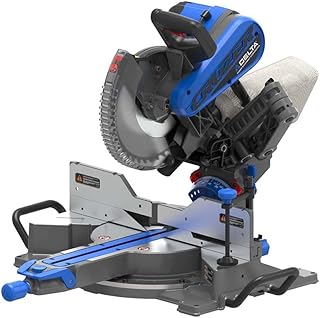
Delta 26-2310 10-Inch Dual Bevel Sliding
A 16 inch crosscut from a 10 inch blade is remarkable reach, and the lighter head assembly means less arm load per cut than a comparable 12 inch machine. This is the sensible pick for case goods and face frames where you rarely need deep vertical capacity.
DOVAMAN 12-Inch Dual-Bevel Compound Sliding
The ambidextrous control layout is the standout here, letting left-handed users and awkward-angle cuts happen without contorting, and nine positive stops cover standard furniture geometry. Fit and finish sit below the pro tier, so plan on tuning the fence square before your first real project.
DOVAMAN 10-Inch Dual Bevel Sliding, 2-Speed
Two-speed control at 5000 and 3200 RPM plus three TCT blades makes this the most versatile option for mixed material work, and the LED shadow line beats a laser for repeatable cut placement. A 3.5 by 13.4 inch capacity handles most furniture stock while keeping the saw light enough to relocate solo.
Frequently Asked Questions
Is dual bevel worth it for furniture work?
Yes, mainly for your body. Single bevel saws require flipping the workpiece to cut opposing angles, which means repeated lifting and re-registering of long boards. Dual bevel keeps the stock planted and moves the head instead.
What bench height should I mount it at?
Set the saw table at roughly 34 to 36 inches, so your forearm stays near horizontal during the slide stroke. Too low forces a stooped back over long sessions, and too high pushes your shoulder into abduction.
Do laser guides stay accurate?
Lasers need periodic recalibration and shift if the housing takes a knock. Shadow-line LED systems avoid the problem by casting the blade’s own silhouette. If you do buy a laser model, such as the 12 inch 15 amp saw bundled with an 80T blade and extension table, verify alignment against a test cut before trusting it.
How often should the blade be replaced?
Judge by cut quality, not hours. Rising feed pressure, burn marks, and fuzzy end grain mean the carbide is dull. Higher tooth counts around 80T give cleaner crosscuts in hardwood but load the motor harder.
Final Thoughts
For the best long-term combination of comfort and build quality, the Makita LS1219L is the one to buy, with the DEWALT DWS780 close behind if you value proven ruggedness and the shadow light over front-panel convenience. On a tighter budget, the DOVAMAN 10-Inch dual bevel delivers genuinely useful two-speed versatility without asking you to compromise on capacity.