Key takeaways
- Tooth count vs. your actual work: 80 to 100 teeth gives glass-smooth crosscuts in hardwood, plywood, and veneer, which is what furniture building demands. Drop to 40 or 60 teeth for framing lumber and deck boards, where high tooth counts clog and overheat.
- Plate stability and vibration: Look for laser-cut expansion slots and a rigid, tensioned plate. These features let the steel absorb heat without warping, and a blade that runs true transmits noticeably less buzz into the handle and the workpiece.
- Carbide grade over tooth count: Fine-grain, high-density carbide holds a keen edge through more linear feet than budget tips, which chip and round over quickly. A 100-tooth blade with soft carbide will outperform nothing after a few hundred cuts.
- Kerf width and feed pressure: A thin kerf removes less material and demands less from the motor, meaning a lighter, more controlled pull through the cut. Just verify your saw’s riving knife and fence setup suit the kerf you choose.
- Arbor fit and coatings: Confirm the 1-inch arbor matches your saw, and favor blades with anti-friction or non-stick coatings. Less pitch buildup means less drag, cooler running, and fewer stalls that force you to muscle the head down.
What's inside
Anyone who has spent an afternoon crosscutting hardwood knows the tell: the motor starts to groan, the workpiece chatters, and your shoulder begins doing work the blade should be doing. A dull or poorly balanced 12-inch blade shifts the burden onto your body. You push harder, hold the piece tighter, and absorb the vibration through your wrists and elbows. The cut quality drops at the same time, leaving burn marks and fuzzy edges that eat into your sanding time. Most people blame the saw. Usually it’s the steel.
This guide looks at 12-inch miter saw blades through two lenses that rarely get enough attention: how the blade feels in use over a long session, and how long it holds its edge before you’re paying for a resharpen or a replacement. We weighed tooth geometry, plate thickness, expansion slots, carbide grade, and the practical difference between a fine-finish blade and a general-purpose one for furniture work. Below are the blades we’d put on a saw that has to cut clean joinery on a Tuesday and rip through construction lumber on a Saturday.
As an Amazon Associate we earn from qualifying purchases.


How to Choose a 12-Inch Miter Saw Blades (2026)
- Tooth count vs. your actual work: 80 to 100 teeth gives glass-smooth crosscuts in hardwood, plywood, and veneer, which is what furniture building demands. Drop to 40 or 60 teeth for framing lumber and deck boards, where high tooth counts clog and overheat.
- Plate stability and vibration: Look for laser-cut expansion slots and a rigid, tensioned plate. These features let the steel absorb heat without warping, and a blade that runs true transmits noticeably less buzz into the handle and the workpiece.
- Carbide grade over tooth count: Fine-grain, high-density carbide holds a keen edge through more linear feet than budget tips, which chip and round over quickly. A 100-tooth blade with soft carbide will outperform nothing after a few hundred cuts.
- Kerf width and feed pressure: A thin kerf removes less material and demands less from the motor, meaning a lighter, more controlled pull through the cut. Just verify your saw’s riving knife and fence setup suit the kerf you choose.
- Arbor fit and coatings: Confirm the 1-inch arbor matches your saw, and favor blades with anti-friction or non-stick coatings. Less pitch buildup means less drag, cooler running, and fewer stalls that force you to muscle the head down.
The Best 12-Inch Miter Saw Blades (2026)s Reviewed
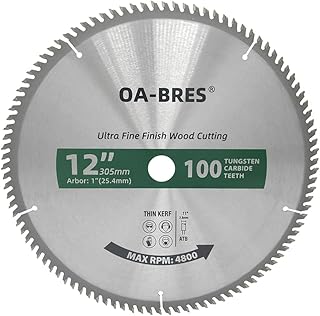
100-Tooth ATB TCT Ultra Fine Finish Blade
The alternate top bevel grind on this 100-tooth blade shears wood fibers cleanly on both sides of the kerf, which is exactly what you want on face frames and mitered case corners. It runs quietly enough that you’ll notice the difference in fatigue after a full session of repetitive cuts.
DEWALT DWA112100 100-Tooth Fine Finish
DEWALT’s tungsten carbide tips are ground sharp from the box and stay that way through a surprising volume of hardwood, and the computer-balanced plate keeps deflection minimal on wide crosscuts. It’s the blade we reach for when the cut face is going to be visible in the finished piece.
Diablo D1280X 80-Tooth Fine Finish
Diablo’s high-density carbide and Perma-Shield coating are the durability story here: the coating fights pitch and resin buildup, so the blade keeps gliding instead of grabbing as the day wears on. Eighty teeth is a smart middle ground, delivering a finish-ready edge while clearing chips well enough to avoid heat buildup.
DEWALT DWA112CMB 40T & 60T Combo Pack
Two blades means you stop compromising, swapping the 40-tooth in for lumber and the 60-tooth for trim and sheet goods rather than burning through one fine-finish blade on rough stock. For a shop that handles mixed material, this is the most sensible purchase on the list.
FOXBC 100-Tooth Polished Finish
FOXBC’s polished plate and tight tooth spacing produce a cut face that often needs little more than a scuff before finish, and the 1-inch arbor drops onto most common saws without an adapter. A solid value pick if you want near-premium surface quality without the premium price.
Frequently Asked Questions
Does a higher tooth count always mean a better cut?
Only for the right material. High tooth counts excel at crosscutting hardwood and plywood, but in thick softwood or pressure-treated lumber they can’t evacuate sawdust fast enough, which causes heat, burning, and extra strain on the motor.
How long should a quality blade last?
With clean, dry hardwood and no nails, expect several hundred to a few thousand linear feet before performance drops noticeably. Cutting through fasteners, wet stock, or engineered material with adhesives shortens that considerably.
Is it worth resharpening rather than replacing?
Yes, for blades with thick, high-quality carbide tips, which typically tolerate several sharpenings. Thin-tipped budget blades often cost more to sharpen than they’re worth.
Why does my saw vibrate even with a new blade?
Check that the arbor washer seats flat and the blade is clean and free of pitch. Persistent vibration after that usually points to worn saw bearings or a bent arbor rather than the blade.
Final Thoughts
For furniture work where the cut face shows, the DEWALT DWA112100 and the Diablo D1280X are the two we’d stake a project on, thanks to their carbide quality and low-vibration plates. If your shop mixes fine joinery with rough lumber, the DEWALT DWA112CMB combo pack is the more economical route, letting you save the fine-finish teeth for the cuts that actually deserve them.