Key takeaways
- Tooth count matched to material: 40T handles solid stock and rough sizing with less feed resistance; 60T is the sweet spot for plywood, MDF, and laminate; 80T and up belong on thin trim, hardwood face frames, and anything where the cut face becomes a visible edge. Overshooting the tooth count on thick stock just loads the motor and heats the plate.
- Kerf thickness and arm fatigue: A thin-kerf blade removes less material per pass, which means noticeably lighter pull-down pressure and less strain during repetitive cutting. On underpowered 10-inch saws it also cuts bogging, though very thin plates need a flat, rigid body to resist deflection.
- Carbide grade and edge life: Micro-grain carbide tips brazed cleanly to the shoulder hold a keen edge far longer than budget carbide, and they take resharpening without chipping. Longer edge life isn’t just economy — a sharp blade is the single biggest reduction in the force your hands have to supply.
- Plate flatness and vibration damping: Look for laser-cut expansion slots, tensioned steel bodies, and a hardened, ground plate. These features suppress the high-frequency chatter that numbs fingertips and leaves ripple marks on the cut face.
- Arbor fit and coating: Confirm a 5/8-inch (16mm) arbor for standard miter saws, and favour anti-friction or anti-stick coatings. Pitch buildup increases drag, raises cutting temperature, and shortens the interval before you’re forcing the cut again.
What's inside
Most people blame their miter saw when a crosscut comes out fuzzy, but the saw is rarely the culprit. A tired or poorly matched blade forces you to push harder, hold the workpiece longer, and drag the head through the cut instead of letting it glide. That extra effort travels straight into your wrist, elbow, and shoulder, and after an afternoon of trim work you feel it. Torn grain on oak, blown-out veneer on plywood, and burn marks on maple are all downstream symptoms of the same problem.
This guide looks at 10-inch miter saw blades through two lenses that rarely make it into spec sheets: how much physical effort a blade demands from you, and how long it holds its edge before that effort creeps back up. We cover tooth counts and grind geometry, kerf thickness, plate quality, and vibration control, then review five blades that earn their place in a home furniture shop. Whether you’re building a walnut console or breaking down cabinet-grade ply, there’s a right blade here.
As an Amazon Associate we earn from qualifying purchases.


How to Choose a 10 Inch Miter Saw Blade (2026)
- Tooth count matched to material: 40T handles solid stock and rough sizing with less feed resistance; 60T is the sweet spot for plywood, MDF, and laminate; 80T and up belong on thin trim, hardwood face frames, and anything where the cut face becomes a visible edge. Overshooting the tooth count on thick stock just loads the motor and heats the plate.
- Kerf thickness and arm fatigue: A thin-kerf blade removes less material per pass, which means noticeably lighter pull-down pressure and less strain during repetitive cutting. On underpowered 10-inch saws it also cuts bogging, though very thin plates need a flat, rigid body to resist deflection.
- Carbide grade and edge life: Micro-grain carbide tips brazed cleanly to the shoulder hold a keen edge far longer than budget carbide, and they take resharpening without chipping. Longer edge life isn’t just economy — a sharp blade is the single biggest reduction in the force your hands have to supply.
- Plate flatness and vibration damping: Look for laser-cut expansion slots, tensioned steel bodies, and a hardened, ground plate. These features suppress the high-frequency chatter that numbs fingertips and leaves ripple marks on the cut face.
- Arbor fit and coating: Confirm a 5/8-inch (16mm) arbor for standard miter saws, and favour anti-friction or anti-stick coatings. Pitch buildup increases drag, raises cutting temperature, and shortens the interval before you’re forcing the cut again.
The Best 10 Inch Miter Saw Blades (2026) Reviewed
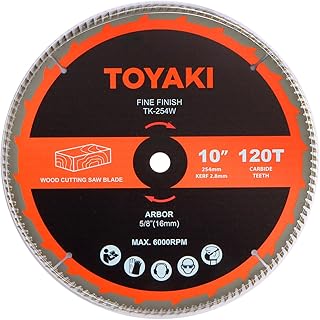
10-Inch 120-Tooth Fine-Finish Professional Blade
With 120 teeth on a 10-inch plate, this is the blade you mount when the cut face becomes the finished surface — mitred picture frames, thin hardwood edging, and delicate moulding. Feed slowly and let the tooth count do the work; rushing it generates heat rather than a better finish.
WEN BL1080 80-Tooth Carbide-Tipped Blade
A well-balanced ultra-fine-finish blade that runs impressively smooth for its price, with carbide tips that stay usable across plenty of cabinetry work. The low vibration signature is the standout here — it makes long sessions of repetitive trim cuts far kinder on your shoulder.
KENDO 10-Inch Blade Set (40T + 60T)
The most sensible starting point for a mixed home shop: the 40T ATB blade rips and crosscuts solid stock with minimal feed pressure, while the 60T handles plywood, MDF, and laminate without chipping the face. Having both means you stop compromising by leaving one blade on the saw for everything.
Benchmark Abrasives 10″ TCT 100-Tooth Non-Ferrous Blade
Purpose-built for aluminium and other non-ferrous metals, this tungsten-carbide-tipped blade uses a negative-friendly tooth profile that shears rather than grabs — critical for safety and for your grip. Ideal for furniture makers cutting aluminium extrusion for legs, rails, or hardware.
WORKPRO 10″ 80T Thin-Kerf Blade
The thin kerf and ATB grind make this the lightest-effort blade in the group for cabinetry, plywood, and trim, especially on 15-amp saws that don’t have torque to spare. Clean shoulders and minimal tear-out straight off the saw mean less sanding later.
Frequently Asked Questions
How many teeth do I actually need?
For general furniture work, 60T covers most tasks. Keep a 40T for thick solid stock and an 80T or higher for visible mitres and thin trim.
Is a thin-kerf blade worth it?
Yes, if your saw is 15 amps or less, or if you make hundreds of cuts in a session. You’ll feel the reduced resistance immediately, and material waste drops slightly too.
When should I replace versus resharpen?
Quality carbide blades can be resharpened two to four times. Replace when tips are chipped, the plate is warped, or a sharpening no longer restores clean entry.
Why does my blade burn hardwood?
Usually dull teeth, pitch buildup, or too slow a feed. Clean the blade with a dedicated resin remover before assuming it needs sharpening.
Final Thoughts
If you’re buying one blade, the KENDO 40T/60T set gives you the widest working range for the least effort at the handle. For furniture where the cut face shows, the WORKPRO 80T thin-kerf is the easiest-cutting fine-finish option, while the WEN BL1080 is the smoother-running choice if vibration control matters more than kerf width.