Key takeaways
- Base and bulb shape: Most chandeliers use E12 candelabra sockets, but the glass profile changes the look entirely. B10 and B11 give a slim torpedo silhouette, CA10 flame tip mimics a candle flicker, and both should clear your shade’s inner rim by a few millimeters so nothing rubs during seasonal expansion.
- Dimming behavior, not just “dimmable”: LED drivers and legacy triac dimmers disagree more often than manufacturers admit. Look for bulbs that specify a smooth low-end range, and if you notice flicker below 20 percent, the fix is usually a modern CL-rated dimmer rather than a different bulb.
- Color temperature and CRI together: 2700K is the standard for chandeliers because it reads as candlelight against warm metals and wood. Pair it with a CRI of 90 or higher if the fixture hangs over a dining table, where accurate rendering of skin tones and food matters.
- Thermal headroom: Enclosed or upward-facing shades trap heat, which shortens LED lifespan far more than switching cycles do. Bulbs with metal or ceramic heat-sink bases at the socket end handle those conditions better than all-plastic housings.
- Count and consistency: Buy in a pack that covers your full fixture plus spares from the same production batch. Mixing batches or brands produces visible color drift across arms, which is the single most common complaint after a partial replacement.
What's inside
Chandelier bulbs fail in a way no other bulb does: at the worst possible height. A kitchen lamp burns out and you reach up. A two-story foyer fixture burns out and you’re negotiating with a ladder, a spotter, and twelve delicate glass arms you’d rather not knock. That physical cost is why bulb selection for a chandelier is really a durability decision first and an aesthetic one second, and why the cheapest twelve-pack often turns out to be the most expensive thing in the room.
This guide evaluates candelabra bulbs the way a fixture technician would: rated service hours, dimmer compatibility under real driver loads, socket fit tolerance, heat behavior in enclosed shades, and how the filament or diffuser looks from directly below, which is the only angle that matters in a hanging fixture. Below are the E12 options worth mounting, plus the specs that predict whether you’ll be back on that ladder next season.
As an Amazon Associate we earn from qualifying purchases.



How to Choose a Bulbs For Chandelier (2026)
- Base and bulb shape: Most chandeliers use E12 candelabra sockets, but the glass profile changes the look entirely. B10 and B11 give a slim torpedo silhouette, CA10 flame tip mimics a candle flicker, and both should clear your shade’s inner rim by a few millimeters so nothing rubs during seasonal expansion.
- Dimming behavior, not just “dimmable”: LED drivers and legacy triac dimmers disagree more often than manufacturers admit. Look for bulbs that specify a smooth low-end range, and if you notice flicker below 20 percent, the fix is usually a modern CL-rated dimmer rather than a different bulb.
- Color temperature and CRI together: 2700K is the standard for chandeliers because it reads as candlelight against warm metals and wood. Pair it with a CRI of 90 or higher if the fixture hangs over a dining table, where accurate rendering of skin tones and food matters.
- Thermal headroom: Enclosed or upward-facing shades trap heat, which shortens LED lifespan far more than switching cycles do. Bulbs with metal or ceramic heat-sink bases at the socket end handle those conditions better than all-plastic housings.
- Count and consistency: Buy in a pack that covers your full fixture plus spares from the same production batch. Mixing batches or brands produces visible color drift across arms, which is the single most common complaint after a partial replacement.
The Best Bulbs For Chandelier (2026)s Reviewed
E12 Candelabra LED Flame Tip Bulbs, 4W 460LM, 12-Pack
The frosted flame-tip envelope hides the diode array well, so you get an even warm glow from below instead of the hot pinpoints that make bare filaments unpleasant in open-arm fixtures. At 460 lumens per bulb it holds up in a multi-arm chandelier, and the twelve-pack means one purchase covers most standard fixtures with a spare or two banked.
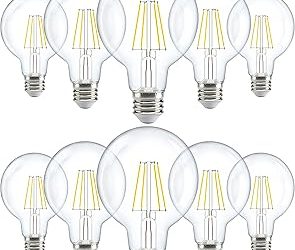
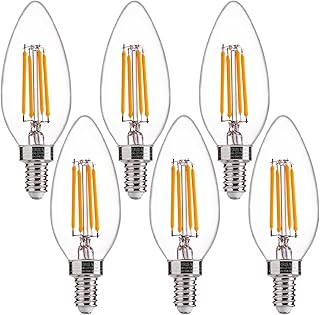
60W Equivalent Clear B11 LED Filament Candelabra, 6-Pack
Choose these when the fixture is designed to show the bulb, since the clear B11 glass and straight filament strips read as genuine period lighting rather than an LED imitation. The 60W-equivalent output is the pick for larger rooms or higher ceilings where 40W-equivalent bulbs leave the corners dim.
12-Pack Dimmable E12 LED Candelabra, 4W B11 Vintage
A sensible balance of vintage clear-glass looks and practical pack economics, with 450 lumens and a warm 2700K tone that flatters brass and antique bronze hardware. Dimming performance is stable through the mid-range, making these a reliable default for dining rooms and ceiling-fan light kits alike.
60W Candelabra Incandescent B10 Clear, 12-Pack
Sometimes the honest answer is incandescent: these deliver flawless dimming on any legacy dimmer, perfect color rendering, and 600 lumens of genuinely warm light with zero driver electronics to fail. The tradeoff is service life and energy draw, so reserve them for fixtures you can reach easily or occasions where dimming precision outranks efficiency.
E12 LED Candelabra 4W B10 Edison Filament, 5-Pack
The 470-lumen output edges slightly above most 40W-equivalent competitors, and the B10 Edison profile suits narrow sconce shades where wider CA10 tips crowd the glass. The five-pack size fits small fixtures and half-chandeliers without leaving you with unused stock aging in a drawer.
Frequently Asked Questions
Why do my LED chandelier bulbs flicker when dimmed?
Almost always a dimmer mismatch. Older incandescent-era dimmers need a minimum load that a handful of 4W LEDs can’t provide, so replacing the switch with a CL-rated LED dimmer resolves it more reliably than swapping bulbs.
Can I mix LED and incandescent bulbs in one fixture?
Electrically yes, visually no. The color temperature and brightness differences show plainly from below, and on a dimmer the two types ramp at different rates, so the fixture looks uneven at every setting except full brightness.
How long should candelabra LEDs actually last?
Rated figures often cite 15,000 to 25,000 hours, but real service life depends on heat. In an open-arm chandelier expect close to the rating; in a tightly enclosed shade, plan on noticeably less.
Does the Hizashi 90+ CRI option justify the premium?
Over a dining table, yes. The higher CRI renders food, wood grain, and skin tones more faithfully, and the flame-tip CA10 shape with UL listing makes it an easy specification for fixtures you want to look considered rather than merely lit.
Final Thoughts
For most chandeliers, the 12-pack E12 flame-tip LEDs are the practical default: enough output, enough spares, and a diffused glow that forgives an open-arm fixture. Step up to the Hizashi 90+ CRI flame tips if the chandelier hangs over a dining table where color accuracy earns its keep, and choose the 60W-equivalent clear B11 filament bulbs when the fixture is meant to show off the bulb itself in a larger or taller room.