Key takeaways
- Deployment mechanics: The best stands let you tip the whole assembly upright and let geometry do the lifting, so you never deadlift the saw. Gravity-rise and pivot-frame designs keep your hands near waist level; scissor-leg stands that require you to hoist a mounted saw shoulder-high are the ones that cause injuries.
- Wheel diameter over terrain: Anything under 6 inches stalls on door thresholds, extension cords, and gravel. Pneumatic or large solid wheels in the 8-inch range roll over obstacles instead of stopping dead and jolting your wrists, which matters more than total weight capacity for most users.
- Deck height and stance: Aim for a saw table that puts the workpiece between 34 and 38 inches off the floor, so your forearm stays roughly horizontal through the cut. Adjustable-height legs let you tune this to your torso rather than accepting a compromise average.
- Frame construction and fatigue points: Look for gusseted, welded steel at the leg pivots and tube-in-tube telescoping sections. Riveted joints and thin stamped brackets develop play within a season, and once a stand racks under load, cut accuracy goes with it.
- Support arms and mounting rails: Universal rails with quick-release brackets let you swap saws and keep resale value. Extendable outfeed arms with flip stops do real ergonomic work by holding long stock at deck height so you’re not bracing a 10-foot board with your hip.
What's inside
A miter saw is one of the few shop tools that punishes you twice: once when you carry it, and again when you use it badly supported. A 55-pound sliding compound saw balanced on sawhorses or a garage shelf forces you into a hunched stance, drops your workpiece below elbow height, and turns every crosscut into a small negotiation with your lower back. Add the reality that most of us build furniture in a space that also has to park a car, and the tool that stays set up is the tool that gets used.
This guide looks at rolling miter saw stands through two lenses I care about most after years of specifying shop equipment: ergonomics — how the stand loads your spine, shoulders, and wrists during setup and cutting — and durability, meaning which parts actually wear out after a few hundred fold-and-roll cycles. Below you’ll find current picks, followed by the selection criteria that separate a stand you keep for a decade from one you quietly leave at the curb.
As an Amazon Associate we earn from qualifying purchases.



How to Choose a Miter Saw Stand With Wheels (2026)
- Deployment mechanics: The best stands let you tip the whole assembly upright and let geometry do the lifting, so you never deadlift the saw. Gravity-rise and pivot-frame designs keep your hands near waist level; scissor-leg stands that require you to hoist a mounted saw shoulder-high are the ones that cause injuries.
- Wheel diameter over terrain: Anything under 6 inches stalls on door thresholds, extension cords, and gravel. Pneumatic or large solid wheels in the 8-inch range roll over obstacles instead of stopping dead and jolting your wrists, which matters more than total weight capacity for most users.
- Deck height and stance: Aim for a saw table that puts the workpiece between 34 and 38 inches off the floor, so your forearm stays roughly horizontal through the cut. Adjustable-height legs let you tune this to your torso rather than accepting a compromise average.
- Frame construction and fatigue points: Look for gusseted, welded steel at the leg pivots and tube-in-tube telescoping sections. Riveted joints and thin stamped brackets develop play within a season, and once a stand racks under load, cut accuracy goes with it.
- Support arms and mounting rails: Universal rails with quick-release brackets let you swap saws and keep resale value. Extendable outfeed arms with flip stops do real ergonomic work by holding long stock at deck height so you’re not bracing a 10-foot board with your hip.
The Best Miter Saw Stands With Wheels (2026) Reviewed
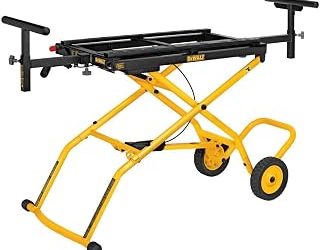
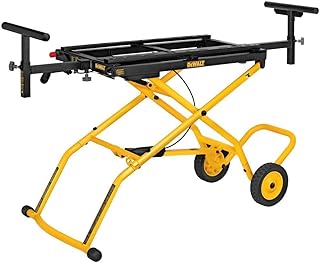
DEWALT DWX726 Rolling Miter Saw Stand
The DWX726 remains the reference point: a 60-inch steel frame with adjustable-height legs, 8 feet of material support, and universal rails that accept nearly any saw. Its pneumatic-style wheels and tilt-to-roll posture keep the load off your back during transport, and the welded leg assemblies show minimal play even after heavy seasonal use.
BORA Portacube PM-8000
The Portacube is less a stand than a rolling workstation, with a rotating top that lets you swing the saw out of the way and use the surface as an assembly bench. For furniture builders working in a single-bay garage, that dual duty is genuinely space-saving, though the cube footprint is bulkier than a folding frame.
Bosch T4B Gravity-Rise
The T4B’s gravity-rise action is still the most refined deployment on the market: one foot on the pedal, one hand on the rail, and the saw rises without a lift. Large pneumatic wheels handle rough ground, and the tubular frame resists the twisting that plagues lighter stands.
POWERTEC MT4000V
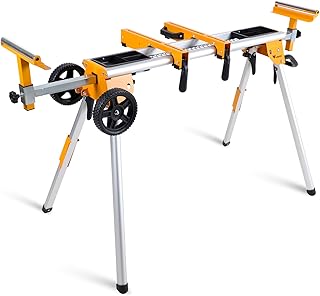
A strong value proposition with 8-inch wheels, quick-release mounting brackets, 330-pound capacity, and triple grounded outlets built into the frame. The powder coat and hardware aren’t quite premium tier, but the ergonomics of setup and the integrated power strip punch well above the price.
WEN MSA330
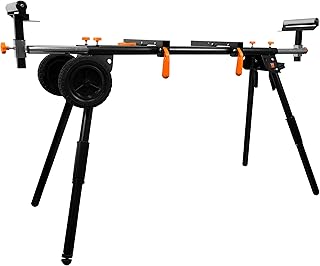
The MSA330 is the budget pick that doesn’t feel like one, with three onboard outlets and a collapsible rolling frame that stores flat against a wall. Expect to snug the pivot hardware occasionally, and keep it on smooth shop floors where its smaller wheels are less of a limitation — the similar WK-MS080 with 6.75-inch wheels is another option in this class.
Frequently Asked Questions
Do I really need wheels if my saw never leaves the garage?
Yes, if the garage does double duty. Wheels mean you roll the saw into position for a project and roll it back against the wall afterward, instead of leaving it permanently in the way or lifting it onto a bench each time.
Will a universal stand fit my miter saw?
Almost certainly. Universal mounting rails with adjustable brackets accommodate the vast majority of 10- and 12-inch compound and sliding saws. Check your saw’s base footprint and bolt-hole spread against the stand’s rail range before buying.
How much weight can these stands actually hold?
Most rate between 300 and 500 pounds, which is far beyond any saw. The practical limit is stability under off-center load — a long, heavy board cantilevered on one extension arm stresses the frame more than a centered static weight.
Can I use a rolling stand as an outfeed or assembly table?
The BORA Portacube is built for it. Folding frames can support sheet goods temporarily, but they aren’t flat enough for glue-ups, and I’d avoid clamping into them.
Final Thoughts
For most furniture makers, the DEWALT DWX726 is the balanced choice: adjustable height, long material support, and a frame that stays tight over years. Choose the Bosch T4B if effortless one-motion deployment is your priority, or the BORA Portacube PM-8000 if you need a saw stand and a rolling work surface out of the same square footage.