Key takeaways
- Tread depth over rung count: Anything you’ll stand on for more than a few minutes should have a flat, deep tread or a full platform. Round rungs concentrate pressure across a narrow band of your sole and turn a 20-minute task into sore feet and unsteady footing.
- Duty rating with headroom: Type IA (300 lbs) and Type IAA (375 lbs) ratings cover you plus tools, plus the shock load of stepping up. Sizing to your bodyweight alone leaves nothing in reserve, and repeated near-limit loading is what accelerates rivet fatigue.
- Hinge and rivet quality: On multi-position ladders, the hinge carries the whole load path. Look for hardened pins, generous bearing surfaces, and rivets you can inspect. This is the part that determines whether year eight feels solid or sloppy.
- Weight versus reach, honestly: A 22-foot multi-position ladder solves almost everything, but it’s a two-hand carry and needs real storage space. If most of your work is at 8 to 10 feet, a lighter dedicated ladder gets used far more often — and an unused ladder helps nobody.
- Fiberglass near electricity, aluminum for portability: Non-conductive fiberglass rails are the right call for anything involving fixtures, panels, or overhead wiring. Aluminum wins on weight for indoor and general household work.
What's inside
Ladder shopping tends to collapse into two numbers: maximum height and price. That’s how people end up standing on a rung that bites into the arch of the foot, gripping a rail that flexes at full extension, or wrestling forty pounds of aluminum up a stairwell for a ten-minute job. The discomfort isn’t cosmetic. Poor tread geometry shifts your weight onto the balls of your feet, which fatigues the calves, which is precisely when balance errors happen. And the parts that fail first on a ladder are rarely the rails — they’re the hinges, rivets, and feet that absorb every open-and-close cycle for a decade.
This guide looks at Little Giant’s lineup through those two lenses: how the ladder treats your body while you’re on it, and which components are engineered to outlast the warranty. I’ve focused on stance width, tread depth, hinge design, foot construction, and the honest tradeoff between reach and haulability, so you can match a model to the work you actually do rather than the tallest ceiling in your house.
As an Amazon Associate we earn from qualifying purchases.


How to Choose a Little Giant Ladder (2026)
- Tread depth over rung count: Anything you’ll stand on for more than a few minutes should have a flat, deep tread or a full platform. Round rungs concentrate pressure across a narrow band of your sole and turn a 20-minute task into sore feet and unsteady footing.
- Duty rating with headroom: Type IA (300 lbs) and Type IAA (375 lbs) ratings cover you plus tools, plus the shock load of stepping up. Sizing to your bodyweight alone leaves nothing in reserve, and repeated near-limit loading is what accelerates rivet fatigue.
- Hinge and rivet quality: On multi-position ladders, the hinge carries the whole load path. Look for hardened pins, generous bearing surfaces, and rivets you can inspect. This is the part that determines whether year eight feels solid or sloppy.
- Weight versus reach, honestly: A 22-foot multi-position ladder solves almost everything, but it’s a two-hand carry and needs real storage space. If most of your work is at 8 to 10 feet, a lighter dedicated ladder gets used far more often — and an unused ladder helps nobody.
- Fiberglass near electricity, aluminum for portability: Non-conductive fiberglass rails are the right call for anything involving fixtures, panels, or overhead wiring. Aluminum wins on weight for indoor and general household work.
The Best Little Giant Ladders (2026) Reviewed
Little Giant Jumbo Step 4-Step (11904)
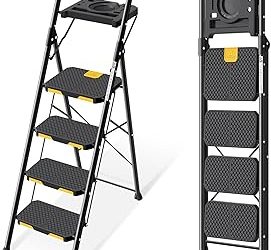
The extra-wide, stair-like treads are the standout here: your foot lands flat, your ankle stays neutral, and the rotating handrail gives you a stable third point of contact while both hands work. At a 375 lb rating with a tool tray on a stool this compact, it’s the household ladder that earns permanent residence in a closet rather than the garage.
Little Giant Conquest 2.0, 22 ft (17122-001)
This is the do-everything ladder — extension, stepladder, 90-degree, and trestle modes on non-conductive hi-viz fiberglass rails rated Type IA. The Tip & Glide wheels matter more than they sound: they let you reposition a heavy ladder without a full lift, which spares your lower back on jobs that require a dozen small moves.
Little Giant Dark Horse 2.0, M17 (16117-001)
The Dark Horse hits the sweet spot for homeowners who need genuine two-story reach without the bulk of a 22-footer, and the fiberglass build keeps it safe around electrical work. Its wide flared base gives a reassuringly planted feel at extension, where narrower ladders start to feel conversational about your safety.
Little Giant Safety Step Four Step (10410BA)
A deceptively simple design: deep aluminum steps with rubber anti-slip treads and a fold-up safety bar that lets you lean into your work instead of bracing against it. For repetitive tasks at shelf and cabinet height, that bar is the difference between finishing comfortably and finishing sore.
Little Giant MightyLite 8 ft (15408-001)
The slim profile and light fiberglass rails make this the one you’ll actually carry between rooms, while the full-size standing platform and wide anti-slip steps keep long sessions tolerable. The Ground Cue feature confirms the feet are planted before you commit weight, and the tool top cap keeps your hands free.
Frequently Asked Questions
What does Type IA actually mean for me?
Type IA certifies a 300 lb duty rating, and Type IAA raises that to 375 lbs. That figure includes you, your clothing, your tools, and anything you’re carrying — treat it as a working ceiling, not a target.
Should I choose fiberglass or aluminum?
Fiberglass is non-conductive and the correct choice near any electrical work, at the cost of extra weight. Aluminum is lighter and easier to move, which makes it better for general indoor tasks well away from wiring.
Can a multi-position ladder replace my stepladder and extension ladder?
Functionally, yes — a Conquest or Dark Horse covers both roles plus scaffold and staircase configurations. Practically, many people still keep a light step stool nearby, because nobody wants to unfold seventeen feet of ladder to change a bulb.
How do I keep the hinges lasting?
Keep the hinge and locking mechanisms clean of grit, wipe down rails after dusty or wet work, and store the ladder indoors or covered. Inspect rivets, feet, and pins annually, and retire any ladder that has taken a hard fall or shows deformed rails.
Final Thoughts
If you want one ladder that handles nearly every job, the Conquest 2.0 22 ft is the most capable pick, with the Dark Horse M17 offering nearly the same versatility in a more manageable package. For daily indoor work where comfort and convenience decide whether a ladder gets used at all, the Jumbo Step 11904 is hard to beat.