Key takeaways
- Grip circumference: Measure the barrel where your palm actually lands. Anything much over 9 inches around forces your fingers into a splayed, low-strength position, and that’s where fatigue and drift begin. Smaller hands should treat this as the first filter, not an afterthought.
- Vibration and soft-start: Buzz that reaches your palm becomes numbness in an afternoon. Variable speed plus a soft-start circuit tames the initial lurch that yanks a router off the line, and lower RPM on large-diameter bits cuts both chatter and burn marks.
- Base flatness and clamping: A stamped base that flexes will telegraph every wobble into the cut. Look for a thick, machined subbase, a wide bearing footprint around the bit, and a clamp mechanism that locks without creeping under load.
- Depth adjustment you can feel: Micro-adjust rings with clear detents let you dial a profile without unclamping and guessing. Beginners set depth constantly, so a stiff or vague adjuster is a daily tax on your patience.
- What wears out first: On brushed motors it’s the brushes and the collet. Check that brushes are user-replaceable and that the collet nut takes a proper wrench rather than a stamped shim. Brushless motors sidestep the brush issue entirely and run cooler in long grooving passes.
What's inside
Nothing exposes a beginner’s grip technique faster than a palm router spinning at 30,000 RPM. The tool wants to walk in the direction the bit is cutting, your forearm tenses to fight it, and twenty minutes later your hand is cramping while the edge profile wanders off the line. Most first-time buyers troubleshoot this as a skill problem. Often it isn’t. It’s a body-to-tool mismatch: a housing too fat for the hand holding it, a base that rocks on the workpiece, or a switch you have to break grip to reach.
I evaluate tools the way a physical therapist reads a workstation, then I look at what fails after the honeymoon period. Below are six compact routers worth a beginner’s money in 2026, assessed on grip geometry, vibration transfer through the housing, base flatness and glide, depth-adjustment feel, and which components tend to give out first. Cord and cordless options are both here, since the right answer depends as much on your bench setup as your budget.
As an Amazon Associate we earn from qualifying purchases.


How to Choose a Wood Router For Beginners (2026)
- Grip circumference: Measure the barrel where your palm actually lands. Anything much over 9 inches around forces your fingers into a splayed, low-strength position, and that’s where fatigue and drift begin. Smaller hands should treat this as the first filter, not an afterthought.
- Vibration and soft-start: Buzz that reaches your palm becomes numbness in an afternoon. Variable speed plus a soft-start circuit tames the initial lurch that yanks a router off the line, and lower RPM on large-diameter bits cuts both chatter and burn marks.
- Base flatness and clamping: A stamped base that flexes will telegraph every wobble into the cut. Look for a thick, machined subbase, a wide bearing footprint around the bit, and a clamp mechanism that locks without creeping under load.
- Depth adjustment you can feel: Micro-adjust rings with clear detents let you dial a profile without unclamping and guessing. Beginners set depth constantly, so a stiff or vague adjuster is a daily tax on your patience.
- What wears out first: On brushed motors it’s the brushes and the collet. Check that brushes are user-replaceable and that the collet nut takes a proper wrench rather than a stamped shim. Brushless motors sidestep the brush issue entirely and run cooler in long grooving passes.
The Best Wood Routers For Beginners (2026) Reviewed
TEENO 6.5 Amp Compact Router Kit
The strongest all-round pick for someone learning technique: six speed settings, a slim barrel that suits medium and smaller hands, and an edge guide plus roller guide included so you’re not freehanding your first profiles. The carrying case matters more than it sounds, since a collet full of sawdust is the fastest route to bit runout and premature bearing wear.
WORKPRO 6.5 Amp Compact Router Kit
Well-balanced weight distribution keeps the center of mass low over the base, which noticeably reduces the tipping tendency that plagues beginners on narrow edges. Speeds run up to 30,000 RPM, and the housing damps vibration better than its price bracket suggests.
TwoWin 800W Compact Wood Router
A sensible budget entry with a 15-piece carbide bit set, best suited to short sessions and light hardwood edging rather than sustained production work. The single-speed simplicity removes a decision point for absolute beginners, though you’ll want to keep passes shallow to avoid heat-soaking the motor.
Cordless Brushless Router (Dewalt 20V/60V Compatible)
If you already own DeWalt batteries, this is the ergonomic upgrade you notice immediately: no cord tugging the tool off its line mid-pass, which eliminates one of the biggest causes of gouged edges. The brushless motor and five speeds handle grooving cleanly, and it’s sold tool-only, so factor a battery in if you don’t have one.
21V Brushless Cordless Palm Router Kit
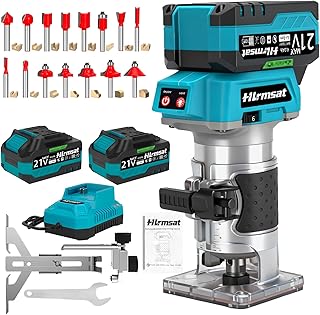
Two 4.0Ah batteries make this a genuinely complete cordless starter package, with six speeds and a 15-piece bit set for edge profiling, grooving, and dovetail work. Battery weight sits behind the grip, so keep your supporting hand on the base rather than the body to maintain control.
Frequently Asked Questions
Is a palm router enough, or do I need a full-size plunge router?
For edge profiles, roundovers, chamfers, dados, and hinge mortises, a compact router covers nearly everything a furniture beginner does. Full-size plunge routers earn their keep with large-diameter bits and deep mortising, which are not first-year tasks.
Corded or cordless for a beginner?
Corded gives you unlimited runtime and consistent power for the price. Cordless removes cord drag, which genuinely improves cut quality on curved edges, but only makes financial sense if you’re already in a battery ecosystem.
Are the included bit sets any good?
Bundled carbide bits are fine for learning cuts in pine and plywood, and losing one to a mistake costs you nothing emotionally. Once your technique settles, buy quality individual bits in the two or three profiles you actually use.
How do I stop hand fatigue during longer sessions?
Grip lightly, guide with the base rather than the body, take multiple shallow passes instead of one deep cut, and break every 20 minutes. Anti-vibration gloves help, though a properly sized housing helps more.
Final Thoughts
For most beginners the TEENO kit is the best balance of comfortable grip geometry, speed control, and included guides, with the WORKPRO close behind on stability and vibration damping. If you’re already invested in DeWalt batteries, the cordless brushless option is the one that will keep your lines clean while your technique catches up.