Key takeaways
- Grip geometry: Look for a handle that lets your wrist stay close to neutral while your forearm pushes in line with the feed direction. Dual-handle designs let you split downforce and forward force between two grips instead of white-knuckling one, which is what actually reduces fatigue on long rips.
- Heel depth and hold-down: A shallow notch only pushes. A deeper heel with real surface behind the workpiece lets you apply downward pressure at the same time, keeping thin stock flat against the table where it belongs.
- Friction face material: EVA foam and textured elastomer pads grip better than bare plastic, especially on melamine and sealed hardwood. They also compress slightly, which dampens the buzz that travels into your palm.
- Body stiffness versus sacrificial wear: You want a body that doesn’t flex under feed pressure but is soft enough that a blade contact chews harmlessly rather than grabbing. Hardwood and glass-filled polymer both work; brittle unfilled plastic does not.
- Coverage and quantity: If you run more than one machine, buy in pairs or sets. Having a dedicated stick at each station removes the temptation to freehand a cut because the good stick is across the shop.
What's inside
The uncomfortable truth about ripping stock is that the hand doing the work and the hand you’re trying to protect are the same hand. A push stick moves your fingers away from the blade, but a poorly shaped one trades one risk for another: a pinched three-finger grip that fatigues in ten minutes, a flexing body that lets the workpiece lift mid-cut, or a heel that shears off under a knot and sends your hand forward with nothing behind it. Cheap injection-molded sticks tend to fail in exactly this way, and they usually fail on the cut where you needed them most.
This guide looks at push sticks through two lenses that matter more than price: how the tool loads your hand and wrist across a long session, and how the contact surfaces hold up after a few hundred passes. I’ve weighted grip geometry, heel depth, body rigidity, and the wear behavior of the friction face, then flagged which options make sense for a benchtop saw versus a shop that runs a saw, jointer, and router table side by side.
As an Amazon Associate we earn from qualifying purchases.


How to Choose a Push Stick For Table Saw (2026)
- Grip geometry: Look for a handle that lets your wrist stay close to neutral while your forearm pushes in line with the feed direction. Dual-handle designs let you split downforce and forward force between two grips instead of white-knuckling one, which is what actually reduces fatigue on long rips.
- Heel depth and hold-down: A shallow notch only pushes. A deeper heel with real surface behind the workpiece lets you apply downward pressure at the same time, keeping thin stock flat against the table where it belongs.
- Friction face material: EVA foam and textured elastomer pads grip better than bare plastic, especially on melamine and sealed hardwood. They also compress slightly, which dampens the buzz that travels into your palm.
- Body stiffness versus sacrificial wear: You want a body that doesn’t flex under feed pressure but is soft enough that a blade contact chews harmlessly rather than grabbing. Hardwood and glass-filled polymer both work; brittle unfilled plastic does not.
- Coverage and quantity: If you run more than one machine, buy in pairs or sets. Having a dedicated stick at each station removes the temptation to freehand a cut because the good stick is across the shop.
The Best Push Stick For Table Saw (2026)s Reviewed
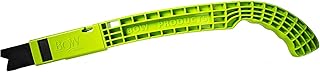
BOW Products PushPRO PP1
The EVA-tipped nose is the standout here: it bites into finished and slick material without leaving marks, and it noticeably takes the edge off the vibration that transfers up your arm during longer rips. Body stiffness is good enough for confident downforce on narrow stock, and the tip is the part that wears, which is exactly the right place for wear to happen.
POWERTEC Deluxe Push Stick, 2-Pack (71338)
Two handles change the ergonomics completely, letting you drive forward with one hand position and press down with the other rather than twisting your wrist to do both. The two-pack pricing means you can stage one at the saw and one at the jointer, and the max-grip texturing holds up better than smooth-shell competitors after repeated blade brushes.
Table Saw Push Stick, 16.5 x 2.8 in. Red Hardwood
At 16.5 inches this gives you meaningful reach across a wider table, and the thin 0.4-inch hardwood profile slips into narrow gaps between the fence and blade where thicker blocks won’t fit. It’s the simplest tool in the group and the easiest to reshape or replace when the heel gets ragged.
POWERTEC Deluxe Push Stick, 2-Pack (71511)
A close sibling to the 71338 with a slightly different handle layout that suits smaller hands and shallower grip spans. Same sensible logic applies: buying two means every machine in the shop has one within arm’s reach.
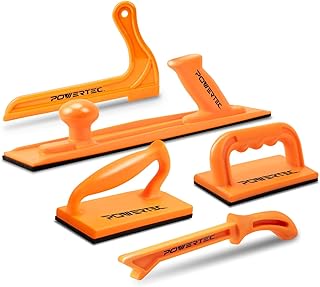
POWERTEC Push Block and Push Stick Set, 5-Pack (71009V)
This is the most complete answer for a mixed shop, pairing wide-footprint push blocks for jointer and router work with sticks for ripping at the saw. Spreading pressure across a broad block face is measurably kinder to your palm than concentrating it on a narrow handle, and having five pieces means a damaged one gets retired instead of reused.
Frequently Asked Questions
What’s the difference between a push stick and a push block?
A stick is narrow and long, built for feeding stock past the blade in tight quarters. A block has a wide gripping face for pressing material down and forward across a jointer, router table, or wide panel cut.
Can I just make one from scrap plywood?
You can, and a shop-made stick is better than none. Commercial versions earn their keep through molded grip texture, deeper heels, and handle angles that keep your wrist neutral over dozens of cuts.
Does a push stick stop kickback?
No. Kickback is prevented by a properly aligned fence, a riving knife or splitter, and sharp blades. A push stick keeps your hand out of the blade’s path when something does go wrong.
When should I replace one?
Retire it when the heel is worn shallow, the body has developed flex or a crack, or the friction pad has glazed over and stopped gripping. These are consumables, not lifetime tools.
Final Thoughts
For a single-saw shop, the BOW PushPRO PP1 offers the best combination of grip and vibration damping in one tool. If you’re outfitting multiple stations, the POWERTEC 71338 two-pack covers the ergonomic essentials affordably, while the POWERTEC 5-piece 71009V set is the most thorough option for anyone running a saw, jointer, and router table.