Key takeaways
- Held weight versus placed weight: Anything above roughly 1.2 lb becomes uncomfortable in a single hand within ten minutes. If a light is heavy because it carries a 13000mAh cell, make sure it also carries a hook, a magnet, or a stand so your arm is never the mount.
- Hinge and detent quality: A pivoting head should click into discrete positions rather than sweep freely. Friction-only pivots loosen predictably as the nylon washer polishes itself, and a light that will not hold 45 degrees is a light you now have to hold.
- Housing material and heat path: Aluminum bodies double as heatsinks, which keeps output honest during long runs and prevents the lumen sag common in sealed plastic shells. The tradeoff is cold-weather grip, so look for a knurled or overmolded band.
- Ingress protection with a real gasket: IP65 handles hose spray and sawdust; IP66 tolerates pressurized washdown. Both depend on a captive port cover, so inspect whether the flap is tethered or the kind that disappears in week three.
- Magnet mounting and pull rating: Rear magnets should be recessed and rubber-shrouded. Bare neodymium chips against sheet metal, marks paint, and eventually snaps at the adhesive joint under shear load.
What's inside
Anyone who has held a work light overhead for twenty minutes knows the spec sheet lies. Lumens get printed on the box in huge numbers; wrist strain, hinge slop, and cracked lens housings do not. The failure pattern I see most often in shop and jobsite lights is mechanical, not electrical: a pivot that no longer holds angle, a magnet that has shed its rubber boot, a USB port that has swallowed enough aluminum dust to stop charging. The LEDs almost always outlive the body they are bolted into.
This guide evaluates rechargeable work lights the way a furniture buyer evaluates a chair: how it distributes load, how the joints wear, and whether the materials tolerate a decade of ordinary abuse. Below you will find six current options ranging from a bare-tool professional flashlight to a 120W solar-assisted flood, followed by selection criteria focused on hold comfort and structural longevity, individual assessments, and answers to the questions that actually determine whether a light survives its second year.
As an Amazon Associate we earn from qualifying purchases.



How to Choose a Led Work Light Rechargeable (2026)
- Held weight versus placed weight: Anything above roughly 1.2 lb becomes uncomfortable in a single hand within ten minutes. If a light is heavy because it carries a 13000mAh cell, make sure it also carries a hook, a magnet, or a stand so your arm is never the mount.
- Hinge and detent quality: A pivoting head should click into discrete positions rather than sweep freely. Friction-only pivots loosen predictably as the nylon washer polishes itself, and a light that will not hold 45 degrees is a light you now have to hold.
- Housing material and heat path: Aluminum bodies double as heatsinks, which keeps output honest during long runs and prevents the lumen sag common in sealed plastic shells. The tradeoff is cold-weather grip, so look for a knurled or overmolded band.
- Ingress protection with a real gasket: IP65 handles hose spray and sawdust; IP66 tolerates pressurized washdown. Both depend on a captive port cover, so inspect whether the flap is tethered or the kind that disappears in week three.
- Magnet mounting and pull rating: Rear magnets should be recessed and rubber-shrouded. Bare neodymium chips against sheet metal, marks paint, and eventually snaps at the adhesive joint under shear load.
The Best Led Work Light Rechargeable (2026)s Reviewed
DEWALT 20V MAX Pivoting Work Light (DCL050)
The most durable option here by a wide margin, largely because it offloads the battery to your existing 20V MAX platform and puts a genuinely stiff detented pivot on a compact head. It is bare tool only, so factor in a pack, and note that the ergonomics shift with battery size: a 2Ah compact keeps it balanced, while a 5Ah turns the grip into an afterthought.
120W Solar Rechargeable Flood Light with Stand
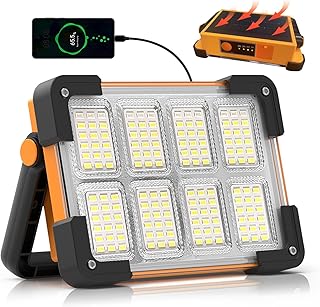
This is the deployment light rather than the handheld, and the integrated stand is what makes it worth carrying. Across 144 emitters the 10000LM claim spreads into usable wide-area coverage without hot spotting, and the IP66 rating plus solar top-up makes it the sensible pick for storm outages and driveway work.
Portable Rechargeable Magnetic Work Light, 13000mAh
The 13000mAh cell is the story: it will run a full shift at mid output and double as a power bank, which is why it earns its bulk. Because that weight makes sustained one-handed use tiring, plan on using the magnet or hook for anything longer than a quick inspection.
innofox 40W Magnetic Work Light, 1500 Lumens
A well-judged balance of output and mass, with a hanging hook that makes it genuinely useful under a hood or inside a cabinet carcass. The 1500 lumen ceiling is modest next to the flood lights, but the beam is smooth and the two-pack makes cross-lighting practical, which matters more than raw brightness when you are trying to see grain direction or a seam.
2Pack Aluminum Magnetic Work Light with Digital Display
All-aluminum construction and 360-degree rotation put this closest to the tool-shaped ideal: heat sheds properly, the body tolerates drops onto concrete, and the digital charge readout removes the guesswork that plagues three-LED indicators. Seven modes is more than most people need, though the low setting is genuinely low, which is useful for close detail work.
Frequently Asked Questions
How long do these batteries realistically last?
Expect 300 to 500 full cycles before noticeable capacity loss on integrated lithium-ion packs. Storing a light fully drained for months is what kills cells early, so top it to roughly half charge before it goes into a drawer for the season.
Is 10000 lumens overkill for garage or workshop use?
For a two-car garage, yes at full output. High modes exist for outdoor and emergency work; indoors you will typically run mid or low, which also triples runtime and keeps the housing cool enough to handle.
Do magnetic mounts damage finished surfaces?
Unshrouded magnets will scratch paint and clearcoat. Keep a microfiber square in the case and set the light on it when working against anything finished, including furniture you are refinishing.
Can these be left on the charger permanently?
Most modern units include charge termination circuitry, so it is safe, but continuous float charging accelerates calendar aging. Unplugging once the indicator completes gives you meaningfully more usable life.
Final Thoughts
For long-term durability and the best pivot mechanism in the group, the DEWALT DCL050 remains the reference point if you already own 20V MAX batteries. If you want one light that covers area work and outages, the 120W solar flood with stand is the practical answer, and the all-aluminum 2-pack with digital display is the one I would keep in a mechanic’s cart for its heat handling and honest charge reporting.