Key takeaways
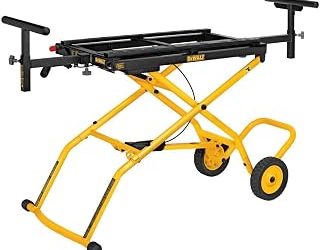
- Stand height and deployment: A rolling stand that clicks up to roughly 34 inches lets you feed stock with your elbows bent and your back neutral. Scissor-leg stands often land closer to 30 inches, which means you lean over every cut. Also check whether the saw deploys standing up or requires you to crouch and lift the whole assembly off the floor.
- Fence mechanism, not fence numbers: Rack-and-pinion fences stay square through thousands of adjustments because both ends move together. Single-point clamp fences rely on the operator to seat them correctly and tend to develop play at the rear guide as the extrusion wears. This is the single biggest predictor of long-term cut accuracy.
- Real lift weight versus rolling weight: A 110-pound saw on good pneumatic-style wheels is easier to move than a 70-pound saw you have to carry up three steps. Decide whether yours will roll on concrete or get hoisted into a truck bed, then weigh accordingly.
- Vibration and table rigidity: Cast or heavily ribbed aluminum tables damp arbor vibration; thin stamped tops transmit it into your hands and telegraph into the cut edge. Run your palm on the table with the saw idling in the store if you can.
- Serviceable wear points: Look for an accessible arbor, a replaceable throat plate, and a blade guard with anti-kickback pawls that come off and back on in seconds. Guards that require tools get left in the drawer, and that’s a safety problem, not a convenience one.
What's inside
Most DIY table saw regret has nothing to do with horsepower. It shows up in the shoulders after an afternoon of ripping sheet goods on a stand that sits two inches too low, in the wrist that absorbs every bit of arbor vibration through a flexing tabletop, or in the fence that drifted 1/32″ out of parallel somewhere around month four and quietly ruined every cabinet face frame since. Buyers shop by amps and rip capacity because those numbers are easy to compare. The things that actually determine whether you still like the saw in year three are harder to read off a spec sheet.
This guide looks at the current crop of DIY-friendly table saws through two lenses: how the machine treats your body during a long build, and how its moving parts hold up to repeated setup, teardown, and garage storage. Below you’ll find the models worth shortlisting, followed by the specific things to check before you commit — fence mechanism design, stand deployment geometry, lift weight, and the wear points that decide a saw’s real lifespan.
As an Amazon Associate we earn from qualifying purchases.



How to Choose a Table Saw for DIYers (2026)
- Stand height and deployment: A rolling stand that clicks up to roughly 34 inches lets you feed stock with your elbows bent and your back neutral. Scissor-leg stands often land closer to 30 inches, which means you lean over every cut. Also check whether the saw deploys standing up or requires you to crouch and lift the whole assembly off the floor.
- Fence mechanism, not fence numbers: Rack-and-pinion fences stay square through thousands of adjustments because both ends move together. Single-point clamp fences rely on the operator to seat them correctly and tend to develop play at the rear guide as the extrusion wears. This is the single biggest predictor of long-term cut accuracy.
- Real lift weight versus rolling weight: A 110-pound saw on good pneumatic-style wheels is easier to move than a 70-pound saw you have to carry up three steps. Decide whether yours will roll on concrete or get hoisted into a truck bed, then weigh accordingly.
- Vibration and table rigidity: Cast or heavily ribbed aluminum tables damp arbor vibration; thin stamped tops transmit it into your hands and telegraph into the cut edge. Run your palm on the table with the saw idling in the store if you can.
- Serviceable wear points: Look for an accessible arbor, a replaceable throat plate, and a blade guard with anti-kickback pawls that come off and back on in seconds. Guards that require tools get left in the drawer, and that’s a safety problem, not a convenience one.
The Best Table Saws for DIYers (2026), Reviewed
DEWALT DWE7491RS 10-Inch with Rolling Stand
The rack-and-pinion fence and the tall rolling stand make this the reference point for ergonomics in the portable class — the working height is genuinely comfortable and the 32-1/2-inch rip capacity handles sheet goods without an outfeed shuffle. It’s heavy, but the wheels do the work, and the fence geometry is the reason these saws stay accurate long after lighter models start drifting.
SKIL TS6307-00 15 Amp 10-Inch Jobsite Saw
SKIL’s rack-and-pinion fence and integrated dust port punch well above the price, and the folding stand deploys in one motion without an awkward floor lift. The tabletop flexes slightly more than the DEWALT under heavy stock, so support long rips and it will serve a home shop for years.
DEWALT DWE7485 8-1/4-Inch Compact
At around 54 pounds this is the pick for anyone storing a saw on a shelf or working out of a shared garage, and it keeps the same fence quality in a smaller footprint. The tradeoffs are a shorter maximum depth of cut and no stand in the box, so budget for a bench or a separate rolling base at proper height.
SKIL SPT99-11 Worm Drive 10-Inch
The worm-drive gearing delivers noticeably steadier torque through thick hardwood and wet framing lumber, with less bog and less vibration at the handle than belt-driven rivals. It’s the heaviest option here and the most shop-oriented, best suited to a DIYer whose saw lives in one place and cuts real material.
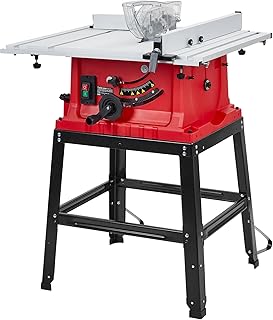
10-Inch 15 Amp Table Saw with Stand and Protective Cover
A generous 36 x 25-inch tabletop and 5000 RPM motor give you a lot of surface and speed for the money, plus a cover that keeps garage dust out of the trunnions. Expect to spend an hour checking blade-to-fence parallel and squaring the miter slot before your first real project, and re-verify periodically.
Frequently Asked Questions
Is 8-1/4 inches enough blade for DIY work?
For 3/4-inch plywood, 1x material, and most furniture stock, yes. You’ll feel the limit crosscutting 4x4s or resawing, where the reduced depth of cut forces two-pass work.
How do I know if the fence is still accurate?
Lock the fence, measure from the front of the miter slot to the fence face, then from the rear. Any difference beyond about 0.005″ means it’s time to adjust — do this quarterly, or after any transport that involved a drop.
Do I need a dust collector?
A shop vacuum on the dust port captures most below-table waste and dramatically reduces the fine airborne dust that matters most for your lungs. It also keeps grit out of the height and bevel mechanisms, which extends their life.
What’s the most common early failure?
Fence and stand hardware, not motors. Loose fence rail bolts and stressed stand pivots account for most complaints in the first two years, so torque-check the fasteners after your first few projects.
Final Thoughts
For most home woodworkers, the DEWALT DWE7491RS remains the best balance of comfortable working height, fence durability, and rip capacity — it’s the saw you stop thinking about. The SKIL TS6307-00 delivers most of that experience for meaningfully less, and the compact DEWALT DWE7485 is the right answer if storage space and lift weight are your real constraints.