Key takeaways
- Working height and stance: A table surface near 34–36 inches lets you push with your hips and shoulders instead of hinging your spine. Benchtop saws only reach that height on a proper stand or a purpose-built bench, so budget for the support, not just the saw.
- Fence rigidity over fence markings: Press sideways at the far end of the fence with your thumb. If the tip moves visibly, your rip cuts will taper. Rack-and-pinion designs and heavy extruded fences hold position far better than single-point locking bars, which is what keeps furniture joints tight.
- Trunnion and tabletop mass: Cast or heavily ribbed tables plus well-supported trunnions absorb vibration instead of transmitting it to your grip and your cut edge. Mass is the honest durability signal on this category of tool.
- Mobility that doesn’t cost you setup time: Rolling stands with a single-lever fold beat carrying a 60-pound saw across a garage. If the saw lives under a bench between projects, wheels and a fast deploy sequence are worth more than a couple of inches of rip capacity.
- Dust, noise, and guarding: Look for a functional riving knife, anti-kickback pawls, a switch reachable without leaning over the blade, and a dust port that actually mates to a 2-1/2 inch hose. Hearing protection and extraction are not accessories; they are the reason you’ll still enjoy this hobby in a decade.
What's inside
Most hobbyist table saw regret has nothing to do with horsepower. It shows up three months in, as a sore lower back from a saw perched too low on a plastic sawhorse, a fence that drifts a few thousandths every time you clamp it, and a switch you have to reach across the blade path to hit. Buyers compare amps and RPM because those numbers are easy to compare, then discover that the parts touching their hands and spine every session were the ones that mattered.
This guide evaluates hobbyist table saws the way a shop that runs them for years does: by working height and stance, fence and trunnion rigidity, how the machine holds calibration after being carried and set down, and how much dust, noise, and vibration it puts into your body per hour of use. Below you’ll find a selection framework, then focused reviews of the strongest options for furniture-scale work and small-parts precision work, plus answers to the questions that come up most often.
As an Amazon Associate we earn from qualifying purchases.




How to Choose a Hobbyist Table Saw (2026)
- Working height and stance: A table surface near 34–36 inches lets you push with your hips and shoulders instead of hinging your spine. Benchtop saws only reach that height on a proper stand or a purpose-built bench, so budget for the support, not just the saw.
- Fence rigidity over fence markings: Press sideways at the far end of the fence with your thumb. If the tip moves visibly, your rip cuts will taper. Rack-and-pinion designs and heavy extruded fences hold position far better than single-point locking bars, which is what keeps furniture joints tight.
- Trunnion and tabletop mass: Cast or heavily ribbed tables plus well-supported trunnions absorb vibration instead of transmitting it to your grip and your cut edge. Mass is the honest durability signal on this category of tool.
- Mobility that doesn’t cost you setup time: Rolling stands with a single-lever fold beat carrying a 60-pound saw across a garage. If the saw lives under a bench between projects, wheels and a fast deploy sequence are worth more than a couple of inches of rip capacity.
- Dust, noise, and guarding: Look for a functional riving knife, anti-kickback pawls, a switch reachable without leaning over the blade, and a dust port that actually mates to a 2-1/2 inch hose. Hearing protection and extraction are not accessories; they are the reason you’ll still enjoy this hobby in a decade.
The Best Hobbyist Table Saws (2026) Reviewed
DEWALT DWE7491RS 10-Inch with Rolling Stand
The rack-and-pinion fence tracks smoothly and stays square under hand pressure, and the 32-1/2 inch rip capacity handles sheet-good breakdown for casework without an outfeed circus. Its real ergonomic advantage is the foldable rolling stand: it lifts the table to a comfortable standing height and deploys in seconds, which removes the excuse that keeps a saw boxed up.
SKIL TS6307-00 10-Inch with Folding Stand
A solid value pick where the money went into the right places, including a rugged fence, a usable riving knife system, and an integrated folding stand that puts the table at working height out of the box. Expect slightly more vibration than the DEWALT under heavy rips, but it holds calibration well for a saw in this bracket.
DEWALT DWE7485 8-1/4 in. Compact Jobsite Saw
The best choice for small shops and apartment woodworkers, at roughly 54 pounds with a footprint you can shelve. The tradeoffs are honest: less cut depth for thick stock and a table that needs a bench or aftermarket stand to reach a spine-friendly height.
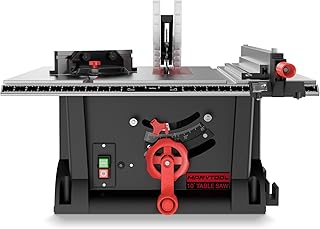
15 Amp Portable 10-Inch Benchtop Saw
A capable entry point for DIY furniture making, with 90-degree crosscut and 0–45 degree bevel coverage and a 36-tooth blade included. Plan on swapping to a quality 40- or 50-tooth blade and clamping the base firmly to a bench, since the light chassis is where vibration and long-term wear show up first.
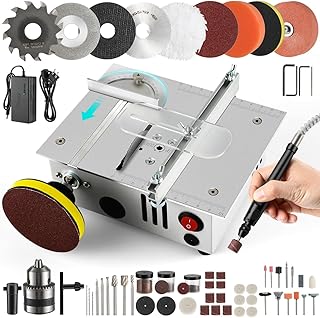
MXBAOHENG Mini Precision Table Saw
This is a modeler’s tool, not a small version of a furniture saw: 96W, seven speeds, and about 1/2 inch of adjustable depth for wood, plastic, and PCB stock, with a chuck and sanding disc included. For inlay, jewelry boxes, scale models, and small hardwood parts it delivers control a full-size saw can’t, and it sits comfortably on a seated bench setup.
Frequently Asked Questions
Is a mini table saw enough for furniture work?
No. Mini saws top out around a half-inch of depth and are built for small, delicate parts. If you’re cutting 3/4 inch hardwood or plywood for cabinets and tables, you need a 8-1/4 or 10 inch saw.
Does the stand really matter that much?
It’s the single biggest ergonomic variable. A saw at 30 inches forces you to stoop through every cut, while the same saw at 35 inches lets you drive from your legs. Stability also affects accuracy, since a wobbling base translates straight into a wavy cut line.
How do I keep my saw accurate over time?
Check blade-to-fence parallelism and the 90-degree stop every few months and after any move, keep the trunnion area and elevation screw free of packed sawdust, and wax the table to prevent rust from binding your stock. Ten minutes of maintenance protects the tolerances you paid for.
Do I need dust collection in a small home shop?
Yes. Fine wood dust is a respiratory hazard and it also fouls the mechanism that keeps your saw calibrated. A shop vacuum on the dust port plus a decent respirator covers a hobbyist setup adequately.
Final Thoughts
For most home furniture builders, the DEWALT DWE7491RS is the pick that pays back daily in comfortable working height, fence rigidity, and fast setup, with the SKIL TS6307-00 close behind at a friendlier price. Tight on space? The DEWALT DWE7485 is the compact saw worth building a bench around, and if your work is small-scale and detail-driven, add the MXBAOHENG mini precision saw rather than trying to make one machine do both jobs.