Key takeaways
- Canopy span versus table geometry: Aim for roughly two feet of overhang past the table edge on each side. A 10ft canopy suits 48–54in round tables; a 7.5ft canopy is the honest choice for bistro sets and narrow balconies, where an oversized top just becomes a sail.
- Rib count and rib material: Six ribs across a 10ft span means longer unsupported segments and more visible flutter; eight ribs distribute load better and keep the fabric taut. Powder-coated aluminum resists corrosion and stays lighter overhead, while steel tolerates more abuse at the cost of weight.
- Crank and tilt mechanics: Test the effort, not just the feature list. A smooth crank with a wide handle radius keeps opening force low on the wrist, whereas push-button tilt requires you to reach above shoulder height with one hand loaded — fine for shorter poles, tiring on large frames.
- Base load and anchoring: Center-pole umbrellas through a table want 30–50 lb of base; freestanding poles want 75 lb or more. Cantilever models are entirely different animals and need 150–220 lb of plates or ballast, since all the leverage sits off to one side.
- Fabric and fastener weathering: Look for tightly woven polyester with UV inhibitors, reinforced stitching at rib tips, and a vent at the crown to bleed pressure. Then check the hardware: stainless or coated fasteners outlast bare steel screws, which are usually the first components to seize or bleed rust onto light canopies.
What's inside
Most patio umbrellas are bought on two data points: canopy diameter and color. Neither predicts how the thing will feel in your hand in August, or whether it will still open smoothly in its third season. The parts that decide those outcomes are unglamorous — the crank gearbox, the hub casting, the rib joints, the fastener metallurgy, and the mass of whatever is holding the pole down. A canopy that looks identical in two listings can sit on a rib set with double the flex, and that flex is what eventually tears grommets and cracks hubs.
This guide looks at six popular Best Choice Products and comparable outdoor umbrellas through an ergonomics-and-durability lens: how much wrist torque each mechanism demands, where stress concentrates during a gust, how much ballast the frame actually needs, and which designs are realistic to raise and lower daily versus once a season. Center-pole market models, two-tier vented canopies, and large cantilever offset frames all behave differently, so the picks below are separated by use case rather than ranked on size alone.
As an Amazon Associate we earn from qualifying purchases.




How to Choose a Best Choice Products Patio Umbrella (2026)
- Canopy span versus table geometry: Aim for roughly two feet of overhang past the table edge on each side. A 10ft canopy suits 48–54in round tables; a 7.5ft canopy is the honest choice for bistro sets and narrow balconies, where an oversized top just becomes a sail.
- Rib count and rib material: Six ribs across a 10ft span means longer unsupported segments and more visible flutter; eight ribs distribute load better and keep the fabric taut. Powder-coated aluminum resists corrosion and stays lighter overhead, while steel tolerates more abuse at the cost of weight.
- Crank and tilt mechanics: Test the effort, not just the feature list. A smooth crank with a wide handle radius keeps opening force low on the wrist, whereas push-button tilt requires you to reach above shoulder height with one hand loaded — fine for shorter poles, tiring on large frames.
- Base load and anchoring: Center-pole umbrellas through a table want 30–50 lb of base; freestanding poles want 75 lb or more. Cantilever models are entirely different animals and need 150–220 lb of plates or ballast, since all the leverage sits off to one side.
- Fabric and fastener weathering: Look for tightly woven polyester with UV inhibitors, reinforced stitching at rib tips, and a vent at the crown to bleed pressure. Then check the hardware: stainless or coated fasteners outlast bare steel screws, which are usually the first components to seize or bleed rust onto light canopies.
Best Choice Products Patio Umbrellas Reviewed (2026)
Best Choice Products 10ft Market Umbrella, Beige
A clean, conventional market design with six ribs, crank lift, and push-button tilt — the crank keeps opening effort low, and the beige polyester hides pollen and water spotting better than dark shades. With six ribs over ten feet, expect some canopy movement in breeze, so pair it with a heavier base than the minimum and close it when you leave.
7.5ft Push-Button Tilt Patio Umbrella, Red
The most ergonomically sensible pick for small decks and porches: the shorter pole puts the tilt button within comfortable reach, and the reduced span means far less load transferred to the base. Water-shedding, UV-treated fabric holds color reasonably well, though red pigments always fade faster than neutrals in direct exposure.
11ft Cantilever Offset Umbrella with Base, Creamy White
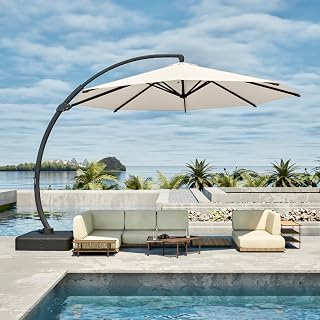
The offset aluminum frame clears the table entirely and rotates a full 360 degrees, which is the single biggest comfort upgrade for dining and lounging — no pole splitting the table, no shuffling chairs to chase shade. Budget setup time and a second pair of hands for assembly, and treat the included base as a starting point rather than a maximum.
FLAME&SHADE 9ft Two-Tier Patio Umbrella, Beige
Eight ribs and a two-tier vented canopy make this the most wind-tolerant center-pole option here; the crown gap releases pressure instead of letting it build under the fabric. The nine-foot span is a sweet spot for durability, keeping rib length short enough to limit flex while still shading a full table setting.
Best Choice Products 10ft Offset Hanging Market Umbrella, Tan
An offset hanging design with eight ribs and simple tilt adjustment, giving you cantilever-style clearance without stepping up to an eleven-foot frame. The tan polyester is forgiving in dusty conditions, and the tilt lever sits low enough to operate without overhead straining.
Frequently Asked Questions
How much base weight do I actually need?
Through a table, 30–50 lb is usually adequate because the tabletop shares the lateral load. Freestanding center poles need 75 lb minimum. Cantilever umbrellas need 150 lb and up, and manufacturers’ included bases are often at the low end of safe.
Can I leave the umbrella open overnight?
Not if you want it to last. Nearly all rib and hub failures happen during unattended gusts, and closing the canopy takes ten seconds of crank time. Rain matters less than wind, though letting water pool in a slack canopy stretches fabric over time.
How long should the canopy and frame last?
Expect three to five seasons from a UV-treated polyester canopy with regular closing and off-season storage, and longer from powder-coated aluminum framing. Fabric almost always retires before the frame does, so check that replacement canopies exist before committing.
Is a cantilever easier to live with than a center pole?
Daily comfort is better — nothing blocks the table, and rotation lets you track the sun without moving furniture. The tradeoffs are heavy ballast, longer assembly, and a larger footprint, which makes center-pole models the better fit for compact or frequently rearranged patios.
Final Thoughts
For most dining setups, the FLAME&SHADE 9ft two-tier is the durability pick, thanks to its eight-rib frame and pressure-relieving vent. If clearing the table matters more, the 11ft cantilever offset delivers the best shade ergonomics available here, while the Best Choice Products 10x10ft cantilever with solar LEDs and included base is the strongest choice for anyone who wants that same clearance plus usable light after sunset.