Key takeaways
- Drawer slide type: Ball bearing slides are the dividing line. Friction slides feel acceptable empty and turn gritty once you load 20 lb of sockets into them. Full-extension ball bearing runners also let you reach the back of a drawer without leaning over the frame, which is the single biggest posture win in any chest.
- Steel gauge and corner bracing: Thin panels aren’t automatically bad if the carcass is gusseted or double-folded at the corners. Look for reinforced drawer fronts and a welded or interlocked back panel; a chest that racks under load will misalign its slides long before the paint wears through.
- Working height and reach zone: Keep your most-used drawers between roughly hip and mid-chest. A rolling cabinet with a detachable top box gets you close to that naturally. If a chest puts your daily wrenches at ankle height, you’ll pay for it in your back regardless of build quality.
- Casters and roll path: Larger diameter wheels clear expansion joints, cords, and door thresholds that stall small casters. Two locking wheels minimum, and check that the swivel plates are riveted through the frame rather than screwed into a thin base panel.
- Locking and load discipline: A central lock protects tools; smart loading protects the chest. Heavy items belong in the bottom drawers, both for tip resistance and to keep upper slides from carrying weight they weren’t rated for.
What's inside
Most metal tool chests get chosen the same way: count the drawers, glance at the price, pick the one with the biggest number. Six months later the top box has a visible sag under a bench vise, two drawers bind halfway out, and the casters have flat-spotted into ovals that fight every crack in the concrete. The failure is rarely the steel itself. It’s the slides, the frame bracing, and the mismatch between how tall the chest sits and how the person using it actually moves.
This guide looks at metal tool chests from a wear-and-posture perspective: how drawer hardware behaves after ten thousand cycles, where the frame flexes when load isn’t centered, and what working height keeps your lumbar spine out of the equation during a long session. Below are six chests worth considering in 2026, plus the specifications that predict whether one will still open smoothly in year five.
As an Amazon Associate we earn from qualifying purchases.


How to Choose a Metal Tool Chest (2026)
- Drawer slide type: Ball bearing slides are the dividing line. Friction slides feel acceptable empty and turn gritty once you load 20 lb of sockets into them. Full-extension ball bearing runners also let you reach the back of a drawer without leaning over the frame, which is the single biggest posture win in any chest.
- Steel gauge and corner bracing: Thin panels aren’t automatically bad if the carcass is gusseted or double-folded at the corners. Look for reinforced drawer fronts and a welded or interlocked back panel; a chest that racks under load will misalign its slides long before the paint wears through.
- Working height and reach zone: Keep your most-used drawers between roughly hip and mid-chest. A rolling cabinet with a detachable top box gets you close to that naturally. If a chest puts your daily wrenches at ankle height, you’ll pay for it in your back regardless of build quality.
- Casters and roll path: Larger diameter wheels clear expansion joints, cords, and door thresholds that stall small casters. Two locking wheels minimum, and check that the swivel plates are riveted through the frame rather than screwed into a thin base panel.
- Locking and load discipline: A central lock protects tools; smart loading protects the chest. Heavy items belong in the bottom drawers, both for tip resistance and to keep upper slides from carrying weight they weren’t rated for.
The Best Metal Tool Chests (2026) Reviewed
13-Drawer Double Door Rolling Tool Chest (2-in-1)
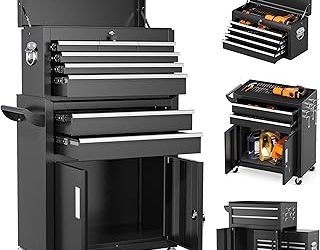
The most storage-dense option here, pairing thirteen drawers with a double-door lower cabinet that swallows the bulky, awkward items drawers handle badly. The detachable design lets you set the top box on a bench at proper elbow height while the rolling base stays where the heavy stuff belongs.
LDHTHOPI 8-Drawer Rolling Tool Chest
Arrives assembled, which matters more than it sounds: factory-set slide alignment is consistently better than what most people achieve with a flat-pack carcass and an Allen key. The detachable top box and locking sliding drawers make it a sensible single-chest solution for a one-bay garage.
5-Drawer Rolling Tool Chest with Detachable Top Box (Green)
A leaner 2-in-1 built around heavy-duty steel and locking wheels, with a security system that actually engages the drawer bank rather than just the lid. Fewer, deeper drawers means less partitioning fuss and a lower center of gravity when it’s loaded.
Workington 26″ 9-Drawer Tool Chest (4016)
This is the bench-top or truck-bed workhorse of the group: nine shallow drawers on ball bearing slides give you genuine one-tool-per-slot organization without deep drawers turning into a pile. Portable enough to relocate, rigid enough that the drawers stay square once it’s full.
Workington 20″ 4-Drawer Tool Chest (4004)
The compact sibling, and the one I’d recommend for apartment workshops or as a dedicated kit for a specific trade. Four ball bearing drawers in a 20-inch steel shell keep the weight manageable for repeated lifting, which is the durability factor people forget applies to their own joints.
Frequently Asked Questions
How much weight can a single drawer really hold?
Ball bearing slides in this class typically handle 30 to 60 lb per drawer depending on width. Treat the manufacturer figure as a static rating, not a rolling one; a fully loaded chest being pushed across rough concrete puts shock loads on the hardware.
Is a detachable 2-in-1 chest actually useful?
Yes, if you work in more than one spot. Lifting the top box onto a bench brings small parts up to a neutral reach zone, and it lets you service or reposition the rolling base without emptying everything first.
Do I need to worry about tipping?
Only if you load it backwards. Keep dense items low, avoid opening more than one loaded drawer at a time, and lock the casters before pulling anything out. Options like the 24″ portable metal tool box with a carry handle sidestep the issue entirely for smaller kits.
Will a steel chest rust in an unheated garage?
Powder coat resists surface humidity well, but bare drawer interiors and cut edges are vulnerable. Add drawer liner mats, keep a desiccant pack in the bottom, and touch up chips early rather than after they bloom.
Final Thoughts
For a full garage build-out, the 13-Drawer Double Door rolling chest gives you the widest range of storage geometries and the ergonomic flexibility of a removable top box. The pre-assembled LDHTHOPI 8-Drawer is the better pick if you’d rather skip alignment fiddling, and the Workington 26″ 9-Drawer remains the smartest choice for anyone who needs shallow, sortable drawers that travel.