Key takeaways
- Tooth count and gullet volume: Stay in the 24 to 30 tooth range for ripping. Deep gullets clear the coarse, ribbon-like chips hardwood produces, which keeps cutting temperature down and dramatically reduces how hard you have to push. High-tooth-count blades choke on thick stock and force you to muscle the board through.
- Kerf width versus saw power: Thin kerf (roughly 0.094 inch) removes less material, so an underpowered contractor saw feeds noticeably easier and the operator does less work. Full kerf plates are stiffer and track truer in 2-inch stock, but they want 3 horsepower or more behind them. Match the kerf to your motor, not to your ambitions.
- Plate flatness and vibration control: A tensioned, laser-cut plate with anti-vibration expansion slots does more for hand and arm comfort than any grip upgrade. Vibration is cumulative fatigue. It also shows up as scalloped cut lines that cost you sanding time later.
- Carbide grade and tip thickness: Look for micrograin C4 carbide and generously sized tips. Thicker brazed carbide means more resharpening cycles before the blade is scrap, which is the real measure of value. A cheap blade that dies after one sharpening costs more per board foot than a premium one that survives five.
- Grind geometry: Flat top (FTG) grinds excel at pure ripping and leave a flat-bottomed kerf. Alternate top bevel (ATB) grinds handle mixed duty with less tearout on veneered panels. Choose based on whether this blade will live in the saw or come out for dedicated rip work.
What's inside
Ripping hardwood is where a table saw earns its keep, and where the wrong blade turns a straightforward operation into a wrestling match. Dense stock like white oak, hard maple, and jatoba pushes back. If the blade is fighting you, that resistance travels straight into your wrists, shoulders, and lower back as you lean into the feed. The symptoms are familiar: scorched edges, a stall that makes the motor bog and drop pitch, a workpiece that wants to climb or drift off the fence. Most people blame the saw. Usually it’s a blade with too many teeth, too little gullet volume, or a plate that has lost its flatness after a few hundred board feet.
This guide looks at ripping blades through two lenses I care about professionally: how much physical effort the blade demands from the operator, and how long it holds its geometry under real workshop conditions. Feed effort, vibration, plate stability, carbide volume, and resharpening life all matter more than a tooth count printed on the packaging. Below are ten blades worth considering in 2026, followed by selection criteria and detailed notes on the standouts.
As an Amazon Associate we earn from qualifying purchases.



How to Choose a 10 Table Saw Blade For Ripping Hardwood (2026)
- Tooth count and gullet volume: Stay in the 24 to 30 tooth range for ripping. Deep gullets clear the coarse, ribbon-like chips hardwood produces, which keeps cutting temperature down and dramatically reduces how hard you have to push. High-tooth-count blades choke on thick stock and force you to muscle the board through.
- Kerf width versus saw power: Thin kerf (roughly 0.094 inch) removes less material, so an underpowered contractor saw feeds noticeably easier and the operator does less work. Full kerf plates are stiffer and track truer in 2-inch stock, but they want 3 horsepower or more behind them. Match the kerf to your motor, not to your ambitions.
- Plate flatness and vibration control: A tensioned, laser-cut plate with anti-vibration expansion slots does more for hand and arm comfort than any grip upgrade. Vibration is cumulative fatigue. It also shows up as scalloped cut lines that cost you sanding time later.
- Carbide grade and tip thickness: Look for micrograin C4 carbide and generously sized tips. Thicker brazed carbide means more resharpening cycles before the blade is scrap, which is the real measure of value. A cheap blade that dies after one sharpening costs more per board foot than a premium one that survives five.
- Grind geometry: Flat top (FTG) grinds excel at pure ripping and leave a flat-bottomed kerf. Alternate top bevel (ATB) grinds handle mixed duty with less tearout on veneered panels. Choose based on whether this blade will live in the saw or come out for dedicated rip work.
The Best 10 Table Saw Blade For Ripping Hardwood (2026)s Reviewed
Freud LM75R010 Industrial Thin Kerf Glue Line Ripping Blade
This is the benchmark for edges that go straight from the saw to the clamps without a jointer pass, which eliminates an entire handling step and the reaching and lifting that goes with it. The tensioned plate and heavy carbide make it a long-term investment rather than a consumable.
CMT 250.024.10 ITK XTreme 24-Tooth
The thin kerf and ATB grind give it unusually light feed resistance for a blade that still handles 2-inch hardwood, and CMT’s plate coating resists the pitch buildup that quietly increases drag over time. A strong choice for anyone whose saw sits at or below 1.75 horsepower.
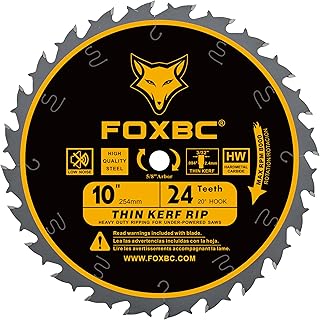
FOXBC 10-Inch 24-Tooth Flat Tooth Ripping Blade
Flat top teeth and deep gullets make this a purpose-built ripper, and the flat-bottomed kerf it produces is a bonus if you cut tenon cheeks or grooves. Comfortable feed pressure, honest performance, and a price that makes it easy to keep a spare on the shelf.
10-Inch 24T Carbide Ripping Blade with 5/8-Inch Arbor
A sensible general-purpose ripper that handles hardwood, softwood, and plywood without complaint. Expect to true up glue edges afterward, but for breaking down rough lumber it does the job with minimal effort at the push stick.
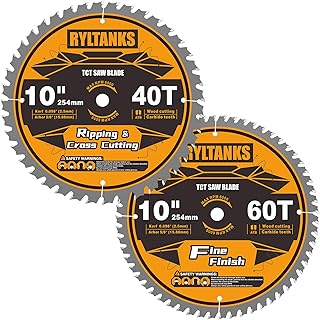
40T/60T Table and Miter Saw Blade 2-Pack
Not a dedicated ripper, but a practical pairing for shops that switch tasks constantly and want to avoid over-cutting with the wrong blade. Reserve the 40-tooth for light ripping in thinner stock and let the 60-tooth handle crosscuts and finish work.
Frequently Asked Questions
Why does my hardwood burn even with a sharp blade?
Burning usually means the wood is spending too long against the teeth. Check fence parallelism, feed at a steady confident rate rather than creeping, and verify the blade is not deflecting under load. A high-tooth-count blade in thick stock is the most common culprit.
Is thin kerf worth the tradeoff in stability?
On saws under 3 horsepower, yes. The reduced cutting load means less bogging, less operator effort, and less heat. Add a stiffening washer or blade stabilizer if you see any flutter in tall stock.
How often should a rip blade be sharpened?
Judge by feel, not by hours. When you notice yourself pushing harder or hear the pitch of the motor drop earlier than it used to, the carbide has dulled. Sharpening at that point preserves tip material and extends total blade life.
Do I need separate rip and crosscut blades?
If you work hardwood regularly, dedicated blades reduce both effort and finishing time. If your projects are occasional, a good 40-tooth combination blade is a reasonable compromise.
Final Thoughts
For serious hardwood ripping where edge quality and long service life both matter, the Freud LM75R010 remains the one I recommend without qualification. The CMT ITK XTreme is the smarter pick for lower-powered saws thanks to its genuinely light feed effort, and the FOXBC 24-tooth flat tooth blade delivers dependable ripping performance at a price that makes keeping a sharp spare on hand entirely practical.