Key takeaways
- Working height: Choose a platform that keeps your elbows relaxed and your back mostly upright; a stand that is too low makes repeated cuts unnecessarily tiring.
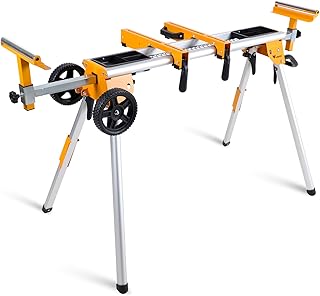
- Mobility: Large wheels roll more confidently over thresholds, cords, and rough concrete, while a secure handle and balanced frame make repositioning safer.
- Material support: Extension arms should lock firmly, stay level with the saw table, and provide enough reach for the boards you typically cut.
- Mounting system: Universal rails and quick-release brackets simplify saw changes, but confirm that the included hardware fits your saw before buying.
- Frame durability: Favor thick steel, reliable locking joints, and wide feet or wheel placement; these features reduce flex and improve confidence during long cuts.
What's inside
A rolling miter saw stand has to do more than move from one corner of the garage to another. It must remain steady while cutting, support long stock without sagging, fold without a wrestling match, and survive the bumps that come with regular jobsite use. The wrong stand can introduce vibration, awkward working height, and frustrating setup delays.
This guide evaluates the leading options from an ergonomics-and-durability perspective. We focus on wheel design, working height, material support, mounting flexibility, storage, and the practical details that determine whether a stand feels dependable after months of furniture projects and renovation work.
As an Amazon Associate we earn from qualifying purchases.



How to Choose a Rolling Miter Saw Stand (2026)
- Working height: Choose a platform that keeps your elbows relaxed and your back mostly upright; a stand that is too low makes repeated cuts unnecessarily tiring.
- Mobility: Large wheels roll more confidently over thresholds, cords, and rough concrete, while a secure handle and balanced frame make repositioning safer.
- Material support: Extension arms should lock firmly, stay level with the saw table, and provide enough reach for the boards you typically cut.
- Mounting system: Universal rails and quick-release brackets simplify saw changes, but confirm that the included hardware fits your saw before buying.
- Frame durability: Favor thick steel, reliable locking joints, and wide feet or wheel placement; these features reduce flex and improve confidence during long cuts.
The Best Rolling Miter Saw Stand (2026)s Reviewed
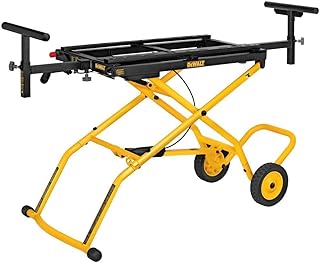
DEWALT DWX726 Rolling Miter Saw Stand
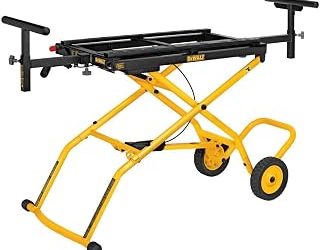
The DEWALT DWX726 is a strong all-around choice for demanding home workshops and mobile renovation work. Its broad steel frame, adjustable height, universal mounting rails, and 8-foot material support provide a stable cutting platform, while the large wheels make it easier to move when the saw is mounted. The folding mechanism is practical rather than delicate, though the stand’s substantial build gives it noticeable weight.
POWERTEC MT4000V Portable Miter Saw Stand
POWERTEC’s MT4000V combines an appealing 330-pound load rating with quick-release mounting brackets and 8-inch wheels. The wide base feels reassuring when handling longer boards, and the built-in three-prong outlets reduce cord clutter around the work area. It is a sensible pick for users who want workshop-level sturdiness without giving up convenient storage.
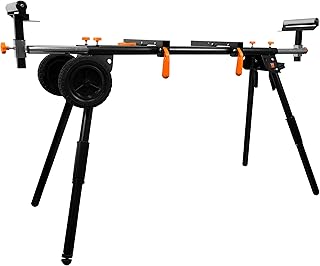
WEN MSA330 Rolling Miter Saw Stand
The WEN MSA330 is geared toward homeowners who need capable support without an overly complicated setup. Its collapsible frame, rolling design, extension arms, and three onboard outlets make it efficient for trim, shelving, and general furniture work. It is not the most imposing stand here, but its straightforward controls and compact storage profile are valuable in a crowded garage.
Channellock Folding Miter Saw Stand
Channellock’s folding stand emphasizes a sturdy steel chassis and generous 10-foot extensions, making it well suited to long molding, framing lumber, and cabinet components. The rolling mobile base helps with repositioning, although its larger footprint rewards users who have clear paths through the workshop. For durability-minded buyers, it offers a reassuringly solid feel.
BORA Portacube PM-8000
The BORA Portacube PM-8000 takes a different approach by combining a rolling miter saw station with a rotating-top workbench. That design can save valuable floor space and create a more useful furniture-building surface once the saw is out of the way. It is best for a dedicated workshop rather than frequent transport, but its integrated workspace is unusually versatile.
Frequently Asked Questions
Do rolling miter saw stands fit every saw?
Most universal stands accommodate many common miter saws, but compatibility is not automatic. Check the saw’s mounting-hole pattern, base dimensions, and weight against the stand’s specifications before purchasing.
Are larger wheels always better?
Not necessarily, but larger wheels usually handle thresholds, debris, and uneven garage floors more smoothly. Wheel quality, frame balance, and a secure parking position matter just as much as diameter.
How much material support do I need?
For trim and ordinary furniture components, moderate extensions are often sufficient. If you regularly cut long boards or molding, prioritize extensions that lock rigidly and remain level with the saw table at full reach.
Should the stand stay assembled?
Leave it assembled if you have room and use the saw frequently; this minimizes repeated mounting adjustments. If storage space is limited, select a model with quick-release brackets and a folding frame that can be handled safely by one person.
Final Thoughts
The DEWALT DWX726 is the strongest general-purpose pick for stability and mobility, while the POWERTEC MT4000V is compelling for heavy loads and convenient power access. Choose the WEN MSA330 when compact storage matters most, or the BORA Portacube PM-8000 if your workshop can benefit from a rolling saw station that doubles as a workbench.