Key takeaways
- Interior headroom: Look for a ridgeline-suspended design rather than a net that simply drapes. Lift of 10 to 14 inches above your chest keeps mesh off your skin, which is what allows you to lie flat and rotate your shoulders instead of sleeping in a fixed, compressed position.
- Mesh density and fabric feel: No-see-um grade netting (roughly 1,000 to 1,500 holes per square inch) blocks midges and biting flies, not just mosquitoes. Softer polyester mesh also reduces the scratchy contact that makes people cinch the net tighter than necessary.
- Zipper architecture: Dual-sided or double-pull zippers matter for ergonomics, not convenience alone. Being able to exit from either side means you can enter and exit without twisting your spine against the hammock’s curve. Check for a stiffened zipper flap that prevents snagging.
- Length and hammock compatibility: An 11-foot net fits most 9- to 10-foot hammocks with slack to spare. Undersized netting pulls tight at the foot box, which cramps ankle position and puts constant load on the end seams.
- Reinforcement at load points: Inspect the tie-outs, end channels, and mesh-to-hem seams. Bar-tacking, bound edges, and reinforced end sleeves are the difference between a net that lasts and one that tears the first time you sit up too fast.
What's inside
Anyone who has spent a still, humid evening suspended between two trees knows the specific frustration: the hang is dialed in, the shoulder angle is right, the diagonal lay is perfect, and then a mosquito lands on your eyelid. Hammock comfort is a posture problem first and an insect problem second, but the two are inseparable. A net that sags onto your face forces you to sleep tucked and rigid, and a rigid sleeper wakes up with a sore neck regardless of how good the suspension is. Meanwhile the cheapest netting on the market tends to fail at the same three points every time: the zipper slider, the ridgeline tie-out, and the seam where fine mesh meets heavier fabric.
This guide looks at hammock bug nets through two lenses that matter more than marketing copy: interior geometry, which determines whether you can actually stretch out, and stress-point construction, which determines whether the net survives its third season. Below you will find the models worth considering in 2026, a short buying framework, and answers to the questions that come up most often once the net is out of the stuff sack.
As an Amazon Associate we earn from qualifying purchases.


How to Choose a Bug Net For Hammock (2026)
- Interior headroom: Look for a ridgeline-suspended design rather than a net that simply drapes. Lift of 10 to 14 inches above your chest keeps mesh off your skin, which is what allows you to lie flat and rotate your shoulders instead of sleeping in a fixed, compressed position.
- Mesh density and fabric feel: No-see-um grade netting (roughly 1,000 to 1,500 holes per square inch) blocks midges and biting flies, not just mosquitoes. Softer polyester mesh also reduces the scratchy contact that makes people cinch the net tighter than necessary.
- Zipper architecture: Dual-sided or double-pull zippers matter for ergonomics, not convenience alone. Being able to exit from either side means you can enter and exit without twisting your spine against the hammock’s curve. Check for a stiffened zipper flap that prevents snagging.
- Length and hammock compatibility: An 11-foot net fits most 9- to 10-foot hammocks with slack to spare. Undersized netting pulls tight at the foot box, which cramps ankle position and puts constant load on the end seams.
- Reinforcement at load points: Inspect the tie-outs, end channels, and mesh-to-hem seams. Bar-tacking, bound edges, and reinforced end sleeves are the difference between a net that lasts and one that tears the first time you sit up too fast.
The Best Bug Net For Hammock (2026)s Reviewed
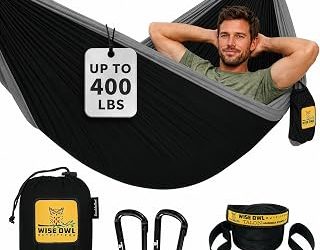
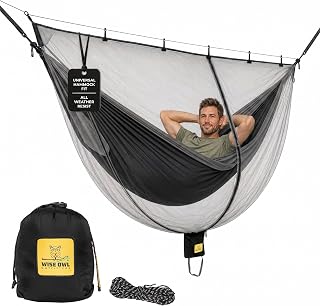
Wise Owl Outfitters Hammock Bug Net
A well-balanced option for backpackers who count grams but still want a net that holds its shape, with clean stitching at the end channels and enough interior volume to keep mesh off your face when suspended from a ridgeline. It is the pick for anyone whose priority is packed size without giving up structural integrity.
Hammock Bug Mosquito Net XL 11×4.6FT
The extra width here is the real ergonomic story: 4.6 feet of girth creates a genuine cocoon rather than a sleeve, so you can lie diagonally and let your knees fall naturally. The dual-sided diagonal zipper is also the easiest of the group to operate from inside without contorting.
AYAMAYA Hammock Bug Net
An 11-foot net with 360-degree coverage and a double-sided zipper that sets up quickly once the ridgeline is tensioned. Reliable everyday choice if you want straightforward geometry and a fabric hand that does not feel abrasive against bare skin.
G4Free Large Camping Hammock with Mosquito Net
A complete system rather than an add-on, rated to 440 pounds and bundled with tree straps and a tarp. The heavier nylon body resists abrasion well, making it the most durable pick for people who camp frequently or share the hammock with a partner.
Camping Hammock with Mosquito Net and Rain Fly
An integrated setup that solves bugs and weather in one purchase, which simplifies the pitch and eliminates the compatibility guesswork of matching a net to an existing hammock. Best suited to travelers who want one bag to grab.
Frequently Asked Questions
Do I need a separate ridgeline for my bug net?
Almost always, yes. A ridgeline is what lifts the mesh off your body and preserves interior space. Without it, even a well-made net collapses onto your face and defeats the point.
Will a bug net make my hammock hotter?
Slightly. Fine mesh cuts airflow by a modest margin, though the effect is smaller than most people expect. Choosing a net with more interior volume helps, since the trapped air layer stays away from your skin.
Can one net fit different hammocks?
Generally yes, if the net is 11 feet or longer and uses open end channels. Gathered-end hammocks are the standard fit; bridge and spreader-bar styles usually need purpose-built netting.
How do I keep the zipper from failing?
Keep it clean, avoid forcing it against fabric bunching, and open it fully before entering rather than squeezing through a partial gap. Lateral strain on a partly closed slider is the most common cause of failure.
Final Thoughts
For most people, the XL 11×4.6FT net offers the best combination of interior room and easy access, which translates directly into better sleep posture. The Wise Owl Outfitters net is the smarter pick when pack weight drives the decision, and the G4Free system is the one to choose if long-term durability and a complete kit matter more than shaving ounces.