Key takeaways
- Duty cycle over peak PSI: A 150 PSI rating is meaningless if the motor overheats at eleven minutes. Look for stated continuous run times at pressure, or a 100% duty cycle claim, since RV tires demand long fills at high resistance rather than quick topping-off.
- Hose and lead reach: Measure from your battery terminals or 12V socket to the farthest valve stem, then add slack for kneeling. Anything under 20 feet of combined cable and hose will force repositioning between axles.
- Fitting and housing materials: Brass chucks, metal cylinder heads, and steel-braided or reinforced hose resist the thread wear and heat cycling that crack plastic assemblies. Inspect where the hose meets the manifold — that joint fails first.
- Ergonomic touchpoints: Prioritize a balanced carry handle, a rubber-footed or vibration-damped base that stays put on gravel, a screw-on or lever chuck usable one-handed, and a gauge or display readable from a crouch in daylight.
- Power delivery method: Direct battery clamps with heavy-gauge leads support high-amperage draw properly; cigarette-lighter plugs are convenient but current-limited. Cordless units trade that constraint for finite battery capacity, so check amp-hours against your total tire count.
What's inside
RV tires live a hard life. They sit for weeks at a time, carry loads near their rated maximum, and need pressures that passenger-car equipment simply cannot reach — often 65 to 110 PSI on a Class C, and higher on duallies. The gas station hose that tops off a sedan will stall out well before your sidewall stamp is satisfied, assuming the gauge works at all. Meanwhile the actual work happens at ground level, in a gravel pull-through, with your knees on hot asphalt and one hand steadying a chuck that keeps slipping off the valve stem. Most buyers focus entirely on PSI numbers and discover too late that the real failure points are heat, hose reach, and the awkward posture the tool forces you into.
This guide evaluates portable 12V compressors through a durability and ergonomics lens: duty cycle under sustained load, thermal behavior on a second and third tire, fitting materials that survive repeated threading, hose length that lets you reach inner duals without unhooking the tow vehicle, and controls you can read and operate while crouched. Below are the units that hold up over seasons rather than weekends, along with the specification details worth checking before you commit.
As an Amazon Associate we earn from qualifying purchases.




How to Choose a/an Air Compressor For Rv Tires (2026)
- Duty cycle over peak PSI: A 150 PSI rating is meaningless if the motor overheats at eleven minutes. Look for stated continuous run times at pressure, or a 100% duty cycle claim, since RV tires demand long fills at high resistance rather than quick topping-off.
- Hose and lead reach: Measure from your battery terminals or 12V socket to the farthest valve stem, then add slack for kneeling. Anything under 20 feet of combined cable and hose will force repositioning between axles.
- Fitting and housing materials: Brass chucks, metal cylinder heads, and steel-braided or reinforced hose resist the thread wear and heat cycling that crack plastic assemblies. Inspect where the hose meets the manifold — that joint fails first.
- Ergonomic touchpoints: Prioritize a balanced carry handle, a rubber-footed or vibration-damped base that stays put on gravel, a screw-on or lever chuck usable one-handed, and a gauge or display readable from a crouch in daylight.
- Power delivery method: Direct battery clamps with heavy-gauge leads support high-amperage draw properly; cigarette-lighter plugs are convenient but current-limited. Cordless units trade that constraint for finite battery capacity, so check amp-hours against your total tire count.
The Best Air Compressor For Rv Tires (2026)s Reviewed
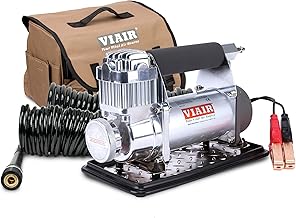
VIAIR 400P RV
Purpose-built for Class C motorhomes, this kit pairs a 150 PSI head with an extended air hose and a genuinely robust automatic shutoff, so you can set a target and stand up instead of hovering over a gauge. The alligator clamps and heavy leads reflect an honest understanding of the amperage this class of work requires.
ALL-TOP Air Compressor Kit
At 12.35 CFM from dual cylinders, this is the volume option for anyone airing down and back up on a regular basis, and the metal construction plus long braided hose survives repeated deployment far better than consumer-grade plastic bodies. Its weight is real, so plan on a two-hand carry from the storage bay.
VIAIR 88P
Rated for tires up to 33 inches, the 88P is the compact, reliable middle ground — small enough to live in a cabinet permanently, well built enough to keep working after several seasons of vibration. Expect longer fill times than the larger VIAIR units on high-pressure RV tires.
ETENWOLF VORTEX S6
The 19200mAh cordless design removes the cable-routing hassle entirely, and the 100% duty cycle rating plus dual cylinders keep it viable across multiple tires rather than dying after one. The LED backlight and clean digital readout are legitimately easier on the eyes and back during roadside checks after dark.
GSPSCN 12V Heavy Duty
An all-metal body and dual cylinders give this inflator strong value density, with fill speeds that make a six-tire walkaround tolerable. The chuck and hose are the components most worth upgrading over time.
Frequently Asked Questions
What PSI capability do I actually need?
Check the sidewall and your RV’s load placard, then choose a compressor rated at least 20 PSI above your target. Compressors slow dramatically near their ceiling, so buying headroom protects both fill time and motor life.
Will a car tire inflator work on RV tires?
Rarely well. Most consumer inflators are optimized for 35 PSI volumes and overheat or stall at high pressure, which is why duty cycle and cylinder count matter more than the number printed on the box.
Should I connect to the battery or the 12V socket?
Direct battery clamps for anything drawing over roughly 15 amps. Socket plugs risk blown fuses and voltage drop, which shows up as sluggish inflation and premature motor wear.
How do I reach inner dual valve stems?
Use a dual-tire valve extender paired with a compressor whose hose exceeds 20 feet. Rigid extenders mounted permanently spare your wrists and eliminate most kneeling entirely.
Final Thoughts
For most motorhome owners, the VIAIR 400P RV is the durability benchmark — automatic shutoff, proper leads, and a hose that reaches. Choose the ALL-TOP kit if high-volume off-road airing up is part of your routine, or the ETENWOLF VORTEX S6 if cordless convenience and a readable display matter more than raw CFM.