Key takeaways
- Tooth count: Lower counts remove material quickly for ripping, while 40 to 60 teeth offer a useful balance for furniture work. Blades with 80 teeth favor smoother crosscuts and reduced tear-out.
- Tooth geometry: Alternate-top-bevel teeth generally produce clean crosscuts. Flat-top or specialized ripping designs can clear waste efficiently but may need more care when used across grain.
- Kerf and power: A thin-kerf blade can reduce motor strain and make feeding easier, especially on compact saws. Confirm compatibility before choosing a thin-kerf design for a riving-knife setup.
- Carbide and durability: Larger, well-ground carbide tips tolerate repeated sharpening and occasional abrasive materials better than inexpensive stamped teeth. Avoid cutting embedded fasteners unless the blade is specifically designed for it.
- Arbor and safety: Most 10-inch table saws use a 5/8-inch arbor, but verify the specification. The blade must seat flat, run true, and work with the saw’s guard, riving knife, and maximum rated speed.
What's inside
Choosing the right blade is less about chasing the highest tooth count and more about matching the blade to the work, saw, and material. A poorly matched blade can leave burn marks, tear-out, vibration, or premature tooth wear—and it can make a well-tuned table saw feel inaccurate. This guide, Best 10 In Table Saw Blade (2026), focuses on cutting consistency, user comfort, and long-term durability for home furniture projects.
We compare finish blades, general-purpose options, and multi-blade packs with an ergonomics-and-durability perspective. The recommendations consider tooth configuration, carbide quality, expected workload, cut quality, and how practical each blade is for a home workshop where one tool may handle everything from sheet goods to hardwood joinery.
As an Amazon Associate we earn from qualifying purchases.


How to Choose a/an 10 In Table Saw Blade (2026)
- Tooth count: Lower counts remove material quickly for ripping, while 40 to 60 teeth offer a useful balance for furniture work. Blades with 80 teeth favor smoother crosscuts and reduced tear-out.
- Tooth geometry: Alternate-top-bevel teeth generally produce clean crosscuts. Flat-top or specialized ripping designs can clear waste efficiently but may need more care when used across grain.
- Kerf and power: A thin-kerf blade can reduce motor strain and make feeding easier, especially on compact saws. Confirm compatibility before choosing a thin-kerf design for a riving-knife setup.
- Carbide and durability: Larger, well-ground carbide tips tolerate repeated sharpening and occasional abrasive materials better than inexpensive stamped teeth. Avoid cutting embedded fasteners unless the blade is specifically designed for it.
- Arbor and safety: Most 10-inch table saws use a 5/8-inch arbor, but verify the specification. The blade must seat flat, run true, and work with the saw’s guard, riving knife, and maximum rated speed.
The Best 10 In Table Saw Blade (2026)s Reviewed
FOXBC 10-Inch 80-Tooth Ultra Finish Blade
The FOXBC 80-tooth blade is aimed at presentation-quality crosscuts where edge cleanliness matters more than fast stock removal. Its dense tooth pattern can minimize splintering on plywood and veneered panels, although slower feeding and a properly aligned fence are important to prevent heat buildup. It is a sensible choice for cabinet components, trim, and visible furniture parts.
DEWALT 10-Inch 40-Tooth Fine Finish Blade
The DEWALT DWA11040 occupies the useful middle ground between a ripping blade and a dedicated finishing blade. Its 40-tooth layout is easier to live with for mixed home-shop work: it can crosscut cleanly while still clearing sawdust during moderate ripping. The carbide construction and familiar 5/8-inch arbor format make it a practical everyday replacement for a standard table-saw blade.
WEN BL1080 80-Tooth Ultra-Fine Finish Blade
WEN’s BL1080 is designed for smooth, controlled cuts in both table-saw and miter-saw applications. The 80-tooth configuration is particularly helpful when working with delicate trim, hardwood crosscuts, or finished sheet goods, but it is not the efficient choice for routinely ripping thick stock. Its value is strongest for users who prioritize a clean edge and can afford a slower feed rate.
WEN BL1060 60-Tooth Fine-Finish Blade
The BL1060 offers a more versatile finish profile than an 80-tooth blade, with enough teeth for clean crosscuts while retaining better chip clearance. For furniture makers who switch between solid wood, plywood, and occasional ripping, this is often a comfortable compromise. It should also feel less demanding on a smaller saw than an ultra-fine blade when the cut requires steady material movement.
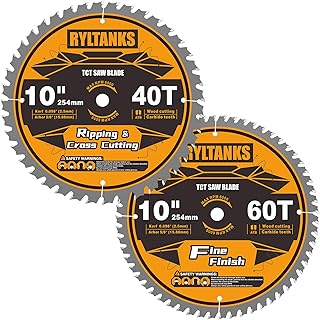
10-Inch 3-Pack: 32T, 60T, and 80T Blades
This three-blade set is attractive for workshops that want to match the blade to each operation rather than force one blade to do everything. The 32-tooth option handles faster framing-style cuts, while the 60-tooth and 80-tooth blades cover progressively cleaner furniture and finish work. The ergonomic advantage is consistency: using the correct blade reduces pushing effort, heat, and the temptation to force a cut.
Frequently Asked Questions
Is an 80-tooth blade best for a table saw?
Not for every task. An 80-tooth blade excels at smooth crosscuts and fragile surfaces, but its closely spaced teeth remove waste slowly. A 40- or 60-tooth blade is usually more comfortable for general furniture construction.
Can a table-saw blade be used on a miter saw?
Only when the blade is rated and specified for that application. Check the manufacturer’s instructions, arbor size, diameter, tooth profile, and maximum speed. Never assume that a blade fits safely simply because it has the correct diameter.
How often should a carbide blade be replaced?
Replace or sharpen it when cuts become noticeably rough, burning increases, or feeding requires unusual force. Quality carbide blades can often be professionally sharpened several times, making sharpening more economical than replacing a durable blade.
Why does a new blade still make rough cuts?
Blade quality is only one factor. Check fence parallelism, arbor cleanliness, blade alignment, stock moisture, and the condition of the riving knife. A dull or misaligned machine can produce poor results even with an excellent blade.
Final Thoughts
For versatile everyday furniture work, the DEWALT 40-tooth blade is a strong starting point, while the FOXBC 80-tooth and WEN BL1080 suit projects where edge quality takes priority. If your workshop handles varied cuts, the three-pack with 32T, 60T, and 80T blades offers the most adaptable approach and can reduce both operator fatigue and unnecessary blade wear.