Key takeaways
- Usable length before deflection: A 68-inch track is only as good as its support. Look at web thickness and internal ribbing, then plan to bolt the extrusion to a continuous wing rather than spanning air — unsupported aluminum sags under a leaning 8-footer and your stop reads long.
- Stop lever reach and force: The flip stop is the part you touch hundreds of times a day. Test whether you can unlock, slide, and relock it with one hand at a neutral wrist angle. Knobs that require a pinch grip and a quarter turn become a real complaint by hour three.
- Tape orientation and contrast: Dual-direction tapes let you register from either side without mental arithmetic, which cuts errors more than any accuracy spec. Matte, high-contrast printing under a recessed lip stays readable when sawdust and overhead glare conspire against you.
- T-track hardware quality: Anodized channels resist galling; bare mill finish scores and eventually binds. Check that stops ride on nylon or UHMW pads rather than metal-on-metal, and that the fasteners are steel rather than zinc castings that strip under repeat torque.
- Zero-clearance behavior: If you run a slider, confirm the fence profile clears the full rail travel and supports the workpiece right at the blade line. Tear-out on the exit face is a fence problem, not a blade problem, in most cases.
What's inside
Most miter saw stations fail people long before they fail structurally. You set a stop, cut six rails, and by the seventh your left hand is stretched past comfortable reach while your right shoulder holds the trigger at an awkward angle. Read the tape wrong once in bad light and a set of table aprons goes in the offcut bin. The saw isn’t the bottleneck — the surface around it is. A short factory fence gives you nothing to register long stock against, no repeatable stop, and no way to work without leaning, twisting, or eyeballing pencil marks that shift a sixteenth each time.
This guide looks at miter saw fence systems through two lenses that matter after the first weekend: how the setup treats your body over a long session, and how it holds tolerance after a few thousand clamp cycles. That means extrusion stiffness and deflection under a leaning board, lever geometry you can operate one-handed without wrist strain, tape legibility under shop lighting, and whether the stop returns to the same number after being knocked. Below are the systems worth building a station around in 2026.
As an Amazon Associate we earn from qualifying purchases.




How to Choose a/an Miter Saw Fence System (2026)
- Usable length before deflection: A 68-inch track is only as good as its support. Look at web thickness and internal ribbing, then plan to bolt the extrusion to a continuous wing rather than spanning air — unsupported aluminum sags under a leaning 8-footer and your stop reads long.
- Stop lever reach and force: The flip stop is the part you touch hundreds of times a day. Test whether you can unlock, slide, and relock it with one hand at a neutral wrist angle. Knobs that require a pinch grip and a quarter turn become a real complaint by hour three.
- Tape orientation and contrast: Dual-direction tapes let you register from either side without mental arithmetic, which cuts errors more than any accuracy spec. Matte, high-contrast printing under a recessed lip stays readable when sawdust and overhead glare conspire against you.
- T-track hardware quality: Anodized channels resist galling; bare mill finish scores and eventually binds. Check that stops ride on nylon or UHMW pads rather than metal-on-metal, and that the fasteners are steel rather than zinc castings that strip under repeat torque.
- Zero-clearance behavior: If you run a slider, confirm the fence profile clears the full rail travel and supports the workpiece right at the blade line. Tear-out on the exit face is a fence problem, not a blade problem, in most cases.
The Best Miter Saw Fence System (2026)s Reviewed
O’SKOOL RTS024 Expandable Fence System
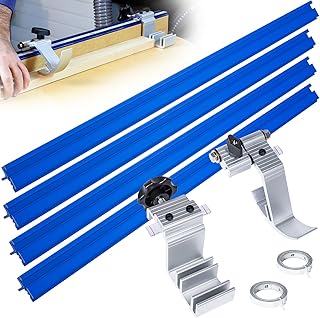
The 68-inch expandable aluminum track is the standout for anyone cutting cabinet stiles and long trim, and the dual-direction tape genuinely reduces measure-twice fatigue when you’re flipping between left and right registration. The flip stop moves smoothly with a low-effort cam action, though I’d mount the full length to a solid wing to keep the extrusion honest under load.
POWERTEC 71742 Miter Saw Fence with T-Track Stop Kit
A well-rounded kit that arrives with the tapes, T-track cap, and stop hardware you’d otherwise buy piecemeal, which makes it the easiest path to a working station in an afternoon. The channel finish is clean enough that stops slide without chatter, and the fence cap keeps grit out of the track — a small detail that pays off in year two.
Kreg KMS8000 Precision Trak & Stops Kit
Still the reference for repeatability. The stops lock with reassuring positive engagement and return to the same reading after knocks that would drift lesser hardware, and the components are sized for real workshop abuse rather than showroom photos. Worth the premium if you cut production batches.
Aluminum Zero Clearance Fence for DeWalt Sliders
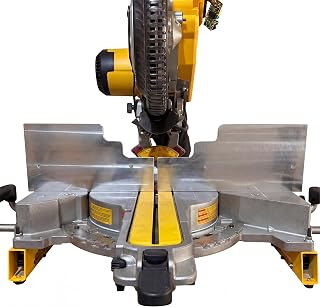
The stairstep cutout is the smart part here: it supports stock right up to the blade while preserving full slide travel on the DHS780, DWS779, DWS782, and DWS780. Crosscut faces come off noticeably cleaner, which saves sanding time on visible furniture edges.
POWERTEC 71391 Precision Miter Gauge System
Not a miter saw fence at all, but if your accuracy problems live at the table saw, this gauge with 27 angle stops and a 24-inch T-track fence solves them properly. The removable T-slot plate lets you dial out slop in the bar, which is where most cheap gauges lose their angle.
Frequently Asked Questions
Do I need a full fence system if I already have a stop block?
A clamped block works for a handful of parts. Once you’re cutting matched sets, a track-mounted stop removes the re-clamping cycle that causes both drift and repetitive strain in your clamping hand.
How accurate are these systems in practice?
Expect roughly a sixty-fourth of repeatability from the better kits, assuming your fence is coplanar with the saw table and the tape was calibrated against a test cut rather than trusted out of the box.
What working height should I build the station at?
Aim for the saw table at roughly wrist height when standing relaxed, typically 34 to 38 inches depending on your build. Too low forces sustained forward flexion; too high compromises your view of the blade line.
Will aluminum tracks wear out?
Anodized extrusions hold up for years with occasional cleaning. The wear items are the stop pads and fasteners, both of which are replaceable on the major kits.
Final Thoughts
For most furniture shops, the O’SKOOL RTS024 offers the best reach-to-effort ratio at its length, while the Kreg KMS8000 remains the choice when repeatability under daily use matters more than budget. DeWalt slider owners should add the aluminum zero clearance fence regardless of which stop system they run — it’s the cheapest cut-quality upgrade on this list.