Key takeaways
- Step geometry: Look for wide, evenly spaced steps with a surface that remains useful when wet. A comfortable step reduces twisting and lets users climb with a stable, deliberate rhythm.
- Handrails: Handrails should be easy to grasp from the water and continue naturally through the transition onto the deck. Avoid designs that force a narrow grip or make users pull against sharp edges.
- Construction: Marine-grade stainless steel, particularly 316 stainless, generally offers better resistance to saltwater exposure than ordinary steel. Weld quality and reinforcement matter just as much as the alloy label.
- Deployment: Telescoping or folding sections save space, but they must lock securely and operate without excessive force. Check whether the ladder can be lowered and raised while standing in a balanced position.
- Installation and capacity: Confirm the mounting layout, platform clearance, and included hardware before ordering. A stated weight capacity does not compensate for weak decking, undersized fasteners, or an installation that does not match the ladder’s intended orientation.
What's inside
A pontoon ladder has one job: make getting back aboard predictable, even when the platform is wet, crowded, or being used by someone with limited mobility. In practice, buyers often discover that a ladder that looks substantial in a listing can flex under load, pinch fingers while folding, or place its lowest step too high above the water. Corrosion, awkward handrail geometry, and poor mounting alignment can turn a small convenience into a daily frustration.
This guide evaluates pontoon ladders from an ergonomics-and-durability perspective. The focus is on step width, hand placement, deployment effort, structural reinforcement, marine-suitable materials, and the realities of rear-entry installation. Capacity figures are useful, but they should be treated as one part of a broader safety assessment that includes mounting hardware, deck condition, and proper use.
As an Amazon Associate we earn from qualifying purchases.




How to Choose a Pontoon Ladder (2026)
- Step geometry: Look for wide, evenly spaced steps with a surface that remains useful when wet. A comfortable step reduces twisting and lets users climb with a stable, deliberate rhythm.
- Handrails: Handrails should be easy to grasp from the water and continue naturally through the transition onto the deck. Avoid designs that force a narrow grip or make users pull against sharp edges.
- Construction: Marine-grade stainless steel, particularly 316 stainless, generally offers better resistance to saltwater exposure than ordinary steel. Weld quality and reinforcement matter just as much as the alloy label.
- Deployment: Telescoping or folding sections save space, but they must lock securely and operate without excessive force. Check whether the ladder can be lowered and raised while standing in a balanced position.
- Installation and capacity: Confirm the mounting layout, platform clearance, and included hardware before ordering. A stated weight capacity does not compensate for weak decking, undersized fasteners, or an installation that does not match the ladder’s intended orientation.
The Best Pontoon Ladders (2026) Reviewed
4-Step Heavy-Duty Stainless Steel Pontoon Ladder
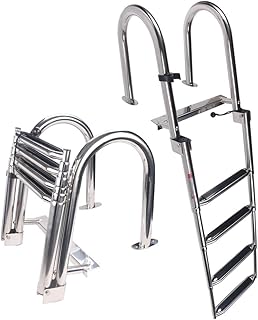
This 316 stainless steel rear-entry ladder is designed around the fundamentals that matter most: extra-wide steps, substantial handrails, and a telescoping folding format. Its advertised 600-pound capacity gives it a useful margin for many family boats, while the broad step design should feel more forgiving for tired swimmers or users wearing bulky footwear.
Heavy Duty 316 Stainless Steel Folding Ladder
The all-welded reinforced construction is the key attraction here. Reinforcement can help limit flex at the joints and mounting area, while the four-step layout and wide treads support a more controlled climb. It is a strong candidate for owners who prioritize rigidity and want a ladder suited to rear-entry or swim-deck installation.
Stainless Steel Inboard 4-Step Welded-Reinforced Ladder
This inboard ladder emphasizes a compact folding profile without abandoning structural support. The welded reinforcement is reassuring for repeated use, and the telescoping rear-entry arrangement can keep the ladder neatly out of the way when the boat is underway. Measure carefully before buying, since inboard placement and platform clearance vary considerably between pontoons.
4-Step Stainless Steel Telescopic Pontoon Ladder
With a listed 900-pound capacity, this model stands out on paper for buyers seeking a high load rating. Its four-step telescoping design should provide a practical compromise between reach and storage, but capacity should still be verified against the installation surface and fasteners. The extendable format is especially useful where the lowest step needs to reach comfortably below the waterline.
Stainless Steel Telescoping Folding Heavy-Duty Ladder
This broadly compatible marine ladder is aimed at pontoons, yachts, outboards, and fishing boats, making it a versatile option for owners who may change boats or use multiple boarding locations. Its folding telescopic mechanism supports cleaner deck storage, while the stainless construction addresses routine exposure to spray and moisture. Confirm the handrail height and mounting angle for your particular swim platform.
Frequently Asked Questions
How many steps should a pontoon ladder have?
Four steps are a practical starting point for most pontoon boats because they provide a manageable climb without making the ladder excessively long when folded. The correct choice depends on platform height and how far the lowest step extends below the water.
Is 316 stainless steel worth choosing?
For saltwater use, 316 stainless steel is generally preferable because its composition offers improved resistance to corrosion. It is not maintenance-free, however. Rinse away salt and periodically inspect welds, fasteners, hinges, and areas where dissimilar metals contact each other.
Should a pontoon ladder fold or telescope?
Either format can work well. Folding designs are convenient for keeping the ladder clear of the water and deck traffic, while telescoping sections can provide a compact storage profile and adjustable reach. The best mechanism is the one that locks positively and can be operated without leaning dangerously over the stern.
What is the safest way to install one?
Follow the manufacturer’s mounting pattern and use hardware appropriate for the deck structure and marine environment. Reinforce the mounting area when necessary, seal penetrations correctly, and test the ladder gradually before relying on it for full-weight boarding.
Final Thoughts
For a balanced combination of wide steps, handrails, and corrosion resistance, the 4-Step Heavy-Duty Stainless Steel Pontoon Ladder is a sensible all-around pick. Choose the Heavy Duty 316 Stainless Steel Folding Ladder when rigidity and welded reinforcement take priority, or consider the 900-pound 4-Step Stainless Steel Telescopic Pontoon Ladder when its higher stated capacity and reach match your installation requirements.