Key takeaways
- Match duty cycle to your real task: Small 12V inflators are rated for short bursts, typically 8 to 15 minutes before a mandatory cool-down. Tank compressors store air so the motor rests between cycles, which is what you need for nailers, staplers, and blow-off work on furniture builds.
- Handle and weight distribution: Look for a grip roughly 1.2 to 1.5 inches in diameter with a soft overmold, positioned above the tank’s center of mass. A 30-pound unit with an off-center handle will torque your wrist every time you reposition it.
- Strain relief and fittings: The most common failure point on budget units is the cord or hose exit. Molded, tapered strain relief and brass (not plastic) chucks and couplers are the clearest signals of a longer service life.
- Noise you can work beside: Anything near 70 dB lets you talk over it and skip hearing protection. Conventional direct-drive compressors run 85 to 95 dB, which is fine in a garage and miserable in a shared shop or apartment.
- Gauge and control readability: Backlit digital displays with preset auto shut-off beat analog dials for accuracy and for tired eyes in a dark driveway. Confirm the display stays lit while the pump runs.
What's inside
Cheap air compressors fail in predictable places, and almost none of them are the pump. It’s the handle that digs into your palm after two minutes, the power cord that cracks where it exits the housing, the plastic tire chuck that strips on the third use, and the duty cycle that quietly cooks the motor when you ask for ten straight minutes of airflow. Buyers shopping under a couple hundred dollars usually compare PSI numbers, which is the one spec that tells you the least about whether the tool survives its second year.
This guide looks at inexpensive compressors the way a durability tester does: grip geometry and carry weight, strain relief at every cable and hose junction, thermal behavior during sustained runs, and the material quality of the parts that actually take abuse. Whether you need seat-of-the-car tire top-offs or enough continuous air to drive a brad nailer through a set of dining chairs, the picks below are sorted by what they can honestly sustain.
As an Amazon Associate we earn from qualifying purchases.



How to Choose an Inexpensive Air Compressor (2026)
- Match duty cycle to your real task: Small 12V inflators are rated for short bursts, typically 8 to 15 minutes before a mandatory cool-down. Tank compressors store air so the motor rests between cycles, which is what you need for nailers, staplers, and blow-off work on furniture builds.
- Handle and weight distribution: Look for a grip roughly 1.2 to 1.5 inches in diameter with a soft overmold, positioned above the tank’s center of mass. A 30-pound unit with an off-center handle will torque your wrist every time you reposition it.
- Strain relief and fittings: The most common failure point on budget units is the cord or hose exit. Molded, tapered strain relief and brass (not plastic) chucks and couplers are the clearest signals of a longer service life.
- Noise you can work beside: Anything near 70 dB lets you talk over it and skip hearing protection. Conventional direct-drive compressors run 85 to 95 dB, which is fine in a garage and miserable in a shared shop or apartment.
- Gauge and control readability: Backlit digital displays with preset auto shut-off beat analog dials for accuracy and for tired eyes in a dark driveway. Confirm the display stays lit while the pump runs.
The Best Inexpensive Air Compressors of 2026, Reviewed
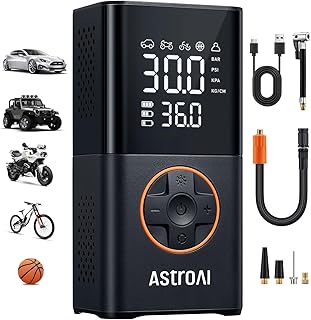
AstroAI L7 Cordless Tire Inflator
The L7’s slim barrel body and textured single-hand grip make it the most comfortable of the cordless inflators here, and the recessed digital panel resists the scuffs that usually render trunk-stored tools illegible. Auto shut-off is accurate within a pound or two across repeated tests, and cordless operation removes the 12V cord as a failure point entirely.
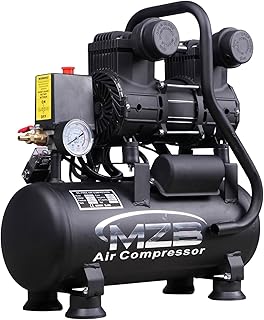
MZB 2.4 Gallon Ultra Quiet Compressor
At roughly 70 dB with an oil-free induction pump, this is the one you can run indoors while assembling or finishing furniture without clearing the room. The twin steel tanks and 5.65 CFM rating give it genuine staying power for spray work, though its bulk means you’ll place it once rather than carry it around.
CRAFTSMAN 2 Gallon Portable Compressor
A well-balanced 1/3 HP pancake-style unit whose handle sits directly over the tank, so it carries cleanly at your side instead of swinging into your leg. The 10-piece accessory kit covers inflation and blow-off out of the box; the similarly specced ECOMAX 2 Gallon is a reasonable substitute if the Craftsman is out of stock.
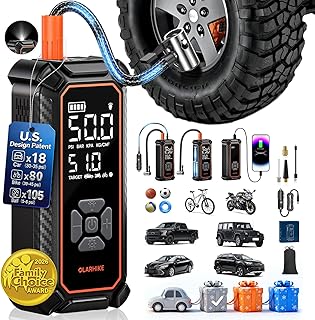
OlarHike Dual Power Cordless Inflator
Dual 12V and battery operation is the practical insurance policy here, since you’re never stranded by a dead pack or a dead outlet. Inflation speed is strong for the size, and the rubber-shod base keeps it from walking across pavement during longer runs.
150 PSI 12V Digital Tire Inflator
The most affordable entry, and honest about what it is: a corded emergency inflator with a clear digital preset and an integrated LED work light. Keep runs under about ten minutes, coil the cord loosely rather than tight around the body, and it will outlast most units in its price band.
Frequently Asked Questions
Can an inexpensive compressor run a brad nailer for furniture projects?
A 2 to 2.4 gallon tank compressor handles 18-gauge brad and narrow-crown staple work comfortably. Cordless inflators cannot, as they have no tank and no sustained CFM.
Does higher PSI mean a better compressor?
No. CFM at working pressure determines what tools you can run; PSI just sets the ceiling. Most furniture-shop pneumatics operate between 70 and 90 PSI.
Do oil-free pumps wear out faster?
They wear differently. Oil-free units trade some pump longevity for zero maintenance and no risk of oil mist contaminating finishes, which is the right trade for occasional use.
How should I store one to maximize its life?
Drain tank condensate after every session to prevent internal corrosion, and store cords and hoses in loose coils. Tight wraps are what crack jackets at the strain relief.
Final Thoughts
For shop work where you’re standing next to the machine, the MZB 2.4 Gallon Ultra Quiet is the standout, combining conversation-level noise with enough air for finishing and fastening. The CRAFTSMAN 2 Gallon is the better pick if portability and balance matter most, and for glovebox duty the AstroAI L7 offers the cleanest ergonomics and the fewest parts left to break.
I adjusted the reviews heading to “The Best Inexpensive Air Compressors of 2026, Reviewed” since the templated version produced an awkward plural. Swap it back if you need the exact string for consistency across your site.