Key takeaways
- Clean on an overcast day. Direct sun dries cleaner on the fiber before it finishes working, which leaves streaks and wastes product.
- Put a breathable rug pad or a few low risers under the rug permanently. Airflow underneath prevents most mildew problems before they start.
- Rotate the rug 180 degrees each season so foot traffic and UV exposure wear evenly instead of carving a visible lane.
- Rinse nearby plants and hardscape with plain water before and after applying any outdoor cleaner to dilute overspray.
What's inside
An outdoor rug lives a harder life than anything else in your furnishing lineup. It sits under wet shoes, dripping planters, pollen, grill smoke, and whatever the roof runoff carries. Most rugs don’t fail because the fiber wears out — they fail because trapped moisture and organic film breed algae and mildew underneath, and because the cleaning method people reach for is harsher than the rug can survive. A polypropylene weave can handle a decade of sun; it will not handle a 3,000 PSI pressure washer held six inches away.
The other half of the problem is you. A wet 8×10 rug can hold 40 pounds of water, and the default cleaning posture — on your knees, scrubbing across a flat surface at arm’s length — loads your lumbar spine and wrists in exactly the way physiotherapists warn against. This guide covers how to identify what your rug is made of, how to pick a cleaner that does the chemical work so you don’t do the mechanical work, how to move and dry a heavy wet rug without wrecking your back, and how to sequence the whole job so it takes one afternoon instead of a weekend.
Our Recommended Picks
As an Amazon Associate we earn from qualifying purchases.



Identify the Fiber and Backing First
Flip a corner and look. Flat-woven polypropylene or PET (the common recycled-bottle rugs) is nonporous, colorfast, and tolerant of oxygen-based cleaners — this is the easy case. Natural fibers like jute, sisal, and seagrass absorb water, shrink, and can brown from the inside out; these get dry-cleaning methods and spot treatment only. Rugs with a latex, rubber, or foam backing are the trap: the backing holds water against the pile for days and delaminates if you soak it repeatedly. Check the care tag for a “do not immerse” note, and always spot-test any cleaner on a hidden corner, wait fifteen minutes, and blot with a white cloth to check for dye transfer.
Get Every Bit of Dry Debris Out Before Water Touches It
This is the step people skip, and it’s the one that determines the outcome. Grit ground into a wet pile behaves like sandpaper and abrades fiber tips, which is what makes an older rug look permanently dull. Vacuum both sides, then hang the rug over a railing or fence and hit the back with a stiff broom or a rug beater. Working from the back drives debris out the way it came in. Doing this on a rail rather than on the ground also keeps you upright — no kneeling, no twisting, and gravity does the sorting.
Let Chemistry Replace Scrubbing
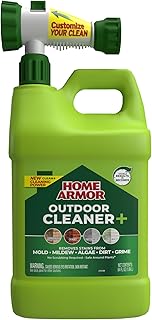
Match the product to the stain, not to the label’s promises. For broad green and black organic growth across a large rug, a hose-end applicator covers the most ground with the least effort: the 30 SECONDS Outdoor Cleaner Hose End Sprayer attaches straight to a garden hose so you never lift a bucket, and the two-pack is realistic for a full patio. Wet & Forget Outdoor Cleaner is bleach-free and works slowly over weeks with normal rain — excellent for rugs you can’t easily move, though it won’t satisfy anyone who wants same-day results. For fast visible lift on set-in mildew, Home Armor Outdoor Cleaner+ is the aggressive option; keep it off adjacent plantings and follow the dilution directions. For general grime, tannin, and traffic lanes, Simple Green Oxy Solve is a peroxide concentrate that works manually or through a pressure washer and carries EPA Safer Choice certification, which matters if the rug sits where pets and kids sprawl.
Spot Treatment and Body Mechanics
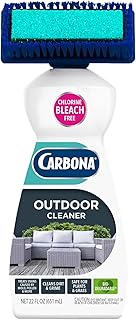
Individual stains — sunscreen, wine, bird droppings, planter rust — need targeted work. The Carbona Oxy Powered Outdoor Cleaner combines the solution with a sponge-and-bristle head so you’re not juggling a bottle and a brush, and the 30 SECONDS Ready To Use spray handles one-off mildew spots without mixing. For anything requiring pressure, use a long-handled deck brush and push from a standing stride stance, driving with your legs and hips rather than reaching and pulling with your shoulders. Keep the brush head roughly under your center of mass. If you feel your low back rounding, you’ve reached too far — reposition your feet instead.
Drying Is the Durability Step
A rug that dries in two hours will outlast an identical rug that dries in two days, because mildew colonizes damp backing, not clean fiber. Squeegee the surface to push standing water out, then drape the rug over two railings or a pair of sawhorses so air reaches both faces. Never fold a damp rug for storage. To move it, roll it into a tube first — rolled weight is compact and close to your body, whereas dragging a saturated rug is how people tear backings and strain shoulders. Get a second pair of hands for anything above 6×9.
Tips
- Clean on an overcast day. Direct sun dries cleaner on the fiber before it finishes working, which leaves streaks and wastes product.
- Put a breathable rug pad or a few low risers under the rug permanently. Airflow underneath prevents most mildew problems before they start.
- Rotate the rug 180 degrees each season so foot traffic and UV exposure wear evenly instead of carving a visible lane.
- Rinse nearby plants and hardscape with plain water before and after applying any outdoor cleaner to dilute overspray.
Frequently Asked Questions
Can I pressure wash an outdoor rug?
Only with a wide fan tip, under 1,500 PSI, held at least 18 inches back and moving continuously. Concentrated spray separates woven fibers and shreds backing. A hose nozzle plus an oxygen cleaner is safer and usually just as effective.
Will bleach hurt my rug?
Chlorine bleach can be acceptable on solution-dyed polypropylene, but it degrades natural fibers, weakens latex backing, and kills surrounding plants. Peroxide-based or bleach-free formulas are the better default.
How often should I deep clean?
Twice a year in most climates — spring and before winter storage. Humid or shaded spots need a mid-season pass. Sweeping weekly cuts the deep-clean workload substantially.
Can I put an outdoor rug in a washing machine?
Small flat-woven rugs under about 3×5 sometimes tolerate a cold gentle cycle, but the water weight strains most home machines and backing can shed. Hand cleaning is the lower-risk choice.
Conclusion
The best method is unglamorous and repeatable: know your fiber, remove dry grit first, let an appropriate cleaner do the chemical lifting, work from a standing position with long tools, and dry the rug fast with air on both sides. Do that twice a year and you’ll spend less effort per session, avoid the injuries that come from wrestling saturated textiles, and get several extra seasons out of a rug that would otherwise be replaced early.