Key takeaways
- Motor type and duty cycle: Brushless DC motors run cooler and draw a fraction of an AC motor’s power, which matters if the fan stays on 12+ hours a day in summer. Cooler windings mean slower insulation breakdown and less bearing grease migration, so a DC unit left on low overnight ages far better than a comparable AC one.
- Blade span versus ceiling clearance: Aim for blade tips at least 18 inches from any wall and 7 feet above the floor. Rooms under 8 feet call for a flush-mount or low-profile build; anything larger than 15 by 15 feet benefits from a 60-inch-plus span running slowly rather than a 52-inch fan working hard.
- Dimming quality at the low end: Cheap drivers hold steady at full brightness and pulse visibly below about 20 percent. If you plan to use the fan light as evening ambient lighting, prioritize models with stepless dimming and adjustable color temperature, and test the lowest setting on day one while returns are still easy.
- Control redundancy: An app-only fan becomes a paperweight during a router outage. Look for a physical remote plus wall-switch or voice fallback, and check whether the fan remembers its last speed after a power cut instead of defaulting to high.
- Serviceable hardware: Steel blade arms, captive canopy screws, and a light kit that unclips without dismantling the motor housing all shorten future ladder time. Rubber-isolated blade mounts and a supplied balancing kit are strong signals that the manufacturer expects the fan to still run quietly in year five.
What's inside
Most ceiling fan complaints have nothing to do with airflow. They show up months later: a faint tick at speed four, a light that strobes when dimmed low, a remote that has to be aimed just right, a blade set that hums because one arm was torqued a half-turn tighter than the rest. Buyers shop by blade span and finish, then live with the parts that actually age — the motor bearings, the LED driver, the wireless board, and the joint where the downrod meets the canopy.
This guide looks at 2026’s smart ceiling fans through a durability and daily-use lens: how the motor holds up under long runtimes, whether the light stays flicker-free at the bottom of its dimming range, how much physical effort the controls demand, and which models are realistically serviceable. Sizing notes for low ceilings and covered patios are included, since mounting geometry drives both comfort and long-term wobble more than any spec sheet number.
As an Amazon Associate we earn from qualifying purchases.


How to Choose a Smart Ceiling Fan With Light (2026)
- Motor type and duty cycle: Brushless DC motors run cooler and draw a fraction of an AC motor’s power, which matters if the fan stays on 12+ hours a day in summer. Cooler windings mean slower insulation breakdown and less bearing grease migration, so a DC unit left on low overnight ages far better than a comparable AC one.
- Blade span versus ceiling clearance: Aim for blade tips at least 18 inches from any wall and 7 feet above the floor. Rooms under 8 feet call for a flush-mount or low-profile build; anything larger than 15 by 15 feet benefits from a 60-inch-plus span running slowly rather than a 52-inch fan working hard.
- Dimming quality at the low end: Cheap drivers hold steady at full brightness and pulse visibly below about 20 percent. If you plan to use the fan light as evening ambient lighting, prioritize models with stepless dimming and adjustable color temperature, and test the lowest setting on day one while returns are still easy.
- Control redundancy: An app-only fan becomes a paperweight during a router outage. Look for a physical remote plus wall-switch or voice fallback, and check whether the fan remembers its last speed after a power cut instead of defaulting to high.
- Serviceable hardware: Steel blade arms, captive canopy screws, and a light kit that unclips without dismantling the motor housing all shorten future ladder time. Rubber-isolated blade mounts and a supplied balancing kit are strong signals that the manufacturer expects the fan to still run quietly in year five.
The Best Smart Ceiling Fans With Light (2026) Reviewed
Sofucor 52-Inch Smart Ceiling Fan
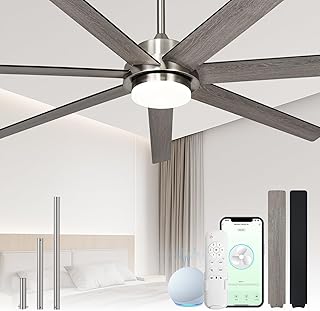
The five ABS blades keep rotating mass low, which reduces bearing load and makes the reversible DC motor feel unstrained across all six speeds. Its brown finish and 3CCT light suit farmhouse and patio-adjacent rooms, and the four-way control set — Alexa, Google, app, remote — means no single failure point locks you out.
DREO 52-Inch RGBIC Smart Fan (White)
Twelve speeds and three modes give you far finer control than the usual three-step ladder, so you can dial in the exact airflow that stops short of drying out your eyes overnight. The 22dB motor rating is credible in practice, and the RGBIC accent layer stays separate from the main dimmable white light rather than muddying it.
ZMISHIBO 24-Inch Low Profile Fandelier
Best answer for a small bedroom or hallway with an 8-foot ceiling, where a full-span fan would put blade tips uncomfortably close to head height. The 3000–6000K dimmable panel and six wind speeds cover the whole day, though the compact rotor moves less air, so treat it as a room under roughly 150 square feet.
DREO 52-Inch Smart Fan (Black)
Mechanically the same well-damped platform as the RGBIC version, minus the color effects and with a cleaner matte-black housing that hides dust shadows better. Stepless dimming plus a timer makes it a strong bedroom choice for anyone sensitive to light flicker.
DREO 52-Inch Low Profile Smart Fan
A flush-mount body that still swings a full 52-inch span, so you get real air movement in low-ceiling living rooms and game rooms. Color tuning and RGB ambient lighting are handled in-app, and assembly is genuinely quick — fewer overhead minutes on a ladder, which is its own kind of ergonomics.
Frequently Asked Questions
Do smart ceiling fans use more electricity than standard ones?
No. The DC motors in nearly all current smart fans draw roughly 60 to 70 percent less power than legacy AC motors at comparable airflow. Standby draw for the Wi-Fi radio is typically under a watt.
Will the fan still work if my Wi-Fi goes down?
On every model here, yes — the remote communicates directly with the fan’s receiver. You lose scheduling and voice control until the network returns, but speed and light control stay intact.
Why does a new fan wobble, and is it dangerous?
Almost always uneven blade weight or unequally torqued arm screws, not a failing motor. Snug all screws to the same firmness, then use a balancing clip. Persistent wobble accelerates bearing wear, so it is worth correcting even when it looks harmless.
Can I use these outdoors?
Only in covered, dry-rated locations unless the listing says damp or wet rated. For an exposed patio, a large wet-rated unit like the Minislak 65-inch is the safer specification.
Final Thoughts
For most rooms, the DREO 52-inch in black is the balanced pick — quiet motor, honest stepless dimming, and speed granularity you will actually use. Choose the DREO low profile 52-inch if your ceiling sits under 8 feet, or the Sofucor 52-inch if you want warmer wood-toned styling with broad voice and app compatibility.