Key takeaways
- Use a fan-rated electrical box and have permanent wiring installed by a qualified professional where required.
- Balance the fan during installation and recheck mounting hardware after the first few weeks of operation.
- Keep blades clean; accumulated dust and pollen can increase vibration, noise, and motor strain.
- Measure the downrod, blade clearance, and door or beam locations before ordering.
What's inside
The best outdoor ceiling fan is not simply the one with the largest blade span or the most app features. It is the model that suits your ceiling, climate, seating layout, and tolerance for noise while continuing to operate reliably through seasonal temperature changes. A fan that moves air efficiently can make a porch, patio, garage, or covered outdoor room feel noticeably more comfortable without relying as heavily on air conditioning.
This guide takes an ergonomics-and-durability approach to choosing one. We will look at airflow, wet or damp-location ratings, mounting height, controls, lighting, motor behavior, and maintenance. The goal is to help you match the fan to the way the space is actually used—not merely to its advertised blade diameter.
As an Amazon Associate we earn from qualifying purchases.




Start With the Space and Mounting Conditions
Measure the room before comparing models. Blade span should correspond broadly to the area being ventilated: compact fans around 20 to 48 inches suit smaller porches, bedrooms, and seating zones, while 60- to 72-inch fans are more appropriate for broad patios, garages, and open-plan covered areas. A large fan running slowly is often quieter and more comfortable than a small fan running at maximum speed.
Ceiling height matters just as much. For most occupied spaces, the blades should sit roughly 7 to 9 feet above the floor, with ample clearance from walls, beams, lights, and door swings. Flush-mount and low-profile installations help with low ceilings; downrods improve circulation on taller ceilings. Always follow the manufacturer’s minimum clearance requirements and use a mounting box rated for ceiling-fan loads.
Check the Outdoor Rating Carefully
“Outdoor” is not a sufficient specification. Damp-rated fans are designed for covered locations where they may encounter humidity and indirect moisture. Wet-rated models are built for areas exposed to rain or splashing, subject to the manufacturer’s installation instructions. A covered porch may accept a damp-rated fan, while an exposed patio generally calls for wet-rated equipment.
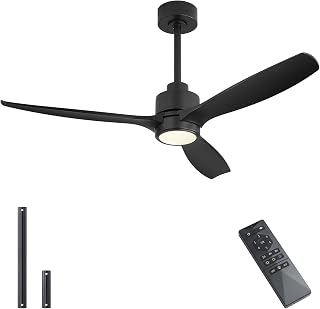
Look beyond the fan housing. The switch, receiver, light kit, and electrical connections must also be suitable for the installation. For example, the WINGBO 48-inch wet-rated fan with light is aimed at indoor and outdoor locations, while the addlon 20-inch IP65 plug-in caged fan is a more compact hanging option. Neither should be treated as interchangeable with a permanently wired, exposed-location ceiling fan without checking the installation requirements.
Choose Airflow for Comfort, Not Just Numbers
Airflow is commonly listed in cubic feet per minute (CFM), but the highest figure is not automatically the best choice. A fan’s effectiveness depends on blade pitch, room size, mounting height, and how directly the air reaches occupants. In a dining or lounge area, you want a broad, steady breeze rather than a concentrated blast that makes conversation, reading, or meals uncomfortable.
Large spaces can benefit from a high-capacity model such as the Minislak 72-inch fan or Ohniyou 60-inch industrial fan. Their larger blades are designed for substantial air movement, but they also need adequate structural support and clearance. For a more decorative, moderate-sized installation, the 52-inch addlon solid-wood-blade fan may be a better ergonomic fit. Compare airflow specifications under the same testing standard, and treat marketing terms such as “high CFM” as a prompt to inspect the actual figures.
Prioritize Motor Quality, Controls, and Noise
DC motors are popular in outdoor fans because they typically offer multiple speed settings, efficient operation, and smooth transitions between speeds. Reversible operation is useful seasonally: in warm weather, the fan should push air downward for cooling; in cooler weather, a low-speed reverse setting can help redistribute warm air near the ceiling, where appropriate.
Noise is a practical durability and comfort issue. A fan advertised at 35 dB, such as the Ohniyou model, may be attractive for a porch near a bedroom, but the finished noise level also depends on balance, installation, wind, and the ceiling structure. Remote controls are convenient when the fan is mounted high. App, Alexa, and timer features—available on the 65-inch smart fan—can improve accessibility, but they add setup and connectivity considerations. Choose simple physical controls if guests or unreliable Wi-Fi are likely concerns.
Decide Whether You Need a Light
A lighted fan can simplify a patio installation, but it should complement rather than replace proper ambient lighting. Check color-temperature choices, dimming range, glare, and whether the light sits below the blades or within the housing. Multiple color-temperature settings, such as the 3CCT feature on the WINGBO, can help a space shift from task lighting to a warmer evening atmosphere.
For a garage, workshop, or large covered entertaining area, a no-light fan may be preferable because it leaves lighting independent and easier to position. Conversely, the 65-inch outdoor fan with light and smart controls may suit a larger porch where centralized illumination is useful. Consider whether the light will shine into seated occupants’ eyes; a diffuser and carefully chosen mounting position can make a bigger difference than raw brightness.
Tips
- Use a fan-rated electrical box and have permanent wiring installed by a qualified professional where required.
- Balance the fan during installation and recheck mounting hardware after the first few weeks of operation.
- Keep blades clean; accumulated dust and pollen can increase vibration, noise, and motor strain.
- Measure the downrod, blade clearance, and door or beam locations before ordering.
Frequently Asked Questions
What is the best size outdoor ceiling fan?
For many covered patios, 52 to 60 inches is a practical starting range. Choose 65 to 72 inches for larger open areas, provided the ceiling and mounting structure can support the fan. Smaller spaces may be better served by a 20- to 48-inch model.
Can I install a damp-rated fan in an uncovered patio?
Usually not. Damp-rated fans are intended for protected areas and should not be exposed directly to rain or splashing. An uncovered location generally requires a wet-rated model specifically approved for that environment.
Are three-blade fans better than five- or seven-blade fans?
Not inherently. Blade count affects the fan’s design, sound, resistance, and appearance, but performance depends on the complete motor-and-blade system. Compare measured airflow, speed control, efficiency, and noise rather than counting blades alone.
Is a remote or app-controlled fan worth choosing?
Remote control is particularly useful when the fan is mounted high or when users have limited reach. App and voice controls add convenience and scheduling, but a dependable manual or remote fallback is valuable if the network is unavailable.
Conclusion
The best outdoor ceiling fan for 2026 is the one that delivers suitable airflow at a comfortable noise level, carries the correct moisture rating, and fits the ceiling safely. Large Minislak and Ohniyou models suit substantial covered areas; WINGBO and the 65-inch smart model combine airflow with integrated lighting; the addlon caged fan serves compact or temporary setups; and the 52-inch wood-blade design offers a quieter, more traditional visual direction. Match those strengths to your space, verify the installation details, and prioritize reliable comfort over headline specifications.