Key takeaways
- Tooth count matched to the job: 24-32 teeth clear chips fast for ripping thick hardwood with minimal feed force; 40-50 teeth handle general crosscuts and sheet goods; 60-80 teeth deliver glue-ready edges but demand slower, more patient feeding to avoid heat.
- Kerf and plate thickness: Thin-kerf plates (roughly 3/32″) reduce the load on saws under 1.75 HP, so the motor holds RPM and you push less. Full-kerf plates resist deflection better on cabinet saws and produce squarer edges in tall stock.
- Carbide grade and regrind potential: Look for generous carbide shoulders brazed cleanly to the tooth seat. Thicker tips survive several sharpenings, turning a single blade into years of service rather than a disposable.
- Vibration and noise control: Laser-cut expansion slots, anti-kickback shoulders, and a tensioned plate cut down the harmonic buzz that numbs hands during long sessions. Quieter blades are almost always straighter blades.
- Arbor fit and runout: A precise 5/8″ bore seats flat against the washer with no wobble. Even a few thousandths of runout widens the kerf, scorches the cut, and forces you to muscle the workpiece through.
What's inside
Most complaints about a contractor saw trace back to the blade, not the motor. When a cut wanders, leaves burn stripes, or forces you to lean into the workpiece, your body is compensating for a tool that has stopped doing its share of the work. That extra feed pressure travels straight into your wrists and shoulders, and it also raises the odds of a kickback event, because you are pushing hard against a plate that wants to stall. A blade that engages cleanly lets you move stock at a steady, relaxed pace with your hands where they belong.
This guide looks at 10-inch blades through two lenses that rarely get equal billing: how much effort they demand from the operator, and how long they hold that behavior before service. That means plate stiffness, kerf width relative to your saw’s available power, carbide thickness and whether it can be reground, and the vibration-damping details that keep a spinning disc quiet at full depth. Below are the blades worth a slot in a home shop this year, followed by selection criteria and answers to the questions that come up most.
As an Amazon Associate we earn from qualifying purchases.


How to Choose a 10 Inch Table Saw Blade (2026)
- Tooth count matched to the job: 24-32 teeth clear chips fast for ripping thick hardwood with minimal feed force; 40-50 teeth handle general crosscuts and sheet goods; 60-80 teeth deliver glue-ready edges but demand slower, more patient feeding to avoid heat.
- Kerf and plate thickness: Thin-kerf plates (roughly 3/32″) reduce the load on saws under 1.75 HP, so the motor holds RPM and you push less. Full-kerf plates resist deflection better on cabinet saws and produce squarer edges in tall stock.
- Carbide grade and regrind potential: Look for generous carbide shoulders brazed cleanly to the tooth seat. Thicker tips survive several sharpenings, turning a single blade into years of service rather than a disposable.
- Vibration and noise control: Laser-cut expansion slots, anti-kickback shoulders, and a tensioned plate cut down the harmonic buzz that numbs hands during long sessions. Quieter blades are almost always straighter blades.
- Arbor fit and runout: A precise 5/8″ bore seats flat against the washer with no wobble. Even a few thousandths of runout widens the kerf, scorches the cut, and forces you to muscle the workpiece through.
The Best 10 Inch Table Saw Blades (2026) Reviewed
DEWALT DWA11040 40-Tooth Fine Finish
The best all-rounder here: 40 teeth is the sweet spot where you can rip 4/4 hardwood without bogging the motor, then crosscut plywood with minimal tearout, all without swapping blades. Thin kerf keeps feed pressure low on jobsite and hybrid saws, and the carbide has enough mass to justify professional sharpening.
FOXBC 80-Tooth Ultra Finish
Reach for this when the cut edge is the finished edge, such as melamine shelving, veneered panels, or trim that goes straight to assembly. With 80 teeth the gullets are small, so feed slowly and steadily; forcing it builds heat that shortens tip life and burnishes the wood.
WEN BL1080 80-Tooth
A well-balanced ultra-fine blade that runs noticeably smoother than budget pricing suggests, which matters if you spend afternoons at the saw. It shares mounting duties across miter and table saws, though the fine tooth geometry rewards a stable stand and a sharp, clean plate.
WEN BL1060 60-Tooth
My pick for the compromise position: fine enough for cabinet-grade crosscuts, open enough to clear chips without stalling. It is the blade I would leave mounted for weeks of mixed furniture work, and the tooth spacing is far more forgiving of an inconsistent feed rate than an 80-tooth.
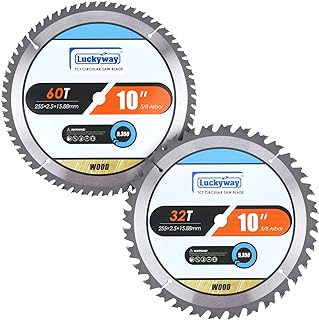
Luckyway 60-Tooth and 32-Tooth Two-Pack
Buying a rip blade and a finish blade together is the single cheapest ergonomics upgrade available, because it removes the temptation to rip thick stock with a fine blade. The 32-tooth clears sawdust aggressively so the motor and your arms both stay relaxed, and the 60-tooth takes over for final dimensioning.
Frequently Asked Questions
How do I know a blade is dull rather than misaligned?
Dull blades need more push and produce fine, powdery dust with scorching on both faces of the cut. Misalignment shows up as burning on one face only, usually the side toward the fence, along with a cut that closes on the blade behind the arbor.
Are thin-kerf blades worth it?
On any saw under about 1.75 HP, yes. Less material removed means less amp draw, steadier RPM, and less feed force, which is the whole ballgame for comfort. Use a stabilizer or zero-clearance insert if you notice flex in tall rips.
Can these blades run in a miter saw too?
Most 10-inch, 5/8″ arbor blades will physically fit, and the WEN and Luckyway options are marketed for both. Just check the maximum RPM rating against your miter saw and confirm the guard clears the tooth projection.
How often should carbide blades be sharpened?
For a home shop, roughly once a year on a primary blade, or sooner if feed effort climbs. Sharpening costs a fraction of replacement, and a good plate happily takes three or four regrinds.
Final Thoughts
If you want one blade to live on the arbor, the DEWALT DWA11040 offers the widest useful range for the least effort at the push stick. Pair it with the WEN BL1060 when you need finish-quality crosscuts, or start with the Luckyway 60T/32T two-pack if you are building a blade set from scratch and want the right geometry for each cut from day one.