Key takeaways
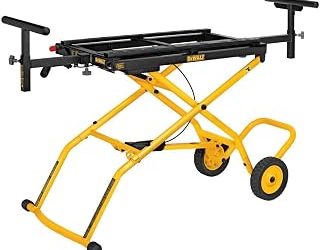
- Deck height and stance: A saw perched on a folding stand should put the table roughly at hip level so your forearms stay near horizontal during a rip. Too low and you round your back over every cut; too high and you lose downward control of the workpiece. Measure the stand’s deployed height before you commit.
- Fence effort and repeatability: Slide the rip fence across its full travel and note where it binds. A fence needing two hands and a shoulder shove will drift out of parallel within a season. Rack-and-pinion systems generally hold square longer and demand far less grip strength.
- Control placement: Bevel locks, height cranks, and blade guards should all be operable from the front, outside the blade’s plane. Reaching across a spinning arbor is a habit that eventually costs something.
- Trunnion and bearing quality: Cast trunnions bolted to the tabletop hold alignment better than thin stamped brackets riveted into a shell. Electric blade brakes multiply this concern: every stop loads the arbor bearings hard, so brake-equipped saws need the sturdier internals.
- Battery thermal headroom: Stacked-cell and high-voltage packs run cooler under a sustained hardwood rip than compact packs pushed to their limit. Sustained cutting is where undersized batteries sag, throttle, and shorten their own service life.
What's inside
Anyone who has hauled a jobsite saw up a flight of stairs, then spent ten minutes hunting for an outlet that isn’t already feeding a compressor, knows the real cost of a corded rig isn’t the cord itself. It’s the setup tax: the extension reel, the trip hazard snaking across a half-finished floor, the tear-down at the end of a two-cut task. Cordless table saws remove that tax, but they introduce their own tradeoffs. Smaller decks mean less workpiece support. Battery packs shift the center of gravity. And motor braking, which is a genuine safety win, puts cyclical stress on arbor bearings that cheaper builds don’t survive.
This guide evaluates portable table saws through two lenses I trust more than spec sheets: how the machine treats your body over a long day, and how its wear points hold up after a few hundred hours. That means measuring fence travel resistance, checking whether the bevel lock is reachable without leaning across the blade, judging deck height against a standing user’s wrist line, and looking hard at trunnion mounting, dust evacuation, and stand deployment mechanics. A few corded models appear below as honest benchmarks, clearly labeled, because pretending cordless wins every category would not serve you.
As an Amazon Associate we earn from qualifying purchases.




How to Choose a Cordless Table Saw (2026)
- Deck height and stance: A saw perched on a folding stand should put the table roughly at hip level so your forearms stay near horizontal during a rip. Too low and you round your back over every cut; too high and you lose downward control of the workpiece. Measure the stand’s deployed height before you commit.
- Fence effort and repeatability: Slide the rip fence across its full travel and note where it binds. A fence needing two hands and a shoulder shove will drift out of parallel within a season. Rack-and-pinion systems generally hold square longer and demand far less grip strength.
- Control placement: Bevel locks, height cranks, and blade guards should all be operable from the front, outside the blade’s plane. Reaching across a spinning arbor is a habit that eventually costs something.
- Trunnion and bearing quality: Cast trunnions bolted to the tabletop hold alignment better than thin stamped brackets riveted into a shell. Electric blade brakes multiply this concern: every stop loads the arbor bearings hard, so brake-equipped saws need the sturdier internals.
- Battery thermal headroom: Stacked-cell and high-voltage packs run cooler under a sustained hardwood rip than compact packs pushed to their limit. Sustained cutting is where undersized batteries sag, throttle, and shorten their own service life.
The Best Cordless Table Saws (2026) Reviewed
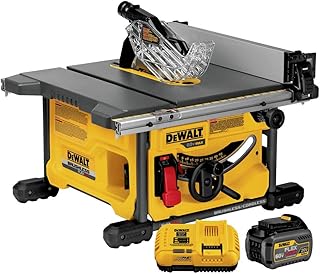
DEWALT FLEXVOLT 60V MAX 8-1/4-Inch (DCS7485T1)
The strongest cordless argument in the category: rack-and-pinion fence movement stays light through its entire sweep, the controls cluster sensibly on the front face, and the 60V pack keeps voltage steady deep into ripping 2x hardwood instead of stumbling near the end of the cut. Wear points are the ones you’d want stressed, with a substantial trunnion assembly carrying the brake loads rather than a thin bracket.
FLEX 24V Brushless 8-1/4-Inch (FX7211-1H)
FLEX built this around thermal behavior, and the stacked lithium pack shows it, staying noticeably cooler than compact packs through repeated rips. Ergonomically it’s tidy, with a fence that tracks smoothly and a rapid charger that keeps a single-pack workflow viable across a full day.
RYOBI ONE+ HP 18V Brushless Compact (Jobsite Kit)
The lightest genuinely usable option here, which matters enormously if you’re carrying it solo through a house. Expect to pace yourself on thick hardwood and let the dual 4.0 Ah packs swap in rotation, but for sheet goods, trim, and cabinet work the compact footprint is a body-saving advantage rather than a compromise.
DEWALT DWE7485 Compact Jobsite Saw (corded)
Corded, and worth naming as the durability yardstick the cordless 8-1/4-inch saws are measured against: same fence architecture, same compact deck, no pack weight hanging off one corner. If your work happens near reliable power, this is the lower-fatigue, longer-runtime version of the same machine.
DEWALT DWE7491RS with Rolling Stand (corded)
Also corded, and the ergonomic outlier in the best sense. The rolling stand deploys in one motion at a genuinely appropriate working height, the 32-1/2-inch rip capacity handles full sheet goods without awkward outfeed gymnastics, and the 10-inch blade means fewer forced passes on thick stock.
Frequently Asked Questions
Can a cordless table saw handle hardwood?
Yes, with attention to feed rate. High-voltage and stacked-cell platforms manage sustained hardwood rips well; compact 18V packs will do it but ask you to slow down and rotate batteries to avoid heat buildup.
Why does blade size matter for comfort?
An 8-1/4-inch blade limits depth of cut, so thicker stock requires flipping the workpiece and making a second pass. That doubles handling, doubles alignment risk, and adds real fatigue over a day of framing-scale work.
How much runtime should I expect per charge?
Plan in cuts, not hours. A 6.0 Ah stacked pack or 60V FLEXVOLT battery typically covers a substantial run of sheet-good rips, while compact packs suit intermittent trim and cabinet tasks between charges.
Is a folding stand worth the extra bulk?
Almost always. Working off sawhorses or a tailgate puts the deck at the wrong height and encourages bracing with your torso, which is where back strain and control loss originate.
Final Thoughts
For cord-free work that still feels like a real saw, the DEWALT FLEXVOLT DCS7485T1 leads on fence feel, control layout, and internal robustness, with the FLEX FX7211-1H close behind on thermal composure and day-long single-pack practicality. Choose the RYOBI ONE+ HP kit if carry weight and tight interior spaces dominate your work, and keep the corded DWE7491RS in mind if your shop has power and you’d rather have the taller stand and full 10-inch capacity.