Key takeaways
- Frame rigidity over headline horsepower: A 1/2 HP motor on a stiff steel body will hold a truer line than a stronger motor bolted to a frame that twists under tension. Press the upper wheel housing by hand; any perceptible give shows up later as blade drift and premature guide wear.
- Throat and depth matched to your real stock: A 10-inch throat covers most cabinet and small furniture work, while 5-inch depth capacity on portable saws handles pipe, tube, and thick offcuts. Buying beyond your typical stock adds weight and cost without improving cut quality.
- Grip geometry and balance on handheld units: Look for a rear trigger handle roughly in line with the cut and a front grip you can load with the palm rather than the fingertips. Tools that sit nose-heavy make you counteract gravity through the wrist, which is where soreness starts.
- Variable speed with usable range: A spread like 137 to 472 FPM lets you slow down for steel and open up for softwood and PVC, keeping heat out of the blade. Slower correct speeds extend blade life dramatically, which is the cheapest durability upgrade available.
- Parts you can replace yourself: Guide bearings, tires, brushes, and blades should be standard sizes and reachable without dismantling the drivetrain. Sealed, proprietary assemblies turn a 20-minute tune-up into a disposal decision.
What's inside
Most home workshop band saws are bought for one job and then judged on every job after it. Someone resaws a walnut board for a floating shelf, discovers the blade drifts, and blames the saw when the real culprit is a flexing trunnion, worn guide bearings, or a tensioning knob that never held true. Add the physical side of the equation, a handheld unit whose balance point sits ahead of the grip, or a benchtop model set at a height that forces the shoulder to carry the work, and small annoyances compound into fatigue, sloppy cuts, and a tool that quietly stops getting used.
This guide looks at band saws through two lenses that rarely appear in spec sheets: how the tool loads your body over a long session, and which components fail first under repeated household use. I have weighted stationary saws for frame and table stiffness, portable saws for grip geometry and vibration transfer, and all of them for the serviceability of the parts that actually wear. Below are the models worth considering in 2026 if you build furniture, break down stock, and occasionally cut metal in the same afternoon.
As an Amazon Associate we earn from qualifying purchases.



How to Choose a Band Saw For Home Workshop (2026)
- Frame rigidity over headline horsepower: A 1/2 HP motor on a stiff steel body will hold a truer line than a stronger motor bolted to a frame that twists under tension. Press the upper wheel housing by hand; any perceptible give shows up later as blade drift and premature guide wear.
- Throat and depth matched to your real stock: A 10-inch throat covers most cabinet and small furniture work, while 5-inch depth capacity on portable saws handles pipe, tube, and thick offcuts. Buying beyond your typical stock adds weight and cost without improving cut quality.
- Grip geometry and balance on handheld units: Look for a rear trigger handle roughly in line with the cut and a front grip you can load with the palm rather than the fingertips. Tools that sit nose-heavy make you counteract gravity through the wrist, which is where soreness starts.
- Variable speed with usable range: A spread like 137 to 472 FPM lets you slow down for steel and open up for softwood and PVC, keeping heat out of the blade. Slower correct speeds extend blade life dramatically, which is the cheapest durability upgrade available.
- Parts you can replace yourself: Guide bearings, tires, brushes, and blades should be standard sizes and reachable without dismantling the drivetrain. Sealed, proprietary assemblies turn a 20-minute tune-up into a disposal decision.
The Best Band Saw For Home Workshop (2026)s Reviewed
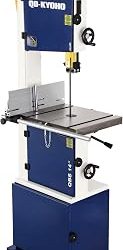
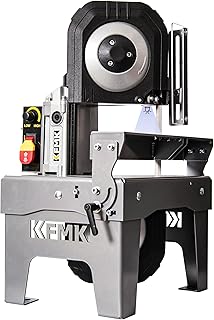
10-Inch Dual-Speed Woodworking Band Saw
The steel body and 1515/3280 FPM dual-speed drive make this the most honest stationary choice here for furniture work, and the double-sided fence assembly gives you a reference face that stays put through repeated resaw passes. Set it on a bench that puts the table near hip height and the miter gauge work becomes noticeably less tiring on the lower back.
5-Inch Benchtop Bandsaw with Liftable Worktable
Its liftable worktable is the standout ergonomic feature, converting a handheld-style deep-cut saw into a stable seated station for repetitive metal and PVC cuts. The 10-amp motor and 137 to 472 FPM range give you enough control to keep blades from bluing, which is the main durability variable on small metal saws.
DEWALT DCS374B 20V MAX Band Saw
The 5-inch capacity and integrated hang hooks reflect a tool designed around how it gets carried and parked, not just how it cuts, and the balance sits close enough to the blade that overhead work stays controllable. As a bare tool it slots neatly into an existing 20V collection, and the guide and tire assemblies are well supported for long-term service.
DEWALT DCS378B 20V MAX XR Brushless Bandsaw
The brushless motor removes the brush wear question entirely and runs cooler under load, while the tighter 3-3/8 inch capacity trims weight where it matters most for one-handed positioning. If your cuts are mostly conduit, angle iron, and hardware rather than heavy stock, this is the least fatiguing of the cordless options.
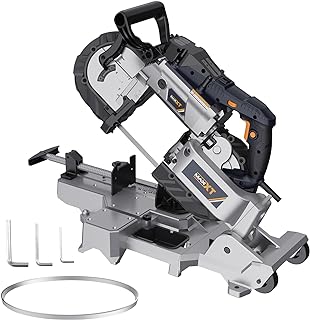
MAXXT 5-Inch Deep Cut Bandsaw
A lightweight aluminum base plus carrying wheels makes this the easiest corded portable to reposition mid-project, and the 10-amp motor means no runtime cliff during longer cutting sessions. Variable speed control is broad enough to move between metal and wood without changing blades constantly.
Frequently Asked Questions
Do I need a stationary band saw if I already own a portable one?
If you resaw, cut curves, or work with wide furniture stock, yes. Portable saws cannot support a workpiece against a fence, so accuracy depends entirely on your hands staying steady, which is where fatigue erodes precision.
How often should blades be replaced?
Replace when the cut starts wandering or the saw needs noticeably more feed pressure, typically well before visible tooth damage. Running a dull blade transfers load into the guides and bearings, turning a cheap blade problem into an expensive drivetrain one.
Can one saw handle both wood and metal?
With variable speed and a blade change, yes. Slow speeds and fine tooth counts suit steel, faster speeds and coarser teeth suit wood, and mixing those settings is the fastest way to ruin a blade.
What single adjustment improves cut quality most?
Proper blade tension followed by guide bearing spacing. Set tension per the manual, then bring the guides close to the blade without contact, and check both after the first hour of use as new blades settle.
Final Thoughts
For a home shop centered on furniture, the 10-Inch Dual-Speed Woodworking Band Saw earns the bench space with its steel frame and dependable fence. Pair it with the DEWALT DCS378B for cool-running cordless convenience, or choose the DCS374B if 5-inch depth capacity matters more to you than shaving weight off the tool.