Key takeaways
- Handle style and trigger reach: Vertical D-handles keep your wrist neutral and suit shorter operators; horizontal grips give better downforce control on wide stock. Check that the safety paddle releases without regripping.
- Control placement over feature count: A front-mounted bevel lever gets used. One reached behind the motor housing gets ignored, and ignored adjustments become inaccurate cuts.
- Detent plate and fence material: Machined aluminum or cast detent plates hold their stops. Thin stamped plates round off, and a rounded 45 stop is a miter saw that lies to you.
- Slide mechanism protection: Sliding saws live or die by their rails. Sealed or rear-shrouded bearings resist MDF dust; exposed rails need wiping or they develop drag and side-to-side play.
- Weight where it counts: Under about 30 pounds with a balanced carry handle is genuinely portable. Heavier saws are fine bolted to a bench, but plan the station before you buy.
What's inside
A miter saw earns its keep in the last ten minutes of a build, when your shoulders ache, the light is going, and a face frame still needs four tight returns. That is exactly when a poorly laid-out tool starts costing you material. Trigger too far forward and your wrist rolls off axis. Bevel lock buried behind the motor and you stop checking it. Detent plate stamped from soft steel and your 45s drift a half-degree over a season of cabinet work. Most buyers compare blade count and amp draw, then discover the real differences live in handle geometry, pivot slop, and how the saw behaves after two hundred cuts in one afternoon.
This guide looks at 10-inch miter saws through two lenses I trust more than spec sheets: ergonomics, meaning how the controls fall under your hands during repetitive cutting, and durability, meaning which components are built to hold calibration rather than merely arrive calibrated. I cover sliding and non-sliding designs, corded and MultiVolt options, and where each one fits in a furniture shop where crosscut accuracy matters more than framing speed.
As an Amazon Associate we earn from qualifying purchases.


How to Choose a 10in Miter Saw (2026)
- Handle style and trigger reach: Vertical D-handles keep your wrist neutral and suit shorter operators; horizontal grips give better downforce control on wide stock. Check that the safety paddle releases without regripping.
- Control placement over feature count: A front-mounted bevel lever gets used. One reached behind the motor housing gets ignored, and ignored adjustments become inaccurate cuts.
- Detent plate and fence material: Machined aluminum or cast detent plates hold their stops. Thin stamped plates round off, and a rounded 45 stop is a miter saw that lies to you.
- Slide mechanism protection: Sliding saws live or die by their rails. Sealed or rear-shrouded bearings resist MDF dust; exposed rails need wiping or they develop drag and side-to-side play.
- Weight where it counts: Under about 30 pounds with a balanced carry handle is genuinely portable. Heavier saws are fine bolted to a bench, but plan the station before you buy.
The Best 10in Miter Saw (2026)s Reviewed
Metabo HPT MultiVolt 36V Sliding Miter Saw (C3610DRAQA)
The strongest all-round pick here: a dual-bevel slider that runs on battery or AC through the same tool, with a compact rail design that lets it sit closer to a wall than most sliders. Bevel controls are reachable from the operator side, and the brushless drive removes brush wear as a service item entirely.
SKIL 10″ Dual Bevel Sliding Compound Miter Saw (MS6305-00)
Thoughtfully arranged for shop work, with dual bevel that saves you from flipping long boards and a fence tall enough to support crown and wide baseboard. The handle sits at a comfortable height for extended sessions, and the miter lock engages positively rather than mushily.
DOVAMAN 10-Inch Sliding Miter Saw
Genuinely ambidextrous handle placement is rare at this price, and it matters if you are left-handed or work from a cramped side of the bench. Three included TCT blades and dual speeds make it flexible across hardwood, laminate, and soft metals, though the exposed slide rails reward regular cleaning.
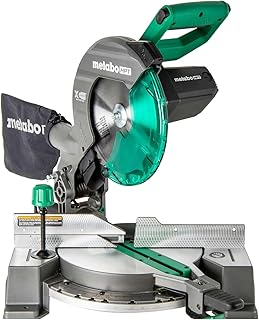
Metabo HPT 10-Inch Compound Miter Saw (C10FCG2)
My recommendation for anyone who moves a saw more than they store it: light enough to carry one-handed, with the Xact Cut shadow line that stays accurate because there is no laser to knock out of alignment. Non-sliding limits crosscut width, but the arm has less flex to fight than most budget sliders.
Hoteche 10-Inch Compound Miter Saw
A straightforward 15-amp single-bevel chop saw for a first shop or a second station dedicated to repeat cuts. Verify the fence square and the 90-degree stop before your first project, then leave the settings alone and it will serve dependably.
Frequently Asked Questions
Is a 10-inch saw big enough for furniture work?
For most casework, table aprons, and chair parts, yes. A 10-inch slider handles roughly 12 inches of crosscut, which covers standard shelving. Step up to 12-inch only if you routinely cut wide panels or tall crown.
Does a sliding saw hold accuracy as well as a chop saw?
A well-built slider does, but it has more moving parts to wear. Fixed-arm saws have inherently less to go out of alignment, which is why they remain popular for precision trim.
Should I trust the laser or a shadow line?
Shadow lines project the actual blade edge, so they cannot drift out of calibration. Lasers are useful but need periodic checking, especially after transport.
How do I keep a miter saw accurate long term?
Blow out the detent plate and slide rails after dusty sessions, check square with a machinist square monthly, and avoid overtightening bevel locks, which deforms the casting over time.
Final Thoughts
For a furniture shop that wants one saw to do everything, the Metabo HPT MultiVolt 36V slider offers the best combination of reach, dual-bevel convenience, and long-term serviceability. The SKIL MS6305-00 is the value choice for a permanent bench station, while the Metabo HPT C10FCG2 remains the saw I recommend when portability and stubborn accuracy matter more than crosscut capacity.