Key takeaways
- Seat depth versus your inseam: Aim for a seat depth roughly two to four inches shorter than your thigh length, measured from the back of the knee to the buttocks. Deeper than that and the front edge presses into your calves; shallower and your legs dangle without support, loading the lower back.
- Backrest angle and lumbar contact: A reclined chaise should meet your spine somewhere between 100 and 120 degrees. If the backrest is a flat slab, plan on a small lumbar pillow from day one rather than treating it as optional.
- Foam density over foam thickness: Thick, low-density foam feels plush in the showroom and bottoms out fast. High-resilience foam or a memory-foam layer over a firmer support core keeps its geometry through thousands of sit cycles.
- Frame construction and load path: Frames with hardwood or engineered-wood rails and reinforced corner blocks resist the racking forces of daily use. Boneless designs skip the frame entirely, which means comfort depends completely on foam quality.
- Upholstery abrasion behavior: Corduroy and bouclé hide wear well and resist pilling under friction. Velvet reads luxurious but shows crushing and body oils at contact points. Faux fur is the softest and the most demanding to maintain.
What's inside
A chaise lounge occupies an awkward middle ground in the furniture world. It has to hold a reclined body at an open hip angle for an hour or more, yet most shoppers evaluate one the same way they evaluate a throw pillow: by how soft it looks in a photo. That mismatch is why so many indoor chaises end up shoved against a wall within six months. The foam has collapsed under the sit bones, the backrest angle fights the lumbar spine instead of supporting it, or the seat depth is three inches too shallow to let the thighs settle. None of that shows up in a product image.
This guide looks at indoor chaise lounges through two lenses that actually predict long-term satisfaction: postural fit and material fatigue. I have flagged where a frame is built around a hardwood or engineered-wood skeleton versus a foam-only “boneless” construction, how each seat depth pairs with different body heights, and which upholstery textures hold up to daily friction rather than occasional guest use. Below are six models worth considering in 2026, followed by a selection framework you can apply to anything you find on your own.
As an Amazon Associate we earn from qualifying purchases.



How to Choose a/an Chaise Lounge Indoor (2026)
- Seat depth versus your inseam: Aim for a seat depth roughly two to four inches shorter than your thigh length, measured from the back of the knee to the buttocks. Deeper than that and the front edge presses into your calves; shallower and your legs dangle without support, loading the lower back.
- Backrest angle and lumbar contact: A reclined chaise should meet your spine somewhere between 100 and 120 degrees. If the backrest is a flat slab, plan on a small lumbar pillow from day one rather than treating it as optional.
- Foam density over foam thickness: Thick, low-density foam feels plush in the showroom and bottoms out fast. High-resilience foam or a memory-foam layer over a firmer support core keeps its geometry through thousands of sit cycles.
- Frame construction and load path: Frames with hardwood or engineered-wood rails and reinforced corner blocks resist the racking forces of daily use. Boneless designs skip the frame entirely, which means comfort depends completely on foam quality.
- Upholstery abrasion behavior: Corduroy and bouclé hide wear well and resist pilling under friction. Velvet reads luxurious but shows crushing and body oils at contact points. Faux fur is the softest and the most demanding to maintain.
The Best Chaise Lounge Indoor (2026)s Reviewed
Velvet Button-Tufted Armless Chaise Lounge (Black)
The armless silhouette and button tufting make this the most space-efficient option here, and the tufting does real work by anchoring the upholstery so it resists migration over time. Best suited to lighter, intermittent use in a bedroom or reading corner rather than as a primary evening seat, since the slimmer profile offers less foam reserve than the oversized models.
ERYE Bouclé Right-Facing Chaise Lounge
Bouclé’s looped construction is genuinely functional upholstery: it diffuses abrasion across many small loops instead of concentrating it on flat pile, so contact points age gracefully. The right-facing orientation and traditional frame give it better structural longevity than boneless alternatives, and assembly is simple enough that alignment errors are unlikely.
ivoros 50″ Corduroy Boneless Chaise Lounge
At 50 inches this is the compact entry in the cloud-sofa category, with a deep seat that suits shorter-legged users well and taller users less so. Corduroy is the standout choice for abrasion resistance, and the no-assembly build means nothing can loosen because there are no fasteners to loosen.
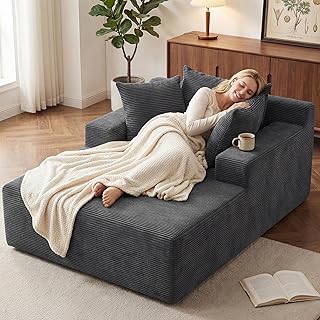
67″ Corduroy Oversized Chaise Lounge
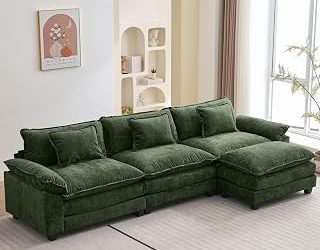
The extra length transforms this from a chair into a legitimate full-recline surface, which matters if you intend to nap on it rather than perch. Expect the usual boneless tradeoff: superb pressure distribution and zero frame noise, offset by gradual compression set in the highest-load zones over several years.
66″ Oversized Boneless Chaise with 3 Pillows
Three included pillows are more than a styling choice here, since they let you build the lumbar and cervical support that a flat boneless back does not provide on its own. A sensible pick for shared households where multiple people of different heights use the same seat.
Frequently Asked Questions
Are boneless chaise lounges durable without a frame?
They can be, but durability shifts entirely onto the foam. Without rails to fail, the failure mode becomes compression set, meaning permanent loss of loft where you sit most. Rotating and reflufing the cushion sections monthly meaningfully slows this.
How much clearance should I leave around a chaise?
Leave at least 18 inches at the foot end so you can swing your legs up without twisting your torso, plus about 30 inches on the entry side for a clear walking path.
Which upholstery is best with pets?
Corduroy and bouclé both perform better than velvet, though for different reasons. Corduroy’s ribs conceal surface scratching, while bouclé’s dense loops resist claw snagging better than smooth pile does.
Can I sleep on an indoor chaise regularly?
Occasional overnight use is fine on the 66- and 67-inch models. For nightly sleep, a purpose-built mattress remains the better choice, since chaise foam is engineered for seated pressure distribution rather than side-sleeping shoulder and hip relief.
Final Thoughts
For most homes, the ERYE Bouclé Right-Facing Chaise is the soundest long-term buy thanks to its framed construction and abrasion-tolerant upholstery. If deep-seat comfort and full recline matter more than frame longevity, the 67″ Corduroy Oversized Chaise delivers the best pressure distribution of the group, while the Velvet Button-Tufted Armless model remains the smartest option for tight floor plans.