Key takeaways
- Strain relief at the cord entry: Look for a molded rubber collar or a reinforced fabric sleeve where the lead enters the blanket. A bare wire disappearing into a stitched hem is the single most common failure point, because every fold flexes the same two centimeters of copper.
- Coverage geometry, not just size: A 60″ x 40″ throw covers a reclined passenger well but bunches behind a driver’s lumbar curve. Compact 12″ x 24″ pads sit flat against the seat back and target the hip and shoulder line without interfering with the belt path.
- Element spacing and cold spots: Run your hand across a warmed blanket in a grid pattern. Wide serpentine spacing produces warm stripes with cool valleys, which reads as uneven pressure against the skin and encourages you to shift position — the opposite of what you want on a long drive.
- Controller placement and auto-off: An inline controller should fall naturally near the console, not dangle by the pedals. Auto-shutoff between one and four hours protects the battery on accessory circuits that stay live with the ignition off.
- Wash tolerance and fabric recovery: Machine-washable models must have a detachable lead and sealed element joints. Flannel and fleece pill after repeated cycles; sherpa-lined shells hold loft longer but need low-heat drying to avoid backing separation.
What's inside
Cabin heat is the slowest comfort system in any vehicle. A cold engine needs eight to twelve minutes before the vents deliver anything useful, and in that window your lower back, hips, and shoulders stiffen — the exact tissues that then have to hold a driving posture for the next two hours. A 12-volt heated blanket short-circuits that delay by putting warmth directly against the body instead of heating a cubic meter of air first. The catch is that most of them fail long before the fabric wears out. The weak point is almost always the same: the junction where the cord meets the blanket, or the plug barrel that rattles loose in an aging accessory socket.
This guide evaluates 12-volt blankets the way a durability engineer would — by looking at cord strain relief, heating-wire layout, seam construction, and how the blanket behaves when it is folded into a seat-back pocket a hundred times. Comfort matters too, but comfort you lose in one winter is not a feature. Below are the models worth your money in 2026, plus the specification details that separate a three-season purchase from a three-week one.
As an Amazon Associate we earn from qualifying purchases.



How to Choose a 12 Volt Heated Blanket (2026)
- Strain relief at the cord entry: Look for a molded rubber collar or a reinforced fabric sleeve where the lead enters the blanket. A bare wire disappearing into a stitched hem is the single most common failure point, because every fold flexes the same two centimeters of copper.
- Coverage geometry, not just size: A 60″ x 40″ throw covers a reclined passenger well but bunches behind a driver’s lumbar curve. Compact 12″ x 24″ pads sit flat against the seat back and target the hip and shoulder line without interfering with the belt path.
- Element spacing and cold spots: Run your hand across a warmed blanket in a grid pattern. Wide serpentine spacing produces warm stripes with cool valleys, which reads as uneven pressure against the skin and encourages you to shift position — the opposite of what you want on a long drive.
- Controller placement and auto-off: An inline controller should fall naturally near the console, not dangle by the pedals. Auto-shutoff between one and four hours protects the battery on accessory circuits that stay live with the ignition off.
- Wash tolerance and fabric recovery: Machine-washable models must have a detachable lead and sealed element joints. Flannel and fleece pill after repeated cycles; sherpa-lined shells hold loft longer but need low-heat drying to avoid backing separation.
The Best 12 Volt Heated Blanket (2026)s Reviewed
Sealy 12-Volt Portable Heated Car Blanket, 59″ x 43″
The most balanced build here: three heating levels, a four-hour auto-off, and a generous 59″ x 43″ footprint that drapes over both legs without pooling in the footwell. Stitching along the plaid shell is dense enough to keep the element grid from migrating after washing, which is where cheaper throws start developing hot bands.
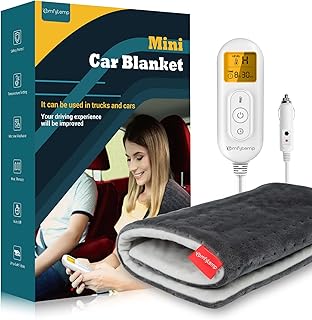
Comfytemp 12V/24V Mini Travel Blanket
At 12″ x 24″ this is a targeted heat pad rather than a blanket, and that is exactly why it works for drivers — it stays put against the lumbar spine, neck, or hip without loose fabric near the controls. The 12V/24V compatibility covers commercial trucks, and eleven auto-off intervals let you match runtime to trip length instead of accepting a single arbitrary timer.
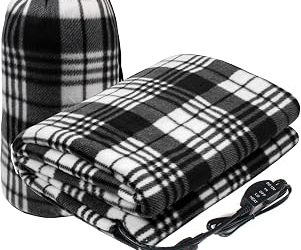
12V Electric Fleece Throw, 60″ x 40″
A straightforward cigarette-lighter throw with two heat settings and the largest coverage area in this group, making it the best pick for passengers and back-seat use. The included storage bag matters more than it sounds: folding along consistent lines rather than random creases meaningfully extends heating-wire life.
Cordless Wearable Heated Blanket, 15000 mAh
The only untethered option, with a 15000 mAh battery, three heat levels, and a sherpa lining that traps warmth well enough to stretch runtime. Best suited to camping, tailgating, and stadium use — the shawl cut keeps the shoulders covered while your hands stay free, and there is no cord to fatigue.
Stalwart 12V Heated Travel Blanket (Navy)
Simple, tough, and the one I would put in a winter emergency kit. There is no elaborate controller to fail, the fabric shrugs off abrasion from being stuffed under a seat, and the plug seats firmly enough to survive rough road vibration.
Frequently Asked Questions
Will a 12-volt blanket drain my car battery?
Most draw 40 to 60 watts, roughly 3 to 5 amps. That is safe while the engine runs, but with the ignition off it can deplete a healthy battery in a few hours — which is why auto-shutoff is a genuine safety feature, not a gimmick.
Can the driver use one safely?
Use a compact pad rather than a full throw. Loose fabric near the pedals or steering column is a real hazard, and the controller should be reachable without looking away from the road.
How do I wash one without ruining it?
Detach the lead completely, wash cold on a gentle cycle, and air dry or tumble on no heat. Never wring the section containing the wire harness, and never dry clean.
Do these work in trucks with 24-volt systems?
Only if explicitly rated for it. The Comfytemp model handles both 12V and 24V; plugging a 12V-only blanket into a 24V circuit will damage the element.
Final Thoughts
For most drivers the Sealy 59″ x 43″ is the safest bet — solid construction, sensible auto-off, and enough coverage to share. Drivers who want heat without loose fabric should choose the Comfytemp mini pad, and anyone heading away from the vehicle will get more use out of the cordless 15000 mAh sherpa shawl.