Key takeaways
- Weight distribution over raw weight: A 7.5 lb gun that carries its mass near the handle feels lighter in use than a 7 lb gun that hangs forward. Hold the tool at arm’s length and note where it wants to tip; that tells you what your shoulder will be fighting all afternoon.
- Recoil management: Rubber-isolated grips and a well-tuned return system cut the shock that travels into the wrist. Bump-fire modes multiply that feedback, so a tool with soft recoil matters more if you plan to sequence-nail sheathing rather than place shots one at a time.
- Collation type and reload posture: Stick nailers reload from a comfortable standing position but hold fewer fasteners; coil nailers carry 200 to 300 nails, meaning far fewer trips down the ladder and less repetitive bending.
- Serviceable wear parts: Driver blades, bumpers, and O-rings are consumables. Tools with published rebuild kits and accessible housings stay in service for a decade; sealed designs get retired the first time they short-drive nails.
- Compressor headroom and noise: Aim for roughly 4 CFM at 90 PSI if you want a framing gun to keep pace without the motor running continuously. Sound output matters too, since 59 dB is conversational and a typical pancake unit is closer to a shop vacuum.
What's inside
Framing nailers punish the operator long before they punish themselves. Anyone who has spent a Saturday toe-nailing a stud wall knows the pattern: the first hour feels effortless, and by the third the wrist is absorbing every bit of recoil the tool refuses to. Buyers tend to shop on nail capacity and price, then discover the real variables were grip circumference, where the balance point sits relative to the muzzle, and how much air the compressor can deliver before it starts cycling nonstop. Those are the things that decide whether a build gets finished cleanly or abandoned with a sore forearm.
This guide looks at pneumatic framing setups through two lenses: how they feel across a long session, and how they hold up across seasons. That means the nailer and the air source together, since an undersized compressor turns a well-balanced gun into a stuttering one. Below you will find selection criteria worth applying before you buy, short reviews of the standout tools, and answers to the questions that come up most often from people building workbenches, platform beds, garage shelving, and outbuilding framing at home.
As an Amazon Associate we earn from qualifying purchases.



How to Choose an Air Compressor Framing Nailer (2026)
- Weight distribution over raw weight: A 7.5 lb gun that carries its mass near the handle feels lighter in use than a 7 lb gun that hangs forward. Hold the tool at arm’s length and note where it wants to tip; that tells you what your shoulder will be fighting all afternoon.
- Recoil management: Rubber-isolated grips and a well-tuned return system cut the shock that travels into the wrist. Bump-fire modes multiply that feedback, so a tool with soft recoil matters more if you plan to sequence-nail sheathing rather than place shots one at a time.
- Collation type and reload posture: Stick nailers reload from a comfortable standing position but hold fewer fasteners; coil nailers carry 200 to 300 nails, meaning far fewer trips down the ladder and less repetitive bending.
- Serviceable wear parts: Driver blades, bumpers, and O-rings are consumables. Tools with published rebuild kits and accessible housings stay in service for a decade; sealed designs get retired the first time they short-drive nails.
- Compressor headroom and noise: Aim for roughly 4 CFM at 90 PSI if you want a framing gun to keep pace without the motor running continuously. Sound output matters too, since 59 dB is conversational and a typical pancake unit is closer to a shop vacuum.
The Best Air Compressor Framing Nailers (2026) Reviewed
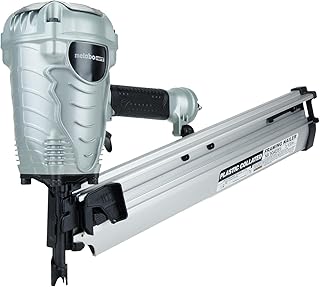
Metabo HPT NR90AES1 Framing Nailer
At 7.5 lbs with a genuinely neutral balance point, this 21-degree plastic-collated gun is the one I recommend to people who have never framed before and do not want to learn what tendonitis feels like. Depth adjustment is tool-free, the selective actuation switch is easy to reach mid-task, and the aluminum housing has a long track record of surviving drops off staging.
Metabo HPT NV83A5 Coil Framing Nailer
Coil collation is the ergonomic argument here: the magazine holds enough 2-inch to 3-1/4-inch nails to sheathe a full wall without stopping, and the 15-degree angle lets you reach into bays a stick gun cannot. Slightly heavier in the hand, but the reduced reloading more than repays it on roof decking and subflooring.
Paslode F325R Pneumatic Framing Nailer
Paslode’s round-head gun is the compact option, and it shows in tight corners and joist hangers where a longer nose gets in the way. Build quality is consistent with the brand’s job-site reputation, and the trigger has a short, predictable break that helps with precise placement.
Metabo HPT EC914S 6-Gallon Pancake Compressor
Four CFM and 200 PSI storage give you the headroom to run a framing nailer hard, or a framing and brad gun simultaneously, without the motor droning nonstop. The pancake footprint is stable on uneven ground and the handle geometry makes single-arm carries manageable.
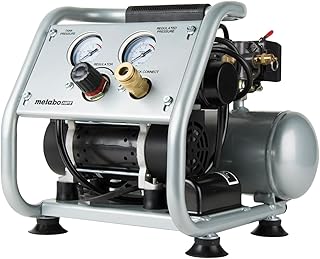
Metabo HPT EC28M Quiet 1-Gallon Compressor
At 59 dB, this oil-free unit is quiet enough to run in an attached garage or a finished basement without clearing the house. It is best paired with finish and brad work rather than sustained framing, but for shop furniture and occasional structural fastening it is the most pleasant compressor to be near.
Frequently Asked Questions
What size compressor does a framing nailer actually need?
Look for about 4 CFM at 90 PSI and at least 4 to 6 gallons of tank. Smaller tanks will drive nails, but the motor cycles constantly, which shortens pump life and makes the workspace unpleasant.
Are coil nailers worth the extra bulk?
If you are sheathing, decking, or fencing, yes. Fewer reloads means less repetitive motion and fewer interruptions. For framing a single wall or building furniture, a stick nailer is easier to handle.
How do I keep a pneumatic nailer working for years?
Drain the compressor tank after each use, add a few drops of pneumatic tool oil daily unless the tool is rated oil-free, and replace the driver blade and bumper at the first sign of inconsistent depth rather than pushing through.
Can I use a framing nailer for furniture projects?
For rough carcass work, garage shelving, and outdoor benches, absolutely. For visible joinery, the head size and driving force are excessive; switch to a brad or finish nailer.
Final Thoughts
For most home builders, the NR90AES1 paired with the EC914S is the balanced answer: light enough in the hand for long sessions, with enough air behind it to never feel starved. If your projects lean toward sheathing and decking, step up to the NV83A5 coil nailer and accept the small weight penalty in exchange for far fewer reloads.