Key takeaways
- Mounting security over raw brightness: A 3000-lumen bar that slides off a strut tower is worse than a 1200-lumen light that stays where you put it. Look for dual magnets plus articulating hooks, and check that the hook rotates a full 360° so you can hang it from any lip angle without twisting the housing.
- Beam spread and glare control: Wide COB strips flood an engine bay evenly and keep your pupils from constantly readjusting. Diffused lenses matter more than peak output — direct-view glare causes more squinting and neck craning than dim light does.
- Weight and balance: Anything over about 1.5 lb becomes noticeable when you’re holding it at arm’s length. Batteries clustered at one end create a lever that pulls the light off its mount and strains your grip when handheld.
- Ingress protection and impact tolerance: IP65 or better keeps brake cleaner, coolant mist, and shop dust out of the driver. Polycarbonate housings with rubber overmold survive concrete drops; bare aluminum dents and bare ABS cracks at the hinge.
- Power strategy: Cordless keeps the workspace clean and eliminates trip hazards, but plan for runtime. Corded models never quit mid-job — just verify the strain relief at both ends, since that’s where cheap trouble lights fail first.
What's inside
Working under a hood is a posture problem before it’s a lighting problem. You’re bent at the waist, one arm braced on a fender, head tilted into a cramped bay, and whatever light you brought has to stay put without you thinking about it. A handheld torch forces you into a one-handed workflow that loads your wrist and shoulder for the entire job. A poorly balanced bar sags off its hook, throws glare straight into your eyes, and gets nudged loose every time you reach past it. The result is the same either way: you finish the repair with a stiff neck and a shadow exactly where you needed to see.
This guide looks at underhood lights the way I evaluate any tool that gets held, clamped, and dropped for years: mounting security, weight distribution, beam geometry relative to eye level, and how the housing, hinge, and cord behave after a few hundred cycles of abuse. Below are the models worth your money in 2026, followed by the selection criteria that actually predict long-term satisfaction.
As an Amazon Associate we earn from qualifying purchases.




How to Choose a/an Underhood Work Light (2026)
- Mounting security over raw brightness: A 3000-lumen bar that slides off a strut tower is worse than a 1200-lumen light that stays where you put it. Look for dual magnets plus articulating hooks, and check that the hook rotates a full 360° so you can hang it from any lip angle without twisting the housing.
- Beam spread and glare control: Wide COB strips flood an engine bay evenly and keep your pupils from constantly readjusting. Diffused lenses matter more than peak output — direct-view glare causes more squinting and neck craning than dim light does.
- Weight and balance: Anything over about 1.5 lb becomes noticeable when you’re holding it at arm’s length. Batteries clustered at one end create a lever that pulls the light off its mount and strains your grip when handheld.
- Ingress protection and impact tolerance: IP65 or better keeps brake cleaner, coolant mist, and shop dust out of the driver. Polycarbonate housings with rubber overmold survive concrete drops; bare aluminum dents and bare ABS cracks at the hinge.
- Power strategy: Cordless keeps the workspace clean and eliminates trip hazards, but plan for runtime. Corded models never quit mid-job — just verify the strain relief at both ends, since that’s where cheap trouble lights fail first.
The Best Underhood Work Light (2026)s Reviewed
3000LM Magnetic Rechargeable Work Light Bar
This is the format I recommend to most home mechanics: a wide bar that spans the bay, magnets and hooks for redundant mounting, and a 5200mAh cell that clears a full afternoon of intermittent use. The elongated body distributes weight across the mount instead of concentrating it, which is why it stays put when you lean on the fender.
3000LM Auto On/Off Underhood Light
The motion-triggered on/off is a genuine ergonomic win — you’re not fumbling for a switch with greasy gloves or setting the light down to cycle modes. Same 3000-lumen output and 5200mAh capacity as the bar above, with mounting flexibility that suits tight engine bays and roadside work equally.
Milwaukee 2125-20 M12 Underhood Light
The durability benchmark, and the one I’d choose for daily professional use. The telescoping bar and reinforced end hooks tension across the bay rather than dangling from a single point, and the housing shrugs off the kind of drops that end cheaper lights — assuming you already own M12 batteries, since it ships bare.
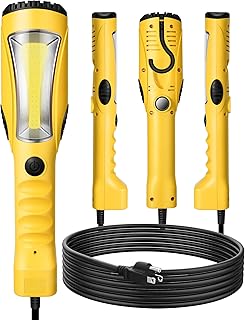
DEWENWILS 15 ft Corded Trouble Light
No runtime anxiety, and at 1200 lumens with a proper diffuser it’s easier on the eyes than brighter cordless competitors. The 360° swivel hook and strong magnet let you set a neutral working angle in seconds, and the ETL listing plus solid strain relief make the 15-foot cord more than a liability.
YXQUA 2 Pack IP66 Magnetic COB Lights
Two lights beat one for shadow control — cross-lighting a bay from opposite sides eliminates the dark pocket that one central light always leaves. IP66 sealing, integrated clamps, and Type-C charging make these the most versatile pick here, and the red SOS mode earns its place in a roadside kit.
Frequently Asked Questions
How many lumens do I actually need?
1200 to 2000 lumens is sufficient for most engine bays if the beam is wide and well diffused. Beyond 3000 lumens you gain little usable visibility and increase glare fatigue, especially in reflective bays.
Are magnets or hooks the better mount?
Use both. Magnets hold fast on strut towers and flat steel; hooks handle the hood lip and painted or composite surfaces where magnets won’t grab. Redundancy is what keeps the light from dropping onto a hot manifold.
Will a magnetic light scratch my paint?
It can if the magnet face is bare metal or grit collects on the rubber cap. Wipe both surfaces before mounting, and prefer hooks on visible painted panels.
Corded or cordless for home use?
Cordless for convenience and safer footing around the vehicle; corded if you routinely run long diagnostic sessions and don’t want to babysit a charge level. Many people end up owning one of each.
Final Thoughts
For most home garages, the 3000LM Magnetic Rechargeable Work Light Bar delivers the best balance of coverage, mounting security, and runtime for the money. Choose the Milwaukee 2125-20 if you already run M12 and want a light that outlives the vehicle, or the YXQUA 2 Pack if eliminating shadows and having a spare matter more to you than any single spec.