Key takeaways
- Match CFM to the gun, not the tank: A brad or pin nailer sips roughly 0.3 CFM at 90 PSI, so a 1-gallon unit is fine. Framing and roofing nailers pull far more per shot, and running two guns needs 4 CFM of real delivery. Undersized airflow shows up as a motor that never stops, which is what kills compressors early.
- Treat decibels as an ergonomic spec: Anything in the 59 to 68 dB range lets you work in an occupied house without ear protection and without shouting. Standard pancake units in the mid-80s cause you to hurry, and hurrying is where misfires and blown-out trim happen.
- Check the carry interface before the spec sheet: Look for a handle centered over the tank’s balance point, a wide grip that does not dig in, and rubber feet that stop the unit walking across a finished floor. A 37-pound compressor with good balance carries easier than a 30-pound one that swings.
- Look at what corrodes and what wears: Aluminum tanks resist rust from condensate, which is the usual slow death for a garage compressor. Also check for a full-size ball drain valve rather than a stiff petcock, a metal quick coupler instead of plastic, and a shroud that protects the pressure switch from drops.
- Be honest about oil-free tradeoffs: Oil-free pumps mean no maintenance and no tipping restrictions, which suits occasional furniture work. They do wear faster under sustained heavy load, so if you run production hours, favor a larger tank that lets the motor rest between cycles.
What's inside
Anyone who has spent a Saturday crouched over a half-built bookcase knows the compressor is the piece of kit you fight with most. It sits behind you thumping away, the hose tugs at your nailer every time you reach across a panel, and by the time you have carried it up the basement stairs twice your forearms are done. Buyers tend to shop on tank size and PSI because those numbers are printed largest, then discover the real variables were noise at ear height, where the handle sits relative to the center of mass, and whether the drain valve is reachable without tipping 40 pounds of steel onto its side.
This guide looks at compressors for nailing work through two lenses: how they feel over a long session, and how they hold up after a few hundred of them. That means grip geometry and carry weight, motor duty cycle and recovery time, tank material and corrosion resistance, coupler durability, and whether the unit can actually keep up with the gun you own. Below are six machines that span quiet indoor finish work through framing and siding, with notes on who each one genuinely suits.
As an Amazon Associate we earn from qualifying purchases.



How to Choose a/an Air Compressor For Nailers (2026)
- Match CFM to the gun, not the tank: A brad or pin nailer sips roughly 0.3 CFM at 90 PSI, so a 1-gallon unit is fine. Framing and roofing nailers pull far more per shot, and running two guns needs 4 CFM of real delivery. Undersized airflow shows up as a motor that never stops, which is what kills compressors early.
- Treat decibels as an ergonomic spec: Anything in the 59 to 68 dB range lets you work in an occupied house without ear protection and without shouting. Standard pancake units in the mid-80s cause you to hurry, and hurrying is where misfires and blown-out trim happen.
- Check the carry interface before the spec sheet: Look for a handle centered over the tank’s balance point, a wide grip that does not dig in, and rubber feet that stop the unit walking across a finished floor. A 37-pound compressor with good balance carries easier than a 30-pound one that swings.
- Look at what corrodes and what wears: Aluminum tanks resist rust from condensate, which is the usual slow death for a garage compressor. Also check for a full-size ball drain valve rather than a stiff petcock, a metal quick coupler instead of plastic, and a shroud that protects the pressure switch from drops.
- Be honest about oil-free tradeoffs: Oil-free pumps mean no maintenance and no tipping restrictions, which suits occasional furniture work. They do wear faster under sustained heavy load, so if you run production hours, favor a larger tank that lets the motor rest between cycles.
The Best Air Compressor For Nailers (2026)s Reviewed
Metabo HPT EC914S 6-Gallon Pancake
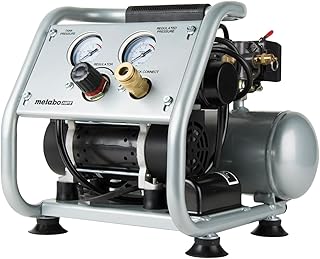
At 200 PSI and 4 CFM, this is the one that will drive a framing nailer and a brad gun off the same manifold without stalling, and the stored pressure headroom means fewer motor starts per hour, which is the single biggest factor in longevity. It is the heaviest option here, so plan on a stationary spot with a longer hose rather than repeated carries.
Craftsman 6-Gallon 4-Tool Combo Kit
Getting the 16GA finish, 18GA brad, and 23GA pin nailers matched to the compressor removes the guesswork for furniture and cabinet work, and 2.6 SCFM at 90 PSI is comfortably ahead of what those three guns demand. The oil-free pump keeps maintenance at zero, though the 150 PSI ceiling gives you less reserve than the Metabo when you are firing quickly.
Metabo HPT EC28M Ultra-Quiet 1-Gallon
At 59 dB this is quiet enough to run in a room where someone else is working, and the universal quick coupler is a small detail that saves real irritation when you swap between a brad gun and a blowgun a dozen times. Best suited to trim, upholstery, and assembly work rather than anything structural.
8-Gallon Aluminum Tank Quiet Compressor
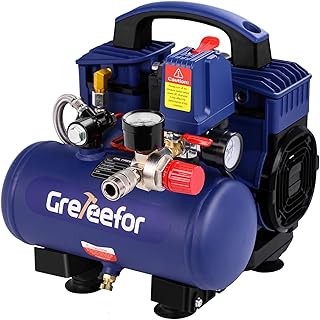
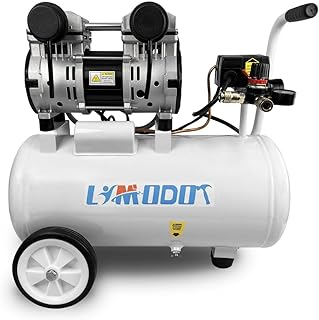
The rustproof aluminum tank is the durability story here: condensate is what ends most garage compressors, and removing that failure mode matters more than any warranty. At 37.5 pounds with dual intakes and 68 dB output, it strikes the most sensible balance in this group between capacity and something you can still shift one-handed.
1-Gallon Ultra Quiet 60 dB Portable
A 13-second fill from a 1.5HP motor makes this the fastest to get working of the compact units, and 60 dB keeps it civil indoors. Treat it as a finish-nailing and inflation tool; the small tank means frequent cycling if you ask it for sustained volume.
Frequently Asked Questions
Is a 1-gallon tank really enough for a nail gun?
For 18GA brad, 23GA pin, and most 16GA finish nailers, yes. Those guns use very little air per shot, so the tank recovers between nails. It is not enough for framing, siding, or roofing nailers, which will empty a small tank in a handful of shots.
Do quiet compressors sacrifice durability?
Not inherently. Low-noise units achieve it with slower-turning induction motors, which typically run cooler and last longer than the high-RPM universal motors in loud budget compressors. The tradeoff is usually weight and fill time, not lifespan.
How often should I drain the tank?
After every session if you can, and never let it sit wet over winter. Moisture pools at the bottom of the tank and thins the steel from the inside, which is precisely why an aluminum tank is worth paying for in a humid garage or basement shop.
Can a cordless compressor replace a corded one?
For punch-list and assembly work away from an outlet, a battery unit like the Makita-compatible model is genuinely useful. Recovery is slower and runtime is tied to your battery stock, so most shops keep one as a companion rather than a primary machine.
Final Thoughts
For a furniture and cabinet shop, the Craftsman 6-gallon combo kit is the most complete starting point since the three nailers are already sized to the pump. If you want one compressor to last a decade in a damp garage, the 8-gallon aluminum-tank model is the smarter long game, and the Metabo HPT EC28M is the one to grab when the work moves into a finished room and 59 dB is what keeps you welcome there.