Key takeaways
- Match CFM to your nailer, not your tank: A brad or finish nailer sips roughly 0.3 CFM at 90 PSI in real use; a framing nailer driving 3-1/2″ sinkers can pull 2 CFM or more. Tank volume only buys you time between cycles, so check the CFM-at-90-PSI figure and leave yourself 50% headroom.
- Weigh the carry, not the crate: Anything over 35 lbs becomes a single-hand strain on stairs. Look for a handle centered over the mass rather than bolted to one end, and a grip with enough diameter that it doesn’t dig into your palm. Wheeled units make sense above 50 lbs.
- Oil-free pumps for intermittent work, cast components for volume: Oil-free means no maintenance and no tipping restrictions, ideal for furniture and trim. If you’re running a nailer for hours weekly, prioritize cast-iron cylinders or a heavy-duty induction motor over convenience.
- Sound level at the operator position: A 60 dB rating is roughly conversational; 80 dB and up demands hearing protection and makes indoor work miserable. Quiet units typically run slower motors, which also means less vibration transferred through the floor into your workpiece.
- Protect the fragile bits: Regulators, gauges, and couplers are the first things to break. A recessed control panel or steel shroud prevents the drop-in-the-truck-bed failure that ends most compressors long before the pump gives out.
What's inside
Anyone who has spent a Saturday assembling a bed frame or tacking trim onto a built-in knows the real bottleneck isn’t the nailer. It’s the compressor sitting three feet away, cycling on every fourth shot, drowning out conversation, and leaving a bruise on your forearm from the carry handle. Buyers tend to shop by tank size and PSI because those numbers are printed largest, then discover the machine they chose recovers too slowly for continuous trim work, or weighs enough that hauling it upstairs becomes a two-person job.
This guide looks at compressors through two lenses that rarely make the spec sheet: how the machine treats your body over a long session, and how it holds up after two hundred cycles. That means handle geometry and balance point, roll-cage protection for the gauges and regulator, pump design and its service life, sound pressure at working distance, and whether the recovery rate actually matches the nailer you own. Below are six units worth considering in 2026, followed by the selection criteria I’d apply before spending anything.
As an Amazon Associate we earn from qualifying purchases.



How to Choose a Air Compressor For Nail Gun (2026)
- Match CFM to your nailer, not your tank: A brad or finish nailer sips roughly 0.3 CFM at 90 PSI in real use; a framing nailer driving 3-1/2″ sinkers can pull 2 CFM or more. Tank volume only buys you time between cycles, so check the CFM-at-90-PSI figure and leave yourself 50% headroom.
- Weigh the carry, not the crate: Anything over 35 lbs becomes a single-hand strain on stairs. Look for a handle centered over the mass rather than bolted to one end, and a grip with enough diameter that it doesn’t dig into your palm. Wheeled units make sense above 50 lbs.
- Oil-free pumps for intermittent work, cast components for volume: Oil-free means no maintenance and no tipping restrictions, ideal for furniture and trim. If you’re running a nailer for hours weekly, prioritize cast-iron cylinders or a heavy-duty induction motor over convenience.
- Sound level at the operator position: A 60 dB rating is roughly conversational; 80 dB and up demands hearing protection and makes indoor work miserable. Quiet units typically run slower motors, which also means less vibration transferred through the floor into your workpiece.
- Protect the fragile bits: Regulators, gauges, and couplers are the first things to break. A recessed control panel or steel shroud prevents the drop-in-the-truck-bed failure that ends most compressors long before the pump gives out.
The Best Air Compressor For Nail Gun (2026)s Reviewed
Metabo HPT EC914S 6-Gallon Pancake
At 4 CFM and 200 PSI, this is the only unit here with genuine capacity to run two framing nailers at once, and the higher tank pressure means more usable air per fill. The pancake footprint sits stable on subfloor, the roll cage does its job around the gauges, and the oil-free pump asks nothing of you between jobs.
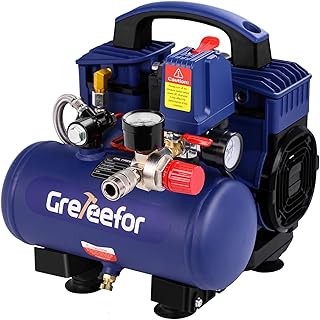
1 Gallon Ultra Quiet Portable 60 dB
Sixty decibels and a 13-second fill make this the obvious pick for indoor furniture assembly, where you’re driving a few dozen brads and want to hear yourself think. It’s a light single-hand carry, though the small tank means it cycles frequently, so treat it as a finish-work tool rather than anything structural.
FORNAX 1.3-Gallon Ultra Quiet
The extra third of a gallon over most silent compressors buys noticeably longer runs between cycles, and 65 dB stays comfortable without ear protection. The 1HP oil-free pump is honest about its limits at 125 PSI max, but for cabinet backs, upholstery tacking, and pin nailing it’s well matched.
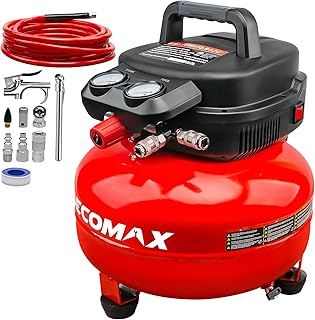
ECOMAX 6 Gallon Pancake
Dual quick couplers let two people work off one machine without a splitter dangling from the manifold, which is a small ergonomic win that adds up over a day. Three CFM at 90 PSI handles brad and finish nailers comfortably, and the included ten-piece kit means you’re working the day it arrives.
13 Gallon Portable, 3.7 HP
Six CFM and a 13-gallon reservoir put this in a different class, capable of running a framing nailer continuously or feeding a spray gun for finishing work. Expect to wheel it rather than carry it, and give it a dedicated 15-amp circuit.
Frequently Asked Questions
What size tank do I need for a brad nailer?
One to two gallons is genuinely sufficient. A brad nailer uses so little air per shot that a small tank cycles often but never actually starves the tool. Tank size matters far more for framing nailers and air-hungry tools like sanders.
Can I use a pancake compressor indoors on finished floors?
Yes, with a mat underneath. The rubber feet on most pancake units transfer vibration into hardwood, and grit trapped beneath them will mark a finish. A scrap of carpet or an anti-fatigue mat solves both the marring and some of the resonance.
How long should an oil-free compressor last?
Oil-free pumps generally deliver several hundred hours of duty before the piston seals degrade, which is a decade of weekend furniture work but under a year of daily framing. Draining the tank after every session is the single biggest factor in whether the tank itself outlasts the pump.
Does higher PSI mean better nail driving?
No. Your nailer has an operating range, typically 70 to 120 PSI, and you regulate down to it regardless of tank pressure. Higher tank pressure simply stores more air in the same volume, extending run time between cycles.
Final Thoughts
For most furniture and trim work indoors, the 1 Gallon Ultra Quiet 60 dB unit is the one I’d reach for, purely because low noise and low weight change how willing you are to use the tool at all. If your projects include framing, decking, or anything structural, the Metabo HPT EC914S offers the best balance of capacity and durability for the money, while the 13 Gallon 3.7 HP model is the right answer if spray finishing is also on your list.