Key takeaways
- Match PSI honestly, not optimistically: A cleaner rated to 4000 PSI paired with a 2300 PSI electric washer will crawl and streak. Check your machine’s actual output and buy within range — the Kärcher’s 2600–3200 PSI window, for instance, is a real specification, not marketing padding.
- Prioritize the swivel bearing: This is the single component that fails first. Sealed stainless or brass bearings shrug off grit; unsealed bushings score, wobble, and start dragging the deck within a season. If the listing won’t say, treat it as a bushing.
- Look for dual handles and load-bearing wheels: Two grip points let you push with your torso rather than steering with your wrists, and wheels carry the deck weight so your shoulders don’t. This is the difference between finishing a 600-square-foot driveway comfortably and stopping halfway.
- Insist on metal at every connection: Brass or stainless quick-connects and M22 adapters tolerate repeated cycling and overtightening. Nylon fittings feel fine on day one and weep at the threads by month three.
- Size the deck to your storage and your reach: A 20-inch head covers ground fast but needs volume to feed it and space to hang it. A 14- or 15-inch deck fits between deck joists, along fence lines, and on a garage hook without a fight.
What's inside
Anyone who has spent a Saturday waving a zero-degree tip across a driveway knows the real cost of pressure washing isn’t the machine — it’s the toll on your forearms, shoulders, and lower back. A bare wand concentrates every bit of reaction force into your wrists, and the striping it leaves behind means you’ll be out there again next season doing it over. The accessories you bolt onto the end of that hose determine whether cleaning your patio is a two-hour chore or a twenty-minute pass, and whether your gear survives past its second summer or cracks at the first brass-to-plastic junction.
I evaluate cleaning tools the way I evaluate seating and casework: load paths, contact points, and the materials at the joints where stress concentrates. This guide covers the pressure washer accessories worth owning in 2026 — surface cleaners that neutralize torque instead of transferring it to you, foam cannons with fittings that won’t gall out, and kits whose swivels are rated for real duty cycles. Below you’ll find quick picks, a buying framework, and honest notes on where each option earns or loses its keep.
As an Amazon Associate we earn from qualifying purchases.


How to Choose a Pressure Washer Accessories (2026)
- Match PSI honestly, not optimistically: A cleaner rated to 4000 PSI paired with a 2300 PSI electric washer will crawl and streak. Check your machine’s actual output and buy within range — the Kärcher’s 2600–3200 PSI window, for instance, is a real specification, not marketing padding.
- Prioritize the swivel bearing: This is the single component that fails first. Sealed stainless or brass bearings shrug off grit; unsealed bushings score, wobble, and start dragging the deck within a season. If the listing won’t say, treat it as a bushing.
- Look for dual handles and load-bearing wheels: Two grip points let you push with your torso rather than steering with your wrists, and wheels carry the deck weight so your shoulders don’t. This is the difference between finishing a 600-square-foot driveway comfortably and stopping halfway.
- Insist on metal at every connection: Brass or stainless quick-connects and M22 adapters tolerate repeated cycling and overtightening. Nylon fittings feel fine on day one and weep at the threads by month three.
- Size the deck to your storage and your reach: A 20-inch head covers ground fast but needs volume to feed it and space to hang it. A 14- or 15-inch deck fits between deck joists, along fence lines, and on a garage hook without a fight.
The Best Pressure Washer Accessories (2026)s Reviewed
MEKOH 20″ Heavy-Duty Surface Cleaner
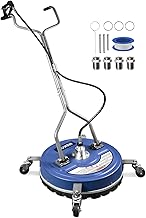
The dual-handle geometry here is the standout: gripping at two separated points converts wrist torque into a straightforward push, which is exactly what you want across long concrete runs. With a 3/8″ quick-connect and a 4500 PSI ceiling, it’s built for gas machines and wide open ground — overkill for a small balcony, ideal for a three-car driveway.
LidoDola 14″ Surface Cleaner
A stainless housing on four wheels at a 14-inch footprint hits the sweet spot for decks, walkways, and anything you have to maneuver around furniture legs. The two included extension wands let you set working height to your torso rather than hunching, and the spare nozzles mean the first clogged orifice doesn’t end your afternoon.
Tool Daily Foam Cannon
One liter of thick foam and a brass 1/4″ connector make this the most ergonomically sensible car-washing upgrade you can buy, because dwell time replaces scrubbing pressure. Five nozzle tips cover everything from wheel wells to clear coat, and the metal fitting survives the repeated connect-disconnect cycle that kills plastic bodies.
Kärcher 15″ Surface Cleaner
Kärcher’s tolerances show up in how little the deck chatters, which directly translates to less vibration reaching your hands over a long session. The 2600–3200 PSI band and multi-brand quick connect make it the safest pick for mid-range electric and light gas machines.
18-Piece Accessory Kit with Foam Cannon
Brass and stainless components across M22 14/15mm and 3/8″ fittings mean this kit adapts to nearly any machine without a hardware-store detour. Six nozzle tips plus the foam cannon and gutter and siding attachments make it the most efficient way to stop improvising with the wrong tip.
Frequently Asked Questions
Will a surface cleaner work with an electric pressure washer?
Yes, provided the deck is sized for the flow. Electric machines typically deliver 1.2–1.8 GPM, which suits 14- and 15-inch heads like the LidoDola, Hourleey, or Kärcher. A 20-inch deck needs more volume to spin its bar properly.
Why does my surface cleaner leave stripes?
Usually a worn or partially clogged nozzle, a dragging swivel, or walking too fast. Clear the tips, confirm the bar spins freely by hand, and overlap each pass by about a third.
Do I need a separate foam cannon if my washer has a detergent tank?
Onboard tanks siphon at low pressure and produce thin soap. A dedicated cannon aerates properly, giving you clinging foam that loosens grime chemically instead of relying on abrasion.
How do I keep quick-connects from seizing?
Flush with clean water after every use, dry the collar, and add a drop of silicone grease on the O-rings a few times a season. Brass and stainless fittings reward this; plastic ones fail regardless.
Final Thoughts
For large concrete expanses where fatigue is the limiting factor, the MEKOH 20″ dual-handle cleaner is the ergonomic winner; for decks, patios, and tighter quarters, the Kärcher 15″ offers the smoothest, best-balanced pass of anything in its class. Pair either with the Tool Daily Foam Cannon and you’ll clean more surface with less strain and far fewer redo passes.